
Restaurant Financing: A Complete Guide to Loans and Funding Options
From opening your first restaurant to expanding your business, explore financing options, compare loan types, and learn how to prepare your application.
Author
 RESOURCE
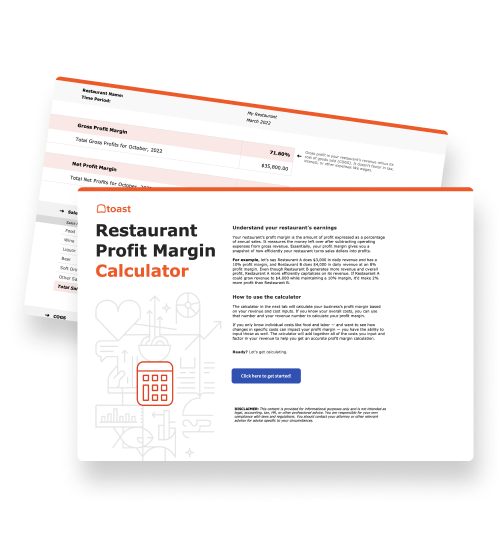
Restaurant Profit Margin Calculator
Use this free Restaurant Profit Margin Calculator to see how efficiently you turn sales dollars into profits.
Get Free DownloadSigning the lease on your first restaurant takes more than a great concept, and the same goes for adding a second location once the first one is packed every weekend. Either way, moving costs real money, and few owners can cover the full bill out of pocket.
That's where restaurant financing comes in. The best fit depends on what you're paying for and how big a monthly payment your restaurant can handle.
This guide breaks down the main types of restaurant financing and how they compare. You'll also learn what lenders look for and how to put together an application that's ready to submit.
Key takeaways
Restaurant financing is outside money that helps you open a restaurant or grow one, through loans and credit or non-loan funding like investors.
Match the financing to the job: long-term loans for buildouts, equipment financing for kitchen equipment, lines of credit for seasonal gaps, and invoice financing for large catering orders.
SBA 7(a) loans go up to $5 million and SBA 504 loans up to $5.5 million. Both can take more paperwork and time than most other options.
Compare offers by the total amount you'll repay and the monthly payment, not the rate alone.
Lenders typically look at your credit, time in business, sales history, existing debt, and collateral.
The information discussed in this article is provided for informational purposes only and should not be relied upon as financial or legal advice. For financial or legal advice, you should consult a professional financial advisor or your attorney.
Restaurant Opening Calculator
This calculator lays out some of the fundamental financial costs of opening a restaurant, so you can start planning and bring your dream restaurant to life.

What is restaurant financing?
Restaurant financing is money from an outside source that helps you open a restaurant or grow the one you have. You either pay it back over time or give something in exchange, like a share of future sales or part ownership.
Most options fit into one of two groups:
Loans and credit: You borrow a set amount (the principal) and repay it with interest or a fee. SBA loans, bank loans, lines of credit, and equipment financing all fall here.
Non-loan funding: You get capital without a traditional loan. Merchant cash advances, crowdfunding, investors, and grants are common examples.
Outside funding is a normal part of running a business. In the Federal Reserve's Small Business Credit Survey, 60% of small employer businesses applied for financing in the past year. Their most common reasons were covering operating expenses and pursuing expansion.
Each type of financing is built for a different job, so matching the right one to your plans keeps your payments in line with your cash flow.
What restaurant financing pays for
Restaurant financing pays for the high costs that daily sales can't cover on their own, like a full buildout or a second location. Most of those needs fall into four groups, and each one points toward a different type of financing.
Opening a new restaurant
Startup costs to open a restaurant can range from hundreds of thousands to several million dollars, depending largely on your rent and how much construction the space needs. Many owners pair their savings with a loan. If you're short on savings, here's how to open a restaurant with no money.
Financing options to consider: SBA 7(a) loans, SBA microloans, investors, and friends and family
Restaurant Opening Calculator
This calculator lays out some of the fundamental financial costs of opening a restaurant, so you can start planning and bring your dream restaurant to life.
Buying or replacing equipment
When a walk-in cooler dies in the middle of July, financing the replacement keeps your cash free for food orders and payroll. Our restaurant equipment checklist can help you plan upgrades and spot the pieces nearing the end of their life.
Financing options to consider: Equipment financing or leasing. For major equipment with a long useful life, an SBA 504 loan is another option.
Covering day-to-day cash flow
Cash flow swings with the seasons and with big catering orders that pay out later. Tracking your restaurant cash flow helps you spot those gaps before they hit, and short-term financing bridges those gaps so your team can keep running at full speed.
Financing options to consider: Business lines of credit and short-term loans. Revenue-based loans can also work well when sales rise and fall with the seasons.
Renovating or adding locations
About 1 in 10 operators (11%) say opening a new location is their top focus for growing revenue, according to Toast's 2026 Voice of the Restaurant Industry survey. Once your restaurant is consistently busy, growth might mean a patio for summer or a second location. Lenders will want to see steady sales and clean financial statements for projects this size. The restaurant expansion checklist walks through the planning side.
Financing options to consider: SBA 7(a) and 504 loans, traditional bank loans, commercial real estate loans, and investors.
Restaurant Profit and Loss Statement Template
Evaluate your restaurant's financial strengths and weaknesses with the free P&L and income statement template.
Types of restaurant financing
Restaurant financing comes in two forms: loans and credit you repay over time, and non-loan options that trade something else for capital (like a share of future sales).
Keep in mind that many of these financing options, especially SBA loans, traditional bank loans, and business credit cards, require a minimum credit score to qualify. Requirements vary by lender and change over time, so for the most accurate information on what score you’ll need, contact the bank or lender directly.
Here's how the most common types of restaurant financing compare.
Type | Is it a loan? | How you repay | Usually backed by | Best for |
SBA loans | Loan | Monthly, often 7–10+ years | Collateral and a personal guarantee are common | Opening or a major expansion |
Traditional bank loans | Loan | Monthly | Collateral and strong credit | Large projects at established restaurants |
Short-term loans | Loan | Daily or weekly | Sales history | Time-sensitive needs |
Business lines of credit | Revolving credit | Interest only on what you draw | Varies (secured or unsecured) | Seasonal cash flow gaps |
Equipment financing | Loan or lease | Monthly | The equipment itself | Kitchen equipment |
Revenue-based loans | Loan | A percentage of daily sales | Sales history | Uneven or seasonal sales |
Business credit cards | Revolving credit | Monthly | Your credit | Small, routine purchases |
Merchant cash advances | Not a loan | A percentage of daily card sales | Future card sales | Short-term needs when loans aren’t an option |
Crowdfunding | Not a loan | Rewards or equity, no repayment | Your community | Concepts with a loyal following |
SBA loans for restaurants
SBA loans are business loans made by banks and other lenders that are partly guaranteed by the U.S. Small Business Administration. That guarantee lowers the lender's risk, which helps restaurants get longer terms and capped rates. You apply through an approved lender, and the SBA's Lender Match tool can connect you with one.
To qualify, your restaurant needs to meet SBA size standards and show it can repay the loan. Expect more paperwork and a longer wait than with most other options.
Note: As of July 2026, borrowers could combine their SBA 7(a) and 504 loans for up to $10 million in SBA-backed financing.
SBA 7(a) loans
The 7(a) program is the SBA's main loan program, with loans up to $5 million. Restaurants can use 7(a) funds for working capital, equipment, real estate, refinancing debt, or buying an existing business. Terms run up to 25 years for real estate and generally 10 years or less for equipment and working capital. Variable rates are capped at 3% to 6.5%, depending on loan size.
Best for: Opening a restaurant or funding a major expansion
SBA 504/CDC loans
504 loans (also called CDC loans) offer long-term, fixed-rate financing of up to $5.5 million for the purchase or renovation of fixed assets like land, building, or equipment. You cannot use a 504/CDC loan for working capital or inventory. Terms run up to 25 years, and the fixed rate is tied to U.S. Treasury rates.
Best for: Buying your building or a large renovation/expansion
SBA microloans
Microloans go up to $50,000, and the average SBA microloan is about $13,000. Funds can cover working capital, inventory, equipment, and more, but they cannot cover real estate or existing debt. Rates generally run 8% to 13%.
Best for: Smaller concepts like a cafe or food truck
Traditional bank loans
Traditional bank loans are lump sums from a bank or credit union, repaid in fixed monthly payments over several years. Banks tend to offer lower rates than non-bank lenders, but they usually want to see a few years of steady sales and strong credit before approving a restaurant. When applying for a traditional bank loan, already having an existing relationship with your bank can help.
Best for: Established restaurants funding a large project
Short-term loans
Short-term loans, sometimes called working capital loans, are lump sums typically repaid within a year or two, often with daily or weekly payments. Many come from online lenders. Decisions can come quickly, and requirements are more flexible, but the cost is usually higher than a bank loan.
Best for: A time-sensitive need with a clear payback, like stocking up before your busy season
Business lines of credit
A business line of credit gives you access to funds up to a set limit. You draw what you need and pay interest only on that amount, then draw again as you repay. Rates are often variable, and lenders can lower your limit. It's a common way to cover the slow season without taking on a full term loan.
Best for: Recurring gaps like seasonal slowdowns or inventory timing
Equipment financing
Equipment financing pays for a specific piece of restaurant equipment, and that equipment serves as collateral. Because the loan is secured, restaurant equipment financing can be easier to qualify for than a general business loan. Leasing is the other route: lower upfront cost and easier upgrades, though you may pay more over time and won't own the equipment unless your lease includes a buyout. Ask your accountant whether the Section 179 deduction applies to your purchase.
Best for: A new oven or replacement refrigeration
Revenue-based loans
Revenue-based loans are repaid as a fixed percentage of your daily sales, so payments rise on busy days and drop on slower ones. Many charge a fixed fee instead of interest. Short terms can push the effective APR high, so compare the total payback before you sign. Some POS providers offer this type of loan based on your sales history (more on that below).
Best for: Restaurants with seasonal or uneven sales
Business credit cards
Business credit cards work for small, routine purchases you can pay off each month, and they can earn rewards while building business credit. Carrying a balance gets expensive quickly, so they aren't the right tool for a buildout or a big equipment purchase.
Best for: Day-to-day purchases you'll pay off in full
Merchant cash advances
A merchant cash advance isn't a loan: a provider pays you a lump sum, then collects a share of your daily card sales, plus a fee, until it's repaid. It's often among the most expensive options.
Crowdfunding
Crowdfunding raises money from your community, usually in exchange for perks like a founders' dinner or, in some cases, a small ownership stake. It works best for concepts with a loyal local following.
Alternatives to traditional restaurant loans
Alternatives to traditional restaurant loans trade a standard bank loan for something else, like a share of future sales or a stake in the business. Some of these options are better suited to opening, and others to growth.
Financing through your POS provider
POS financing is a loan from the company that processes your payments, based on the sales data it already has.
Toast Capital is a type of POS financing that offers WebBank-issued loans to eligible Toast restaurants, advertised at $1,000 to $300,000 depending on eligibility. Each loan costs the amount borrowed plus one fixed fee,1 with no personal guarantee. Applying won't affect your credit score, though loans are subject to credit approval.
Repayments generally come from a fixed percentage of daily card transactions processed through Toast.2 Lower sales don't remove the repayment obligation. Applicable 270- and 360-day agreements include cumulative repayment milestones. Shortfalls may be collected through ACH, and any balance left at the maximum term is collected through ACH too.
Merchant cash advances
A merchant cash advance gives you a lump sum upfront in exchange for a share of your future card sales. The provider collects a percentage of each day’s sales until it’s paid back, so payments shrink on slower days. Approval tends to be quick, but the total cost is usually higher than a loan. Before you sign, ask for the total amount you’ll repay and compare it with your other offers.
Crowdfunding
Rewards-based crowdfunding lets your community back your restaurant in exchange for perks, like a seat at the opening-night dinner or your name on the wall. According to the SBA, backers generally aren't repaid if the project doesn't move forward, so you keep full ownership.
With equity crowdfunding, people invest money and get a small piece of ownership in your restaurant in return. Federal rules limit this kind of raise to $5 million in a 12-month period, and it has to run through a crowdfunding platform registered with the SEC.
Whether using rewards-based or equity crowdfunding, plan for platform fees and a campaign that takes real time to run. Crowdfunding works best when you already have a loyal following.
Investors and equity partners
Investors give you capital in exchange for part of the business. There's no repayment schedule, but you give up a share of future profits, and some say in decisions. Put the deal in writing with an attorney, including ownership percentages and what happens if someone wants out.
Friends and family
For many first-time owners, friends and family put in the first dollars. Treat it like any other financing, with written terms and a clear repayment schedule (or equity agreement). Clear expectations up front help protect the relationship.
Grants
Grants don't need to be repaid, but they're limited and competitive. Look to state and local economic development programs and nonprofits for grant opportunities, and treat a grant as a possible bonus, not the core of your funding plan.
Invoice and purchase order financing
These options are for restaurants that send customers a bill and wait to get paid, like a catering client who pays 30 days after the event. You've already paid for the food and staff, so waiting on that check can leave you short on cash for payroll and your next order.
Invoice financing comes in two forms: a loan based on bills your customers haven't paid yet, or factoring, where you sell those bills to a company that pays you most of the amount now and collects from your customer later. Purchase order financing helps you pay for the food and supplies to fill a big order before the customer pays you.
Fees can add up — and with factoring, a third party will contact your clients directly. However, for restaurants expanding into new revenue channels, these tools can bridge the gap between a big order and the payment.
By the numbers: 26% of operators want to add revenue sources like catering or online ordering, according to Toast's 2026 Voice of the Restaurant Industry survey.
How to compare restaurant financing offers
To compare restaurant financing offers, start with what the money is for, then look at the total amount you'll repay and whether your cash flow can handle the payments. A low rate on its own doesn't make an offer the cheapest.
Match the financing to the job
The right type of financing usually depends on what you're paying for. As a rule of thumb, match the length of the loan to how long the purchase will last. A new oven can run for a decade, while a holiday inventory order sells through in weeks.
Compare the total cost
Lenders price financing in different ways. Some quote an APR (annual percentage rate), which is the yearly cost including fees. Others charge a flat fee or a factor rate, so the easiest way to compare is to ask each lender for the total amount you'll repay.
Here's how two $50,000 offers can look side by side:
Term loan | Fixed-fee loan | |
Cost | 10% APR | $7,500 flat fee |
Term | 3 years | 9 months |
Monthly payment | About $1,613 | About $6,389 |
Total repaid | About $58,081 | $57,500 |
Equivalent APR | 10% | About 34.7% |
The fixed-fee loan costs a little less overall, but the monthly payment is about four times higher. The better choice is the one your restaurant can comfortably pay each month. Our restaurant profit margin calculator can help you see how much room your margins leave for a loan payment.
Check the fine print
Before you sign, look at how often payments come out (some lenders collect daily instead of monthly) and whether the rate can change. Ask if there's a penalty for paying the loan off early. You'll also want to know whether you're signing a personal guarantee, which makes you personally responsible for the debt if the business can't pay.
Plan around your timeline
SBA and bank loans can take weeks or even months, while online lenders and POS financing often move in days. For a big project like a second location, start the application early so you can choose the lower-cost option instead of the fastest one.
How to qualify for restaurant funding
To qualify for restaurant funding, you'll need to show a lender that your business can repay what it borrows. Requirements vary by lender and loan type, and no single factor guarantees approval, but most lenders look at the same handful of things.
Credit history
Lenders check your personal credit and your business credit if you have it. Banks and SBA lenders usually want stronger credit, while some other options put more weight on your sales history. You can get free copies of your credit reports from the major credit bureaus, so check them and fix any errors before you apply.
Time in business
Many banks prefer a few years of history, which can make funding tougher for a brand-new restaurant. Microloans are designed with startups in mind, and SBA 7(a) loans can also fund new restaurants. A solid business plan and your own money in the project also help make your case.
Revenue and cash flow
Lenders want to see steady sales month after month, not just one strong quarter. Know your restaurant profit margin (the average is 3–5%) and prime cost (food plus labor costs) before you apply, since those numbers show how much room you have for a loan payment.
Restaurant Metrics Calculator
Use this free calculator to calculate the key restaurant metrics needed to understand the health and success of your business.
Existing debt
If you already carry loans or credit card balances, lenders will look at how much of your cash flow goes toward paying them. Paying down a balance before you apply can strengthen your application.
Collateral and personal guarantees
Collateral is something of value that backs the loan, like equipment or property. A personal guarantee means you're personally on the hook if the business can't repay. Both are common: among small businesses with debt, 59% used a personal guarantee and 51% used business assets as collateral, according to the Federal Reserve's Small Business Credit Survey.
Financial statements and a business plan
Established restaurants should have recent profit and loss statements and tax returns ready. New restaurants will need a business plan with financial projections. Our profit and loss statement template can help you get your numbers organized for a lender.
How to prepare a strong restaurant loan application
A strong restaurant loan application shows exactly what the money is for and how you'll pay it back. Getting organized before you apply saves time with lenders and helps you compare offers with confidence. You can also read more about how to apply for a business loan for your restaurant.
1. Figure out how much you need
List every cost the money will cover, using real quotes for equipment and contractor bids where you can. Then add a cushion for surprises. Borrowing much more than that adds cost without adding value.
2. Know your numbers
Before a lender asks, check your credit and review your recent sales and profit margins. Walking in with those numbers makes the conversation easier and helps you spot any weak points to address first.
3. Gather your documents
Most lenders will ask for some combination of these:
Business plan with financial projections (especially for new restaurants)
Profit and loss statements and a balance sheet
Recent business bank statements
Business and personal tax returns
Business licenses and permits
Your lease or letter of intent
Equipment quotes or contractor bids
If you're opening, our restaurant business plan template walks you through what lenders want to see.
4. Get more than one quote
Rates and terms can vary a lot for the same restaurant. Compare offers from a few types of lenders, like your bank or credit union and an SBA lender. Line them up by total repayment and monthly payment before you decide.
5. Be specific about how you'll use the money
"Working capital" doesn't tell a lender much. "$60,000 for a patio that adds 30 seats for summer" shows you've done the planning. If you can, explain how the investment will help the business grow.
6. Read the agreement before you sign
Review the total repayment and any fees. Then check what happens if you pay early or miss a payment. If something isn't clear, ask. Some terms may even be open to negotiation, especially with a bank you already work with.
Balance Sheet Template
This template will help you forecast short and long-term cash flow and assess the overall financial health of your restaurant.
Restaurant financing mistakes to avoid
The most common restaurant financing mistakes come from rushing the decision. Here's what to watch for:
Using short-term money for a long-term project. Daily payments on a loan for a full remodel can squeeze your cash flow for months.
Comparing rates instead of total cost. Ask every lender for the total amount you'll repay.
Borrowing more than the plan calls for. Every extra dollar costs you in fees or interest.
Waiting until the last minute. Starting early gives you time to qualify for lower-cost options.
Taking the first offer. A couple of extra quotes can save you thousands.
Skipping the fine print. Know about any early payoff penalties or personal guarantees before you sign.
Applying with messy books. Up-to-date financial statements make every application move faster.
Find the right financing for your next step
Every stage of growth takes planning, from signing your first lease to opening your fifth location. When your restaurant is ready for its next step, Toast Capital offers loans advertised at $1,000 to $300,000 with one fixed fee1 and no personal guarantee.
Already running on Toast and ready to grow? See if you're eligible for Toast Capital.
Restaurant financing FAQs
How do you get financing for a restaurant?
Start by figuring out how much you need and what it's for. Then gather your financial documents and compare offers from a few lenders before you choose one.
Is it hard to get a loan to open or buy a restaurant?
It can be harder for a new restaurant because there's no sales history yet. A detailed business plan and some of your own money in the project help. Microloans are designed with startups in mind, and SBA 7(a) loans can also fund new restaurants.
What's the monthly payment on a $50,000 business loan?
It depends on the rate and the length of the loan. For example, a $50,000 loan at 10% APR over three years works out to about $1,613 a month. A shorter term or a higher rate raises the payment.
What credit score do you need for a restaurant loan?
There's no single minimum, since it varies by lender and loan type. Banks and SBA lenders generally look for stronger credit, while some lenders put more weight on your sales history. If you have bad or low credit, some options rely more on your sales history (though they usually cost more).
Can I use an SBA loan to open a restaurant?
Yes. SBA 7(a) loans and microloans can cover startup costs if you meet SBA and lender requirements.
Toast Capital Loans are issued by WebBank. Loans are subject to credit approval and may not be available to borrowers in certain jurisdictions. WebBank reserves the right to change or discontinue this program without notice.
1Excluding Florida Documentary Stamp Tax costs for Credit Agreements signed in Florida. See your Credit Agreement for details.
2Toast Capital Loans offer different target repayment terms ranging from 90 days to 360 days, depending on eligibility. The maximum repayment term is 60 days following the end of the target repayment term. Any outstanding balance due at the end of the maximum term will be collected automatically via ACH. If you select a 270- or 360-day target term, and you are provided with a Repayment Milestone Schedule with your Credit Agreement, then, every 30 days during the term, your total payments to date must equal the minimum amount disclosed to you. If they fall short, the difference may be collected via ACH.
Is this article helpful?
DISCLAIMER: This information is provided for general informational purposes only, and publication does not constitute an endorsement. Toast does not warrant the accuracy or completeness of any information, text, graphics, links, or other items contained within this content. Toast does not guarantee you will achieve any specific results if you follow any advice herein. It may be advisable for you to consult with a professional such as a lawyer, accountant, or business advisor for advice specific to your situation.

Subscribe to On the line
Sign up to get industry intel, advice, tools, and honest takes from real people tackling their restaurants' greatest challenges.
By submitting, you agree to receive marketing emails from Toast. We’ll handle your info according to our privacy statement. Additional information for California residents available here.