
Fast Food POS Software Built for Speed: 10 Must-Have Features
Reduce wait times, manage orders, and increase revenue with these key features of a fast casual POS system.

Author
 RESOURCE
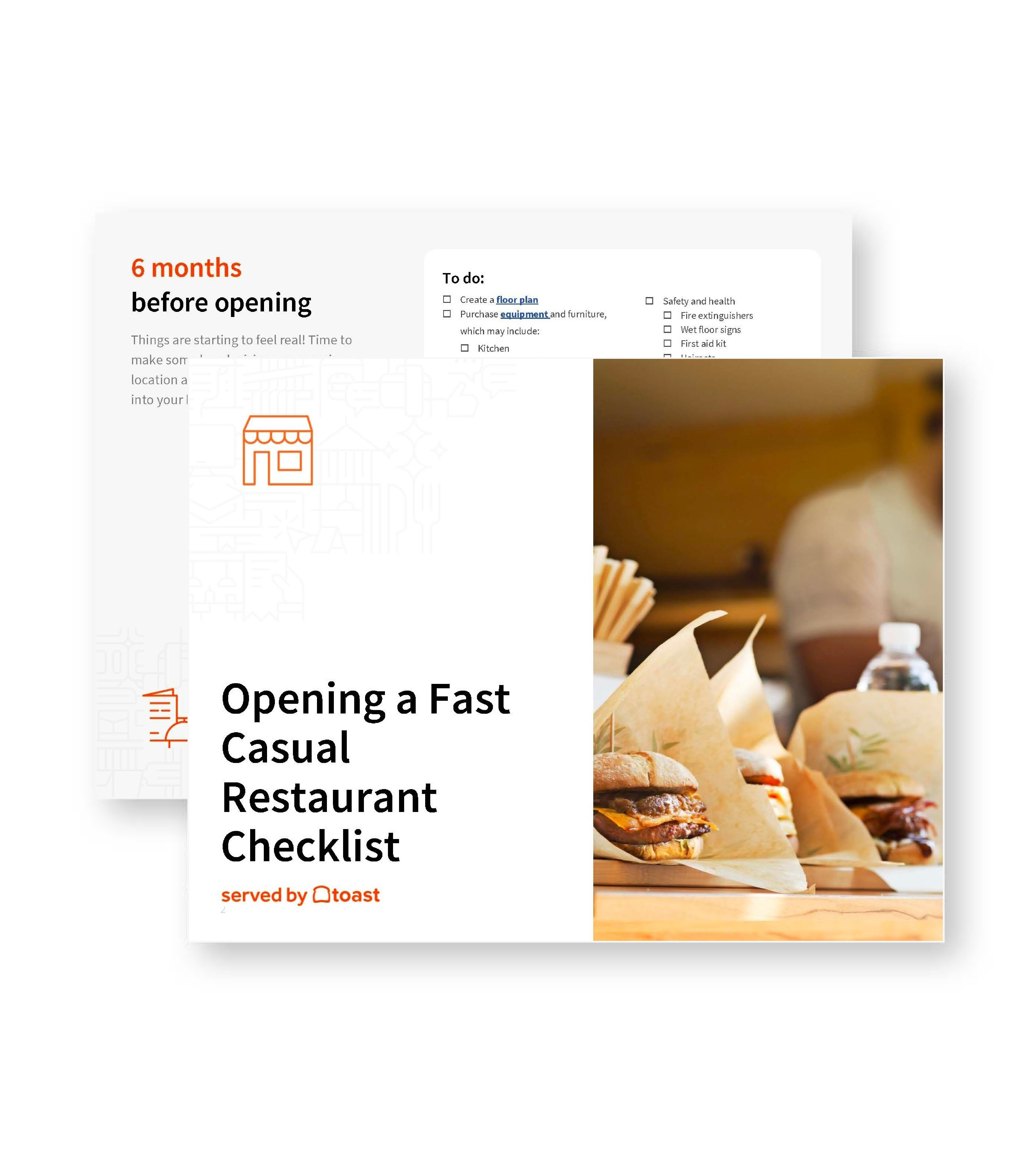
 Opening a Fast Casual Restaurant Checklist
So many things go into opening a fast casual restaurant. With this free PDF checklist, you'll set your new business up for success.
Get Free DownloadWhat’s the best POS system for fast food restaurants?
Toast POS offers some of the top features fast food restaurants need, including online ordering and kitchen display, as well as email marketing and inventory management.
While you may consider yourself a small business owner, the fast food industry is certainly not small potatoes.
As of 2025, there were more than 200,000 quick service restaurants in the country, from ice cream parlors and pizza delivery joints to sandwich shops and, of course, major franchises like McDonald's.
And, the global QSR market is projected to reach $743.5 billion by 2028. That’s right — billion, with a b.
Even though fast food chains have been around for years, many concepts have changed considerably since their first burger hit the grill. From self-ordering kiosks and online ordering to AI solutions and loyalty programs, there are so many tools to improve your guest experience while making your staff’s lives easier.
Whether you’re starting a fast food or fast casual restaurant for the first time or you’re a seasoned pro looking to upgrade your technology, you’ve come to the right place. We’ll discuss how Toast can help your restaurant get started or grow, outline the top features to consider when choosing a fast food POS system, and offer up additional resources to help set you up for success.
And to help you evaluate more tools along the way, you can download the Restaurant POS Comparison Tool and check out the Toast vs competitors compare guide.
Toast for fast casual and fast food
Toast's Starter Kit package is the ideal POS system for fast food or fast casual restaurants with fewer than 10 employees. You can choose between a countertop kit or a handheld kit, both of which come with free setup and installation support, a point of sale software subscription, and a router.
(Have more than 10 employees? Schedule a demo today with a Toast specialist to discuss which Toast products and packages would be best for you.)
With Toast, you can serve up orders fast with easy and efficient tools, all at your fingertips. From 24/7 reliability to flexible options for every budget, here's to finally getting that me time back.
But don’t just take our word for it.
G2 ranked Toast as one of the best restaurant POS systems in 2026. Reviews mention fast table-service order routing, clear KDS communication, and reporting that mirrors real-time activity. Many comment on how easy it is for new staff to learn the system. The overall sentiment shows a platform designed around smooth FOH–BOH collaboration during constant service pressure. Read the full review here.
The top 10 features of a fast food or fast casual POS system
1. Touchscreen point of sale (POS) terminals
Modern point of sale (POS) technologies, like touchscreen terminals, exist to increase efficiency. They should be able to withstand the rigors of the restaurant with durable hardware, like how Toast’s POS terminals are built to pass “Restaurant Grade” testing.
Many POS systems today, especially those used by quick service restaurants, have guest-facing screens, which allow guests to follow along as they order, quickly pay, and tip on the screen. This improves order accuracy and speed, so your team can keep the line moving.
Best-in-class POS terminals can also take credit card and mobile payments via a reader directly integrated with the POS. Whichever payment processing device you go with, make sure it supports contactless Near Field Communication (NFC) — like Apple Pay and digital wallets — Europay Mastercard and Visa (EMV), and Magnetic Stripe Card (MSR).
When choosing which POS platform to use for your fast food or fast casual restaurant, keep speed, reliability, durability, and the ability to grow with your restaurant in mind.
2. Integrated online ordering
There’s no denying the power of online ordering. According to a study conducted by Toast, 40% of guests use food delivery apps or order takeout 3-5 times a month. But how can you implement it for your fast-paced restaurant?
Online ordering systems drive more revenue for your restaurant, allowing guests to order wherever and whenever. And with no one in line behind them, guests have the opportunity to linger over a menu with no pressure, making them more inclined to get that extra menu item. Plus, allowing the guest to place their own order online leads to more accurate orders, which means happier customers and less wasted inventory.
When choosing whether to go with a third-party online ordering service, such as Grubhub or UberEats, or an in-house online ordering solution, be sure to weigh the costs and benefits. While third-party services may allow you to reach new customers who haven’t heard about your restaurant before, they also come with a price: commission fees and no ownership over your own customer data. An in-house online ordering solution helps you control your brand and keep money in your pocket.
But if you do decide to use third-party online ordering services in addition to your own online ordering platform, be sure to go with one that directly integrates to avoid extra tablets cluttering the counter or double entry by your staff.
3. Self-ordering kiosks
Convenient and contactless, self-ordering kiosks simplify the guest experience in quick service environments, like a fast food or fast casual restaurant.
Kiosks create a quick-and-easy ordering experience, allowing guests to customize their order with available add-ons and modifiers. They also streamline your front of house operations by freeing up your staff to handle important tasks elsewhere — an important benefit during a time of staffing challenges.
And, when you go with a cloud-based POS system like Toast, your kiosks are fully integrated with your POS. This means each order is sent directly from the kiosk to the line and allows your staff to 86 an item or add daily specials from the POS terminal and have it reflected on the kiosks.
If you’re looking for a way to reduce wait times, put guests in control of their experience, and free up staff to handle other duties, look no further than self-ordering kiosks for your fast food or fast casual restaurant.
4. Mobile dining solutions and QR code capabilities
No one likes to wait, but that’s especially true when they’re hungry. (Or should we say hangry?)
Mobile dining solutions, such as Toast Mobile Order and Pay™, allow guests to take control of their ordering experience by browsing the menu, ordering, and closing their check with contactless payment options.
With Toast, you can implement a custom QR code to scan to order, allowing guests to serve themselves and keep staff focused on meal prep effectively. Rather than standing at the counter, guests have the freedom to take a short walk, wait in their car, or head back to the office until they receive a text, automatically sent by Toast KDS, that their order is ready.
Plus, restaurants using Toast Mobile Order and Pay™ typically see an average 10% increase in revenue.
For fast casual concepts that offer seating but no staffed table service, Toast Mobile Order & Pay™ is a great way to provide guests with the dining experience they want without pulling staff out of the kitchen or from behind the counter.
5. Inventory management
Having a handle on your inventory is important, no matter what type of restaurant you’re operating. But when it comes to quick service restaurants, like fast food or fast casual concepts, the speed of business and perishable nature of the ingredients make having a clear understanding of inventory even more important.
For example, the more fresh, perishable ingredients you use (looking at you, fast casual health concepts!), the higher your turnover should be to help prevent food waste. However, if your inventory turnover ratio is too high, it may mean you aren’t keeping enough stock on your shelves or maintaining par (periodic automatic replacement) levels.
These days, the pen and paper method of inventory management and even the slightly more technical Excel inventory strategy are not enough. Choosing a POS platform that has an integrated food inventory management tool can reduce the margin of error and give you time back to focus on serving food, not crunching numbers.
xtraCHEF by Toast allows restaurant owners, like you, to perfect menu prices with precise product mixes, balance instincts with insights for more prescriptive costing, and most importantly, reduce costs.
Restaurant Food Inventory Template
Use this free Food Inventory Template to help your business stay organized and manage inventory with ease.

6. Customer engagement and loyalty programs
Whether your restaurant is serving up comfort food or made-to-order salads, there is likely a loyal regular in your community who’s thinking about your food as we speak.
Customer engagement and loyalty programs tap into your regulars by giving them rewards for coming back again and again. Plus, email marketing campaigns can help turn one-time guests into returning visitors.
After all, every regular starts with their first visit!
But when it comes to rewarding returning guests, gone are the days of punch cards and stamps. Toast Loyalty is a credit card-linked program that allows guests to accrue points with each swipe of their card. With an integrated loyalty program like Toast Loyalty, you can easily allow new customers to sign up with opt-in prompts on the checkout screen or self-ordering kiosks, helping you build your customer base without breaking a sweat. Plus, you can customize your sign-up bonuses, set accrual and redemption rates, and offer birthday rewards to tailor the experience to fit your brand and your budget.
And while restaurants may look to a third party for email marketing software, having one that is directly integrated with your POS means no more exporting your email addresses from one tool to another.
If your fast casual or fast food restaurant is located near an office park, college campus, or other high-trafficked area, loyalty programs can provide that extra incentive to keep guests coming back.
7. Detailed customer and sales reporting
One of the biggest challenges for any restaurant type is determining when, and how, to pivot your offerings — especially in the face of historic inflation. But it becomes a lot easier with the right restaurant POS software.
Choosing a POS platform that includes integrated reporting and analytics lets you keep pace with performance in real-time. Plus, cloud-based POS platforms like Toast allow you to access this data from anywhere, at any time. No more waiting days or weeks to review results. With Toast, you get automatic nightly business metrics straight to your inbox.
Curious how that new menu item is doing? A product mix report lets you track sales of a menu item across all your menus. Or maybe you want to reduce your business days due to the ongoing worker shortage? View performance on specific days of the week to identify which days are the slowest.
Integrated sales reporting helps you work smarter, not harder, and keep your fast food or fast casual restaurant serving meals with speed and ease.
8. AI assistant
In 2026, your POS should do more than generate reports. Toast IQ goes beyond showing you what already happened — it actively monitors your business and local market to anticipate what’s coming next and tell you exactly how to respond.
High-volume fast food operators don’t have time to dig through dashboards or interpret complex data. An AI assistant built into your POS surfaces the insights that matter most — flagging sales shifts, menu management changes, and emerging trends in real time. Instead of reacting after revenue is lost, you can make faster, smarter decisions while service is still moving.
With AI-powered menu insights, operators can quickly optimize pricing, promotions, and more. Your POS doesn’t just store data — it works like an extra manager, helping you stay ahead of demand, protect margins, and adapt instantly.
9. Kitchen display
Fast food kitchens can’t rely on paper tickets to keep up with demand anymore. To move faster and stay consistent, consider changing your kitchen workflow to be fully digital—especially for high-volume takeaway and multi-location operations.
Toast Kitchen Display System (KDS) seamlessly connects your front of house and kitchen staff so teams can move in sync and deliver unforgettable meals. Orders flow directly from the POS to the kitchen in real time, eliminating missed tickets, misfires, and bottlenecks during peak hours. The result? A smoother workflow, faster prep times, and more accurate orders—no matter how busy you get.
With Toast KDS, items are fired to the kitchen seconds after a guest orders, thanks to Toast Go® integration, allowing staff to start preparing immediately. Digital ordering integration aggregates orders from kiosks, online ordering, and third-party delivery platforms into one centralized view, making takeaway volume easy to manage without chaos.
Built with restaurant-grade hardware rated for higher temperatures and durability than iPad screens, Toast KDS is designed to perform under pressure. Multiple screen sizes give you the flexibility to mount displays anywhere in the kitchen without sacrificing visibility—ideal for scaling workflows across multi-location restaurants that need consistency, speed, and reliability in every store.
10. Email marketing
Modern email marketing is about using smart, user-friendly functionality to drive real profitability without adding more work to your plate. For fast casual restaurants, the right email tools turn guest data into repeat visits automatically.
Toast’s Email Marketing add-on helps restaurants generate up to $2,300 in a single campaign.* From welcoming new guests with targeted follow-ups to sending “Miss You” emails that re-engage lapsed diners, Toast makes it easy to stay top of mind at every stage of the guest journey. You can also reward VIPs and high-value customers with personalized offers that deepen loyalty and increase lifetime value.
With intuitive, user-friendly tools, Toast email marketing helps you drive specific ordering behavior—whether that’s promoting limited-time items, increasing off-peak visits, or boosting online and takeaway orders. The result is higher profitability powered by automation, not more manual effort.
Restaurant Email Marketing Templates
Download our easy-to-use Microsoft Word templates to create compelling restaurant newsletters and marketing emails.
Deliver faster service for your fast casual concept with the best restaurant technology
Set your restaurant up for success by opting for a cloud-based POS system, like Toast, that will grow with you and allow you to drive great hospitality — even without the table service.
At the end of the day, reliable POS hardware and software will both improve your business's bottom line and help your establishment become one of the hottest joints in town.
Related fast food and fast casual business resources
15 Surprising Facts and Statistics About The Fast Food Industry
What Fast Food Kiosks Mean for the Future of the Fast Food Industry
How Beach Hut Deli Uses Toast Enterprise POS at 45 Locations
DK Sushi Uses Toast Kiosks to Deliver a Seamless Quick Service Guest Experience
FAQs
What features should I look for in a fast casual POS system?
A fast casual POS system should support high order volume, quick service, and operational simplicity. Key features to look for include:
Mobile and handheld ordering to reduce lines and allow staff to take orders anywhere
Fast, intuitive checkout with minimal taps to complete an order
Kitchen display systems (KDS) to send orders instantly and reduce errors
Flexible menu and pricing controls for frequent updates or seasonal items
Integrated payments that support cards, contactless, and digital wallets
Built-in reporting and dashboards for real-time visibility into sales and performance
Cloud-based access so owners can manage the business remotely
How do POS systems impact service speed?
POS systems play a critical role in service speed by removing friction at every step of the ordering and payment process. A modern POS can:
Eliminate bottlenecks by allowing orders to be taken and sent to the kitchen simultaneously
Reduce errors by clearly displaying modifiers and special requests
Shorten checkout times with faster payment processing
Improve staff efficiency by minimizing time spent searching for orders or managing tickets
Keep teams flexible by allowing employees to move freely rather than stay tied to a terminal
When designed for speed, a POS system helps businesses serve more customers in less time—especially during peak periods—without sacrificing accuracy or guest experience.
*Based on the past performance of restaurants using Toast Email Marketing in Q3 and Q4 of 2021. The $2,800 represents the average increase in sales in the 14 days following an email sent via Toast Email Marketing. The average open rate for emails sent via Toast Email Marketing is approximately 39%. Individual results will vary.

Is this article helpful?
DISCLAIMER: This information is provided for general informational purposes only, and publication does not constitute an endorsement. Toast does not warrant the accuracy or completeness of any information, text, graphics, links, or other items contained within this content. Toast does not guarantee you will achieve any specific results if you follow any advice herein. It may be advisable for you to consult with a professional such as a lawyer, accountant, or business advisor for advice specific to your situation.
 Trending

Subscribe to On the line
Sign up to get industry intel, advice, tools, and honest takes from real people tackling their restaurants' greatest challenges.
By submitting, you agree to receive marketing emails from Toast. We’ll handle your info according to our privacy statement. Additional information for California residents available here.