
10 Ways to Increase Customer Spend at Your Restaurant
Getting each guest to spend a few dollars more is almost always cheaper than finding a new one. Here are the menu, upsell, and loyalty moves that lift your average check without making service feel pushy.
Author
 RESOURCE
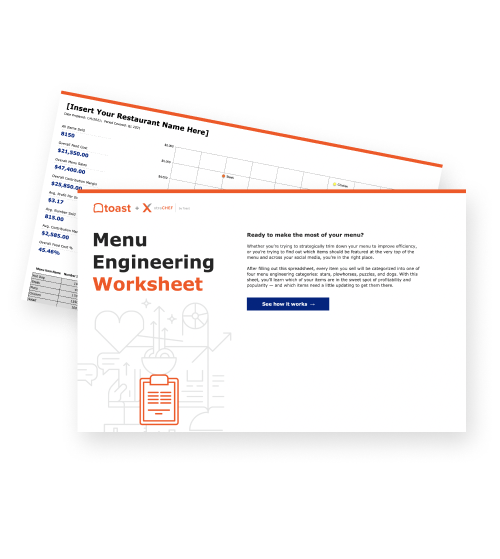
 Menu Engineering Worksheet
Use this menu engineering worksheet, complete with intricate menu engineering formulas, to determine areas of strength and weakness in your restaurant's menu.
Get Free DownloadIncreasing customer spend means raising the average amount each guest or order generates. Restaurants can do this with profitable add-ons, thoughtful menu design and pricing, relevant recommendations, and more reasons to return.
The goal is to help customers discover complementary items and build an order they value. The opportunity also continues after the check closes: Toast Loyalty lets restaurants reward visits or spending across in-store and online orders, giving guests a clear reason to come back.
This guide explains how to measure customer spend, calculate the value of a small check increase, and use practical strategies to grow it.
Key takeaways
A $2 increase per guest can generate $108,000 in annual sales for a restaurant serving 150 guests daily.
Track average check, spend per guest, attachment rates, and contribution margin before testing new tactics.
Promote relevant, high-margin add-ons and bundles instead of simply pushing expensive items.
Specific staff recommendations and well-timed digital prompts can increase spend without pressuring guests.
Loyalty and targeted marketing can increase customer spend by encouraging more repeat visits.
What can a small increase in customer spend mean for restaurant revenue?
Even a modest increase in spend per guest can produce meaningful additional sales when repeated across hundreds of daily transactions. Consider a restaurant serving 150 guests per day for 360 days per year:
Additional spend per guest: $2
Average daily guests: 150
Operating days: 360
Potential additional annual sales: $2 × 150 × 360 = $108,000
That $108,000 represents additional sales, not profit. The financial benefit depends on the contribution margin of the items creating the increase.
For example, suppose a side sells for $6 and costs $2 in ingredients. Its contribution margin is $4 before labor and other operating expenses. Selling 25 more each day would contribute $100 per day before those additional expenses.
That distinction matters because restaurant profit margins depend on how much revenue remains after food, labor, occupancy, and other costs—not revenue alone.
How do you measure customer spend at a restaurant?
Restaurants measure customer spend using average check, spend per guest, items per check, attachment rates, and contribution margin. Establishing these baselines makes it possible to determine whether a new menu, promotion, or sales practice is producing a meaningful improvement.
Metric | How to calculate it | What it reveals |
Average check | Total sales ÷ number of checks | Average revenue generated by each transaction |
Spend per guest | Total sales ÷ number of guests | How much each customer spends |
Average order value | Channel sales ÷ number of orders | Spending through takeout, delivery, or online ordering |
Items per check | Items sold ÷ number of checks | Whether customers are purchasing more products |
Attachment rate | Orders containing an add-on ÷ qualifying orders | How often a targeted recommendation succeeds |
Contribution margin | Selling price − direct item cost | How much an item contributes before other expenses |
Repeat-visit rate | Returning guests ÷ identified guests | Whether customers are coming back |
Restaurant revenue data shows that results vary significantly by concept and service model. Compare your restaurant with similar businesses instead of relying on one industry-wide number.
Toast Reporting and Analytics tracks sales and product-mix performance across in-store and online menus. Toast Benchmarking adds local context through peer-set comparisons of sales, volume, and item-pricing trends.
How to increase customer spend at your restaurant
Restaurants can increase customer spend by identifying profitable item combinations, improving how those choices are presented, and making recommendations at the right point in the ordering experience.
1. Identify the most profitable opportunities
Start with transaction and cost data rather than selecting items based only on price or intuition. The best opportunity may be a modestly priced side or beverage that complements a high-volume entrée and carries a strong contribution margin. A menu engineering worksheet can help classify items by popularity and contribution margin.
Review item performance: Compare selling price, direct cost, sales volume, and contribution margin.
Find incomplete orders: Look for popular entrées frequently ordered without a beverage, side, or appetizer.
Study item pairings: Identify products customers already purchase together.
Separate the data: Review results by daypart, location, and ordering channel.
Prioritize relevance: Promote items that improve the guest's order instead of simply pushing the most expensive option.
A 2025 peer-reviewed study analyzed 9,712 transactions from an independent U.S. hotel restaurant. The researchers demonstrated how purchasing patterns and the expected contribution from complementary items can reveal bundling and upselling opportunities that an entrée-only analysis may miss.
2. Build profitable add-ons into the menu
Add-ons work best when they make an order more complete or customizable. A burger may naturally support cheese, bacon, avocado, fries, sauces, or a beverage, while an entrée may pair with a side, appetizer, or wine.
Keep choices focused: Too many modifiers can slow decisions and complicate preparation.
Display prices clearly: Guests should understand the additional cost before ordering.
Calculate the margin: Confirm that each add-on contributes enough to justify its food and preparation costs.
Use logical pairings: Recommend items that genuinely complement the original selection.
Stay consistent: Make relevant options available across employee-led and digital channels.
Toast Online Ordering can present featured items, offers, and add-ons during digital checkout, making complementary choices easier to find before the order is submitted.
3. Create bundles and upgrades with clear value
Bundles encourage guests to purchase several related items together. They may take the form of combo meals, prix fixe menus, family packages, catering bundles, or size upgrades. Discount and combo strategies can increase ticket size, but they still require careful cost calculations.
Combine complementary products: Pair entrées with sides, beverages, desserts, or other logical additions.
Offer clear tiers: Use good-better-best options to make upgrades easy to compare.
Explain the value: Show what the customer receives for the additional price.
Use margins strategically: Higher-margin beverages or sides can support the overall bundle.
Compare purchasing behavior: Determine whether the bundle generates new add-on sales or merely discounts items customers already buy.
Protect contribution: A larger check is not necessarily better if excessive discounts reduce the order's margin.
4. Give employees specific upselling scripts
Telling employees to "upsell more" gives them little practical direction. Upselling recommendations should be specific, useful, and easy to decline.
Employees also need enough menu knowledge to explain why an item pairs well rather than simply naming whatever management wants to sell. Provide short scripts tied to common orders and let servers adapt them to each conversation.
Add-on: "Would you like avocado or grilled chicken with that?"
Pairing: "The roasted potatoes pair especially well with that entrée."
Upgrade: "For $3 more, you can make that a large."
Beverage: "Would you like to start with one of our house cocktails?"
Dessert: "Would you like to share our most popular dessert?"
In a field experiment covering 2,160 transactions at two fast-food restaurants, verbal prompts increased side-dish sales by 16 to 18 percentage points. Prompts were particularly effective when the recommended side complemented the selected main dish.
5. Make recommendations part of the ordering process
A recommendation is most useful while the customer is already making a related decision. That moment may occur with a server at the table, on a self-ordering kiosk, or during digital checkout.
For instance, across two studies of 20 fast-food restaurants, researchers found customers spent 14% and 16% more at kiosks than at counters, partly because kiosks provided more consistent cross-selling opportunities.
Match the current selection: Recommend items connected to what the guest is ordering.
Show modifiers at the right time: Present upgrades before the item is added to the order.
Limit unnecessary prompts: Too many suggestions create friction.
Support additional orders: Make another round or course easy to request.
Review acceptance: Remove prompts that customers consistently ignore.
Different Toast tools support recommendations across different service models:
Toast Go 3: Servers can enter orders tableside while discussing pairings, modifiers, and additional courses.
Toast Mobile Order & Pay: Guests can add another dish or round from their phones without waiting for a server.
Toast Self-Ordering Kiosks: Built-in prompts can present add-ons, upgrades, and combos during applicable orders.
6. Improve menu design and pricing
A menu should make profitable choices easy to find, understand, and order. Design and pricing work together: prominent placement will not help if the item's value is unclear or its margin is too weak.
Prioritize profitable items: Give strong performers appropriate visibility.
Write useful descriptions: Communicate ingredients, preparation, portion, and value concisely.
Organize around decisions: Group items and modifiers in a way that reflects how guests build an order.
Show upgrades nearby: Do not make customers search for available sizes or additions.
Review price gaps: Make the difference between standard and premium options understandable.
Use current cost data: Revisit pricing when ingredient, labor, or fulfillment costs change.
7. Encourage beverages, desserts, and additional courses
Beverages, appetizers, and desserts should feel like natural parts of the experience—not last-minute attempts to raise the check. A focused drink menu can draw attention to profitable pairings, while an effective dessert menu gives employees and guests a clearer final-course decision.
Start early: Introduce beverages and appetizers before the entrée decision is complete.
Recommend specific pairings: "Would you like a drink?" is less useful than naming an appropriate option.
Time additional rounds: Check satisfaction before offering another beverage.
Create a dessert moment: Present the dessert decision before dropping the check.
Support every channel: Make additional courses easy to order through employees and digital tools.
Track attachment rates: Measure beverages, appetizers, and desserts separately.
8. Use loyalty to encourage valuable behavior
Increasing customer loyalty can encourage repeat visits and higher-value behavior, but the reward structure should reflect the restaurant's goals.
Choose the desired action: Reward spending, visits, off-peak traffic, or specific purchases.
Look beyond discounts: Consider exclusive items, milestone rewards, or early access.
Keep rules simple: Guests should understand how they earn and redeem rewards.
Protect the margin: Set reasonable point values, redemption rules, and minimum spends.
Use purchase history: Make rewards relevant to what each guest enjoys.
9. Send relevant email and SMS offers
Targeted outreach can encourage another purchase without training every customer to wait for a coupon. Start with an identifiable audience and one clear reason to act.
Segment the audience: Use visit frequency, purchase history, and preferences.
Match the offer: Promote products or experiences related to what the group already buys.
Support slower periods: Build campaigns around weekday meals, happy hours, or seasonal demand.
Use one action: Direct guests toward an order, reservation, event, or menu item.
Measure the result: Track clicks, redemptions, orders, and resulting revenue.
Email marketing campaigns can support repeat visits, menu launches, online orders, and loyalty activity. Toast Marketing uses connected guest and ordering data to support targeted email and SMS outreach.
10. Use gift cards to generate future visits
Gift cards create revenue when purchased and give the recipient a future reason to visit. They may also introduce the restaurant to someone who has never ordered before.
Offer physical and digital cards: Let customers choose the most convenient format.
Promote timely occasions: Focus on holidays, birthdays, events, and local celebrations.
Make purchasing simple: Sell gift cards through the restaurant's website and ordering channels.
Protect promotional margins: Calculate the cost of any bonus-card offer.
Review redemption behavior: Track purchases, redemptions, and spending beyond the card balance.
Toast Gift Cards supports physical and digital cards, online and in-store redemption, and connected gift-card reporting.
Small increases can lead to steady growth
A helpful pairing, an easy upgrade, or a well-timed recommendation may add only a few dollars to one check. Repeated across many orders—and delivered in a way guests appreciate—those small gains can become meaningful growth.
After the visit, Toast Loyalty can reward guests for returning or spending, while Toast Marketing helps restaurants follow up with email and SMS based on guest and order data. That makes it easier to build on a good experience instead of starting from scratch with every sale.
FAQ
What is average customer spend in a restaurant?
Average customer spend is the restaurant's total sales during a period divided by the number of guests served.
What is the fastest way to increase customer spend?
One of the fastest approaches is to identify a relevant, high-margin add-on and consistently recommend it when customers order the related item.
Does menu engineering really increase revenue?
Menu engineering can increase revenue by helping restaurants price, position, and promote items based on their popularity and contribution margin.
How do loyalty programs affect customer spend?
Loyalty programs can encourage customers to visit more often or spend toward rewards, especially when incentives reflect their purchasing behavior.
Are digital ordering channels better for increasing spend?
Digital ordering can increase spend when it presents timely add-ons and upgrades, but results depend on the menu, prompts, service model, and customer behavior.
What role do beverages play in increasing customer spend?
Beverages can raise average checks because they are natural additions to many orders and often carry stronger contribution margins than food items.


Is this article helpful?
DISCLAIMER: This information is provided for general informational purposes only, and publication does not constitute an endorsement. Toast does not warrant the accuracy or completeness of any information, text, graphics, links, or other items contained within this content. Toast does not guarantee you will achieve any specific results if you follow any advice herein. It may be advisable for you to consult with a professional such as a lawyer, accountant, or business advisor for advice specific to your situation.
Subscribe to On the line
Sign up to get industry intel, advice, tools, and honest takes from real people tackling their restaurants' greatest challenges.
By submitting, you agree to receive marketing emails from Toast. We’ll handle your info according to our privacy statement. Additional information for California residents available here.