
AI Agents for Restaurants: How They Help Owners Who Wear Every Hat
AI agents can take entire tasks off your plate, from building next week's schedule to answering the phone. Here's how they work and where they help most.

Author

Chief Product Officer & Chief Operating Officer of International at Toast
 RESOURCE
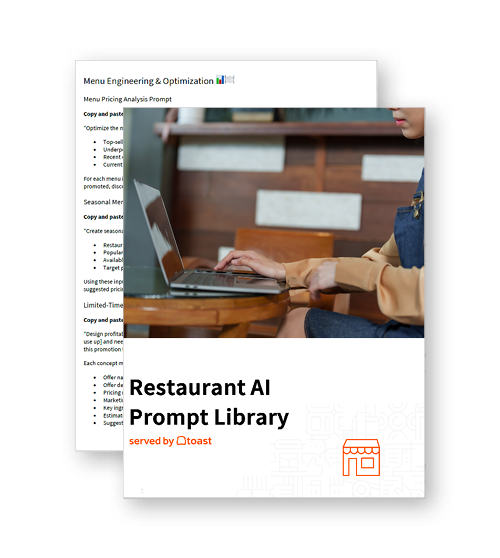
AI Prompt Library for Restaurants
Use these AI prompts to help get the specific, practical guidance your restaurant needs.
Get Free DownloadOn any given day, a restaurant owner might be the HR department, the marketing team, the bookkeeper, and the person who calls about the broken ice machine. Every hour you spend building the schedule or writing a promo email is an hour you're not spending with guests, your team, or your next big idea.
That's the problem AI agents for restaurants are built to solve. A chatbot often needs a new prompt for every answer, whereas an AI agent can take on a whole task, like drafting a schedule or launching a campaign, using what it already knows about your business from the context you’ve shared.
In this guide, we'll explain what restaurant AI agents are, how they differ from other AI tools, where they help most, and how to get started.
Key takeaways
AI agents for restaurants complete multi-step tasks for you, such as scheduling, marketing, menu updates, and phone calls.
Agents integrated with your POS leverage your existing menu structure, shift schedules, and sales history to streamline setup.
Toast restaurants using the scheduling solution in Toast IQ Team averaged 41% fewer overtime hours per employee than Toast restaurants not using it.1
Human support, such as Toast's success managers offered through Toast IQ Grow, can help you get value from AI agents faster.
Start with your biggest time drain, review what the agent produces, and measure the results.
What are AI agents for restaurants?
AI agents for restaurants are AI tools that complete multi-step tasks for an operator, such as building a staff schedule, running a marketing campaign, or answering guest calls. They use the restaurant's own data, like sales, menu, and labor history, to do the work. The operator stays in control of the results.
The key word is tasks. Many restaurants already use AI to get answers; according to Toast’s 2026 Restaurant AI Report, sales and revenue queries represented 30% of total Toast IQ platform threads. An agent can go a step further. You give it a goal, and it gathers the data, does the work, and brings it back for your approval.
AI agents vs. other restaurant AI tools
Not all restaurant AI works the same way. Here's how agents compare to the AI tools you may already be using.
AI chatbot | Built-in AI feature | AI agent | |
|---|---|---|---|
What it does | Answers questions and drafts text | Automates one step inside a tool | Completes a whole task from start to finish with your final approval |
What it knows | Only what you tell it | Data in that one tool | Your connected restaurant data |
Your role | Prompt, copy, paste, repeat | Turn it on | Set the goal, review, approve |
Example | "Write a happy hour email" | Auto-suggested menu modifiers | Build, target, and send a happy hour campaign |
Why restaurants need AI built for restaurants
General-purpose AI tools start from zero. Before they're useful, you have to explain your menu, your staff, your hours, and your goals, and then explain them again the next time.
"Restaurant owners are already just wearing so many hats." - Mike Miller, Chief Product Officer, Toast
Miller points to a familiar frustration: setting up something simple, only to face “a litany of 60 different questions.” Restaurant-specific AI agents skip that step because they run on the systems you already use. Your POS already knows your best sellers, your busiest hours, your staff roles, and your guest list.
The payoff can go beyond saving time. When the admin work is handled, owners often have room for the decisions that grow the business, like refreshing the menu, adding specials, or planning a second location. As Miller puts it, agents are meant to help restaurants move beyond "operating at maximum capacity."
Restaurant Operations Manual Template
Use this free template to easily outline all of your operating procedures and make day-to-day operations as consistent as possible.

6 ways AI agents can help your restaurant
Here's where AI agents are already taking work off operators' plates.
1. Build staff schedules faster
Scheduling is essential, but it means juggling availability, roles, time-off requests, labor budgets, and expected covers. A scheduling agent uses your sales history and your team's preferences to help build a complete schedule, and suggests updates as employee availability or staffing needs change.
Toast's Scheduling Agent, part of Toast IQ Team, is designed to generate a full schedule in seconds. Toast restaurants using the scheduling solution in Toast IQ Team averaged 41% fewer overtime hours per employee than Toast restaurants not using it.1 With staffing still a top challenge (see our guide to the restaurant labor shortage), cutting overtime adds up fast.
2. Run marketing campaigns
Most owners know they should market more but can't find the time. A marketing agent leverages your guest list and ordering insights to help tailor campaigns to opted-in guests across supported channels, such as email, SMS, and digital ads.
Toast's Marketing Agent is the core of Toast IQ Grow. In a pilot, restaurants working with a Marketing Success Manager saw sales grow more than 8% on average compared with similar Toast restaurants, and the top 25% saw more than 40% growth in the first month.2
3. Improve your menu
Your menu is your most important sales tool, but updating it often slips down the list. Toast's Menu Agent3 (beta) finds missing or weak digital menu content, writes better item descriptions, and gives pricing recommendations. For more ideas, see our guide to using an AI menu generator.
4. Answer the phone
Phones ring at the worst times, like in the middle of a Friday rush. Toast's Answering Agent3 (beta) helps answer calls, so you capture more guest questions and orders with fewer interruptions to your team.
5. Catch admin issues before they cost you
Small admin mistakes, like a missed clock-out, can turn into big payroll headaches. Toast IQ Configurable Agents3 (beta) let you set up agents from prebuilt templates for tasks like flagging missed clock-outs before payroll closes. They're built to be set up with little technical expertise.
6. Plan around demand
Good decisions start with knowing what's coming. Sales forecasting in Toast IQ Team helps you plan staffing around expected demand, so you aren't overstaffed on a slow Tuesday or short-handed on a sold-out Saturday.
How Toast IQ agents work
Toast IQ isn't an AI tool that has to learn your business from scratch. It's built on the software, hardware, and data you already use in Toast. That means:
Less setup. Your menu, sales, labor, and guest data are already connected.
Context-aware results. Agents use your restaurant's own data, so results reflect how your business runs.
You stay in control. Agents are designed to keep you in the loop, with your review where it matters most.
Want a broader view? Our guide to AI for restaurant operations covers 10 more ways AI can help across your business.
AI with a person on your side: success managers
New technology works best when someone helps you adopt it. That's why Toast pairs its AI agents with people trained to help restaurants get the most out of them.
Marketing Success Managers come with Toast IQ Grow. They help guide campaign direction and keep your marketing aligned with your brand and goals.
Payroll Success Partners come with Toast IQ Team and help you get the most out of Toast IQ Team's payroll and scheduling tools.
The goal is to pair the speed and insight of AI agents with human judgment and oversight, keeping experts accountable for outcomes and giving operators results they can trust.
How to get started with AI agents in your restaurant
You don't need to automate everything at once. Follow these steps to start small and build from there.
Pick your biggest time drain. Write down the tasks that eat your week. Scheduling, marketing, and payroll are common starting points.
Clean up your data. Agents are only as good as what they work from. Update your menu, employee roles, availability, and guest contact lists.
Start with one agent. Turn it on for one task and review everything it produces for the first few weeks.
Set guardrails. Decide what needs your approval, such as schedules over a labor budget or campaigns over a set spend.
Measure the results. Track the numbers the agent should move, like overtime hours, labor cost percentage, campaign revenue, or missed calls.
Expand what works. Once one agent proves its value, add the next.
Put AI agents to work in your restaurant. Toast IQ gives you AI agents built for restaurants, plus success managers to help you get the most from them. Learn more about Toast IQ.
AI Prompt Library for Restaurants
Use these AI prompts to help get the specific, practical guidance your restaurant needs.
Frequently asked questions
What is an AI agent in a restaurant?
An AI agent in a restaurant is software that completes multi-step tasks for the operator, like building schedules, running marketing campaigns, updating menus, or answering calls. It works from the restaurant's own data and brings results back for the operator to review.
How are AI agents different from AI chatbots?
A chatbot answers questions or drafts content when you prompt it. An AI agent takes a goal and completes the whole task, such as building and sending a campaign, using data from your restaurant's systems.
Will AI agents replace restaurant staff?
AI agents are designed to assist, not replace. They take on repetitive admin tasks like scheduling and payroll checks, allowing managers and staff to focus more on hospitality and operations.
What tasks can restaurant AI agents handle?
Common tasks include staff scheduling, sales forecasting, marketing campaigns, menu optimization, phone answering, and catching payroll issues like missed clock-outs.
Do I need technical skills to use AI agents?
Not much. Restaurant AI agents built into your POS use data you already have. Toast IQ Configurable Agents use prebuilt templates, so you can set up agents with little technical expertise.
How do I know if an AI agent is working?
Choose one or two metrics before you start, like overtime hours, labor cost percentage, or campaign revenue. Compare them before and after turning on the agent.
1Based on Toast internal data and customer-provided data from July 2025-2026 comparing Toast restaurants using Schedule Pro vs. Toast restaurants not using Schedule Pro. Individual results will vary.
2 Toast IQ Grow pilot results, as reported in Toast's announcement, May 5, 2026.
3Currently in beta and available to select customers or by request. Features and general availability may vary.
Is this article helpful?
DISCLAIMER: This information is provided for general informational purposes only, and publication does not constitute an endorsement. Toast does not warrant the accuracy or completeness of any information, text, graphics, links, or other items contained within this content. Toast does not guarantee you will achieve any specific results if you follow any advice herein. It may be advisable for you to consult with a professional such as a lawyer, accountant, or business advisor for advice specific to your situation.

Subscribe to On the line
Sign up to get industry intel, advice, tools, and honest takes from real people tackling their restaurants' greatest challenges.
By submitting, you agree to receive marketing emails from Toast. We’ll handle your info according to our privacy statement. Additional information for California residents available here.