
Toast POS Integrations: The Complete Guide for Restaurants
See how Toast POS integrations work, which tools connect out of the box — DoorDash, QuickBooks, 7shifts & more — and how Toast's open API compares to Square, Clover, and SpotOn.

Author
 RESOURCE
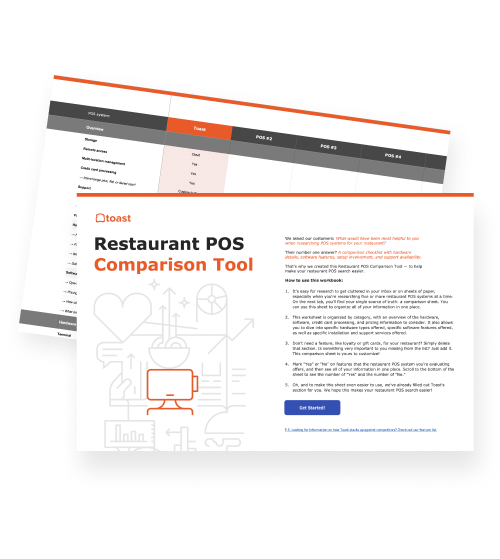
 Restaurant POS Comparison Tool
A free, customizable Restaurant POS Comparison Tool to research and compare point of sale systems in one Excel spreadsheet.
Get Free DownloadThe more your restaurant grows, the more tabs you're keeping open (literally and figuratively). Toast integrations connect the systems running behind the scenes, so your team can stay focused on the floor instead of toggling between six different logins in the back office.
This guide covers what Toast integrations are, which categories matter most for your operation, how they compare to other POS platforms, and how to get them set up.
Key takeaways:
Toast integrations connect the POS to hundreds of third-party tools — delivery, payroll, accounting, inventory, reservations, and marketing — so data flows automatically without manual re-entry.
Major delivery integrations (DoorDash, Grubhub, Uber Eats) are free to add and don't require a Restaurant Management suite; most other integrations run through Toast Partner Connect.
Toast offers open APIs for custom builds — unlike SpotOn, which has no open API, and Clover, whose integrations are more limited and installed per device.
Toast Payroll's native integration with POS time-clock and tip data processes payroll in a median of 15 minutes or less.*
The right integrations depend on your service model; the biggest wins usually come from whichever manual workflow is eating the most staff time.
What are Toast integrations?
Toast integrations are connections between the Toast POS platform and external software tools. When an integration is active, data flows between Toast and the connected platform automatically, meaning an online order placed through DoorDash, for example, fires directly to your kitchen display without staff manually re-entering it.
Toast's integration partner directory lists hundreds of vetted software partners across categories including online ordering, payroll, inventory, marketing, reservations, and accounting. Toast also offers open APIs, so operators with custom needs can work with developers to build proprietary connections.
Restaurant Operations Manual Template
Use this free template to easily outline all of your operating procedures and make day-to-day operations as consistent as possible.

Online ordering and delivery integrations
Every order that gets manually re-entered is a chance for error and time your staff isn't spending on guests. Toast Third-Party Delivery Integrations solve that problem directly: direct integrations with the biggest delivery brands help you cut labor costs and reach more guests.
Guest demand backs this up. According to Toast's own Food Delivery Trends survey of 850 guests, DoorDash is the most frequently used delivery platform (48%) — exactly why it's one of the first integrations most operators turn on. But delivery marketplaces aren't guests' only preference: 33% said they actually prefer ordering directly through a restaurant's own app or website.
The good news is you don't have to pick one. With Toast, you can host commission-free online ordering on your own site, plug into third-party delivery apps and drivers, list your restaurant on Toast Local's guest marketplace, and launch your own fully branded ordering app — all connected to the same POS.
Toast integrates with the major delivery marketplaces, including:
DoorDash — orders route directly to the POS and kitchen
Grubhub — menu syncing and order injection into Toast
Uber Eats — live order flow with no manual re-entry required
Deliverect — ability to manage multiple storefronts on a single delivery platform
According to Toast's support documentation, integrations like DoorDash, Grubhub, and Uber Eats do not require a Restaurant Management suite and can be added without an additional Toast Partner Connect fee (third-party marketplace fees still apply). That makes them accessible even for smaller operators or those just getting started with delivery.
Beyond the major platforms, Toast also integrates with tools like Olo for enterprise-level online ordering management, giving larger groups a centralized way to handle digital orders across multiple locations.
Payroll and HR integrations
Labor is often one of the highest controllable costs in a restaurant, frequently accounting for up to 30% of gross revenue.
When your payroll data lives in a separate system from your time clock, someone has to bridge that gap manually, and that's where errors happen.
Toast Payroll & Team Management connects natively with the POS, pulling time clock data, tip totals, and wage information directly so you can run payroll without the manual export process. The median payroll processing time for Toast Payroll Suite customers is 15 minutes or less.*
For operators who use third-party HR platforms, Toast also supports integrations with tools like 7shifts and HotSchedules (now part of Fourth) for scheduling and labor management.
Toast’s 2025 Voice of the Restaurant Industry Report found that roughly four in ten (41%) operators report facing moderate or extreme hiring challenges, making accurate, automated payroll data more important than ever. That same survey found 47% of operators are responding to labor challenges by focusing on increasing staff efficiency, exactly the kind of gain that comes from payroll and scheduling data flowing automatically instead of requiring manual entry across separate systems.
Accounting and finance integrations
Reconciling daily sales manually is time-consuming and leaves room for error. The stakes are real: in Toast's 2025 Voice of the Restaurant Industry Survey, inflation ranked as the single biggest challenge for one in five operators (20%), and 40% named improving profitability their top priority for the year. When margins are that tight, automatic accounting sync isn't just a convenience — it's how operators catch cost problems before they compound, rather than finding out weeks later during manual reconciliation.
Luckily, Toast integrates with accounting platforms including QuickBooks and Xero, allowing sales data, payment totals, and tax figures to sync automatically at the end of each business day.
These integrations are particularly valuable for multi-location operators or restaurant groups where a bookkeeper or accountant needs clean, consistent data across properties without logging into each POS individually.
Restaurant Competitive Analysis Template
Use this free template to size up your competitors, analyze your market, and identify your restaurant’s strengths, all in one place.
Inventory management integrations
Controlling food costs starts with knowing exactly what you have and what you're losing. Toast Inventory helps track ingredient-level costs right within your POS platform, so there's no separate system to manage for operators who want native inventory visibility.
For those running third-party inventory platforms, Toast also integrates with tools like MarketMan and Compeat, which pull sales data from Toast to automatically deplete stock levels as items are sold.
Whether you're using Toast's native tools or a third-party platform, connecting inventory to your POS gives you:
Visibility into high-waste items before they impact margins
Automated reorder points for critical ingredients
A clear picture of theoretical versus actual usage to catch discrepancies
Less over-ordering and spoilage
For operators managing food costs closely, this is one of the more impactful integrations available.
Reservations and guest management integrations
A full dining room is a good problem to have, as long as your front-of-house can keep up. Toast Tables® is Toast's own integrated waitlist and reservation solution, giving hosts real-time table visibility and a smoother seating experience without toggling between systems. Toast customers with Toast Tables saw a 57% lift in Toast Loyalty signups.1
For operators already using third-party reservation platforms, Toast also connects with tools like OpenTable, Resy, and SevenRooms, allowing hosts to view table status in real time and seat guests more efficiently.
These integrations help sync guest preferences and visit history, enabling your team to deliver personalized hospitality when a regular walks in.
Combined with Toast's own marketing and loyalty tools, you can build a more complete picture of your guest base and put it to work.
Marketing, loyalty & guest engagement integrations
A guest who orders online, joins your loyalty program, and books a table should look like one person to your restaurant, not three disconnected records. Toast's own Marketing Suite (advertising, email marketing, loyalty, gift cards, Toast Tables, and guest CRM) is built to cover most of this natively, so guest data collected at checkout automatically feeds marketing and loyalty without a separate sync step.
For operators using marketing, CRM, or reputation-management tools outside Toast's suite, the Toast partner directory filters specifically by these categories — worth checking directly, since new partners are added regularly and a static list here would go stale fast.
Restaurant Marketing Plan
Create a marketing plan that'll drive repeat business with this customizable marketing playbook template and interactive calendar.
How to add a Toast integration
Integrations are managed through Toast Partner Connect, accessible from your Toast back-end. To use most Toast integrations, Toast customers pay $25 per month per location.** That subscription fee unlocks access to Toast Partner Connect and the full partner ecosystem. (The major delivery integrations — DoorDash, Grubhub, and Uber Eats — are exceptions and can be added at no cost, but third-party marketplace fees still apply.)
The general setup process is:
Log in to your Toast account and navigate to the integrations section
Browse or search the partner directory for the tool you want to connect
Select the integration and follow the setup prompts — some require credentials from the third-party platform
Test the connection before going live, especially for order-injection integrations
Some integrations are self-serve and activate quickly. Others, particularly custom or enterprise-level connections, may require coordination between Toast's integrations team and the partner. Developers building new integrations can reference Toast's developer guide for the full technical process, including authentication, restaurant connections, and rate limits.
Choosing the right integrations for your operation
Not every integration is necessary for every restaurant. A quick-service concept with no reservations has different needs than a full-service restaurant running a loyalty program and catering operation. A practical approach is to:
Start with the highest-friction workflows — where is your team spending the most manual time?
Prioritize integrations with direct POS data flow — tools that sync with Toast in real time are more reliable than those requiring manual exports
Check for additional costs — some integrations carry monthly fees from the third-party provider, separate from Toast's pricing and the Toast Partner Connect subscription
Verify compatibility with your current Toast plan — certain integrations require specific Toast product tiers
The Toast partner directory filters by category, making it easier to compare options within a specific area like scheduling, accounting, or loyalty before committing.
How Toast integrations compare to other POS platforms
Every major POS provider takes a different approach to third-party integrations, and it affects how much flexibility an operator actually has:
Platform | Integration model | Open API? | Notable |
Toast | Partner Connect marketplace, curated partners + open developer platform | Yes | Delivery majors (DoorDash, Grubhub, Uber Eats) free***; most others via Partner Connect subscription |
Square | App Marketplace, 100+ self-serve apps across all business types | Yes | Broad SMB marketplace, not restaurant-specific — less curation for hospitality workflows |
Clover | App Market, browsed by function (accounting, employee mgmt.) or business-type category | Limited | Apps installed per-device from the Clover dashboard rather than a central admin |
SpotOn | Curated "preferred partner" list only | No — SpotOn states it does not offer an open API | No blanket integration fee, but new accounts need a Hospitality Specialist to confirm fit |
Lightspeed | Integration Hub (200+ partners) | Yes, sold as a separate product line | API access is unbundled from the standard integration hub |
The practical difference for operators: Toast and Lightspeed both pair a self-serve partner marketplace with genuine open-API access for custom builds, though Lightspeed's platform spans retail and golf alongside restaurants, so not everything in its ecosystem is built with restaurant workflows in mind. SpotOn's ecosystem is closed by design, and Square/Clover's marketplaces are broader still but built for retail-and-beyond, not restaurant-specific workflows.
Competitive information and data on this page compiled as of August 2026 and is based on publicly available information. This information is subject to change or update without notice. Toast does not make any representations as to the completeness or accuracy of the information on this page.
Building a custom integration
For operators or software vendors with needs that fall outside the existing partner ecosystem, Toast offers open APIs. The integration partner application outlines the process for prospective partners interested in developing a generally available integration for multiple restaurant customers.
Custom integrations go through a review and testing process before being made broadly available, which helps maintain the reliability of the overall ecosystem.
Ready to see how Toast's ecosystem fits your operation? Get a Free Demo and talk to a Toast expert about which integrations make sense for your restaurant, or browse the Toast Partner Directory to explore what's available today.
*Based on Toast internal data from 1/1/24 to 10/31/24 among restaurants using Toast Payroll. Individual results will vary.
**Pricing reflects information available as of August 2026 and is subject to change. Contact Toast or check pos.toasttab.com for current pricing.
***Third-party marketplace fees still apply.
1Based on Toast internal data comparing loyalty signups in Q2 2025 vs Q2 2024. Individual results will vary.
Is this article helpful?
DISCLAIMER: This information is provided for general informational purposes only, and publication does not constitute an endorsement. Toast does not warrant the accuracy or completeness of any information, text, graphics, links, or other items contained within this content. Toast does not guarantee you will achieve any specific results if you follow any advice herein. It may be advisable for you to consult with a professional such as a lawyer, accountant, or business advisor for advice specific to your situation.

Subscribe to On the line
Sign up to get industry intel, advice, tools, and honest takes from real people tackling their restaurants' greatest challenges.
By submitting, you agree to receive marketing emails from Toast. We’ll handle your info according to our privacy statement. Additional information for California residents available here.