
Restaurant Menu Pricing: How to Set Prices That Protect Your Margins
Food costs, labor, and shrinkflation are pushing menu prices higher — here's what's really driving it, and smart ways to adjust your menu without losing guests.

Author
 RESOURCE
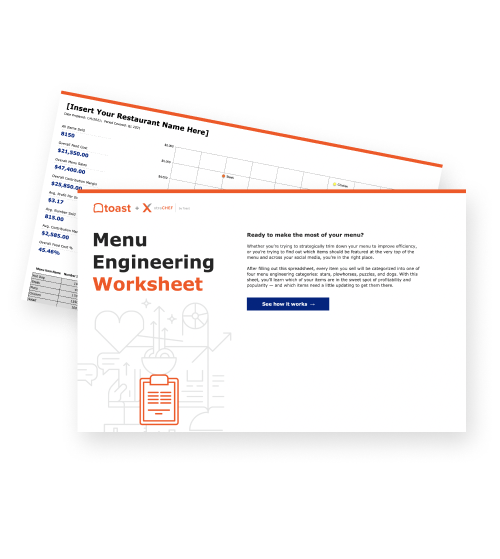
 Menu Engineering Worksheet
Use this menu engineering worksheet, complete with intricate menu engineering formulas, to determine areas of strength and weakness in your restaurant's menu.
Get Free DownloadFood costs don't take breaks, and apparently neither does inflation: According to the USDA, in 2026, prices for all food are predicted to increase 3.1%. If your menu prices don’t keep up with your food costs, you might actively be subsidizing your own losses.
Here's the good news: pricing is one of the few profitability levers you can pull without hiring anyone, buying new equipment, or waiting for supply chains to sort themselves out. And with roughly four in ten operators (41%) already wrestling with moderate or extreme hiring challenges, according to Toast's 2025 Voice of the Restaurant Industry Survey, you need every lever working in your favor. Smart pricing won't make staffing easier, but it will stop you from absorbing that pain twice.
This guide walks through how to calculate menu prices, what costs to factor in, and how to build a pricing discipline that holds up over time.
This guide is for informational purposes only and should not be used as financial or legal advice. Pricing decisions should be based on your own costs and financial situation, ideally with input from a qualified advisor.
 Start optimizing your menu
 Toast Menu Checker
Fresh ideas for your restaurant menu in 3 quick steps.

How to calculate menu prices
Every menu price should start with a number, not a feeling. The most widely used formula in the industry is:
Menu price = raw food cost ÷ target food cost percentage*
For example, if a dish costs $5.00 in ingredients and you're targeting a 30% food cost, your menu price would be $16.67.
Food cost percentage, the ratio of ingredient costs to menu price, is the foundational metric for menu pricing. Most operators target between 28% and 35%, though the right number depends on your restaurant type, labor model, and overhead structure.
Here's a general benchmark by segment:
Quick-service restaurants: 20–25% food cost
Casual dining: 28–32% food cost
Fine dining: 25–35% food cost (offset by higher check averages and labor intensity)
These are starting points, not hard rules. Your actual target should reflect your full cost structure — including labor, rent, utilities, and any third-party delivery fees.
Restaurant Profit Margin Calculator
Use this free Restaurant Profit Margin Calculator to see how efficiently you turn sales dollars into profits.
What costs to factor into your menu pricing
Food cost alone doesn't tell the whole story. A dish that looks profitable on paper can quietly drain margins if you're not accounting for every expense tied to running your operation.
When setting menu prices, factor in:
Ingredient costs: The direct cost of every component in a dish, including garnishes, sauces, and sides
Labor costs: Prep time, cook time, and plating — especially for labor-intensive dishes
Overhead: Rent, utilities, insurance, and equipment costs allocated across your menu
Waste and spoilage: Ingredients that don't make it to the plate still cost money
Payment processing fees: Credit card fees typically run 1.5–3.5% per transaction
Third-party delivery commissions: These can reach 15–30% per order, which significantly affects your effective margin on delivery items
Tracking waste and spoilage is where a lot of operators lose visibility. If you're estimating those numbers rather than measuring them, your food cost data isn't accurate and neither are your prices.
Toast's inventory management tools let you track ingredient-level costs and monitor waste patterns in an up-to-date view, so your pricing decisions are grounded in what's actually happening in your kitchen, not what you think is happening.
Prime cost, the combined total of food cost and labor cost — is the most important profitability metric for most restaurants. Keeping prime cost below 60–65% of total revenue is a widely cited benchmark for sustainable operations.
Common menu pricing strategies
Once you know your costs, you can choose a pricing approach that fits your concept and guest expectations.
Cost-plus pricing The most straightforward method: calculate your food cost, then add a markup to hit your target margin. It's reliable but doesn't account for what the market will bear.
Competitive pricing Set prices based on what similar restaurants in your area charge. Useful for staying relevant in a crowded market, but risky if your cost structure differs significantly from competitors.
Toast Benchmarking helps you get valuable insights into local market trends, so you can capitalize on trends and plan ahead.
Restaurant Competitive Analysis Template
Use this free template to size up your competitors, analyze your market, and identify your restaurant’s strengths, all in one place.
Value-based pricing Price based on the perceived value of the dish to the guest — not just what it costs to make. A well-executed wagyu burger can command a premium that a standard burger cannot, even if the cost difference is modest.
Psychological pricing Small adjustments in how prices are presented can influence guest behavior. Removing dollar signs, using charm pricing (e.g., $14.95 instead of $15), or anchoring with a high-priced item to make mid-range options feel more accessible are all documented tactics in menu engineering.
Dynamic pricing Some operators are experimenting with time-based or demand-based pricing. This means charging more during peak hours or for high-demand items. While more common in hospitality and entertainment, it's gaining traction in food service, particularly for delivery channels.
How to use menu engineering to protect margins
Menu engineering is the practice of analyzing each item's profitability and popularity, then using that data to make strategic decisions about placement, pricing, and promotion.
The classic framework categorizes menu items into four groups:
Stars: High profit, high popularity — protect and promote these
Plowhorses: High popularity, low profit — consider raising prices or reducing portion size
Puzzles: High profit, low popularity — improve visibility or reposition on the menu
Dogs: Low profit, low popularity — candidates for removal
Regularly auditing your menu through this lens helps you identify where pricing adjustments will have the most impact. The challenge for most operators is that pulling this analysis together manually takes time most kitchens don't have.
Toast IQ provides AI-powered insights to help spot top-selling items and other vital business trends without having to manually compile reports, helping you make menu engineering decisions with more confidence.
How often should you update menu prices?
There's no universal rule, but most operators revisit pricing at least twice a year and more frequently when ingredient costs shift significantly. Waiting too long to adjust prices creates a gap between your costs and your revenue that compounds quietly until it becomes a real problem.
Practical triggers for a pricing review include:
A supplier price increase of 10% or more on a key ingredient
A new minimum wage increase in your state or city
A significant change in your sales mix or guest volume
The launch of a new menu season or concept refresh
When raising prices, incremental increases are generally better received than large, sudden jumps.* Communicating value — through quality ingredients, portion consistency, and hospitality — helps guests accept price changes without friction.
Restaurant Menu Costing 101 Infographic
From ingredients and labor to rent and insurance, help your guests see what really goes into every dish.
Toast's reporting and analytics give you a real-time view of item-level performance, so you're not waiting until the end of a quarter to notice that a cost shift has started eating into your margins. The data is there when you need it, which means pricing reviews can be triggered by what's actually happening, not by a calendar reminder.
Pricing for delivery and off-premise channels
If you're selling through third-party delivery platforms, your in-house pricing model may not hold up. Commission rates from major platforms can significantly compress margins on items that are already priced tightly.
Many operators use a separate pricing tier for delivery to offset platform fees. Others build delivery-specific menus with items that travel well and carry stronger margins. Either way, your delivery pricing should be modeled separately from your dine-in menu to ensure you're not subsidizing platform fees out of your own pocket.
Price it right. Then price it again.
Effective menu pricing is an ongoing discipline. Start with accurate food cost data for every item on your menu, layer in your full overhead picture, and choose a pricing strategy that reflects both your costs and your concept. Then revisit it. Regularly.
Operators who treat pricing as a living part of their business, adjusting when costs shift, reviewing when sales mix changes, and making decisions based on real data, are better positioned to protect margins, adapt to pressure, and grow on their own terms.
Toast gives you the tools to do exactly that: from inventory tracking and waste visibility to real-time reporting and AI-powered menu insights. See how Toast can help you run a more profitable restaurant.
Restaurant Menu Templates
Use these menu templates as a starting point for your menu design or to give your menus a refresh.
FAQ
What is a good food cost percentage for a restaurant? Most restaurants target a food cost percentage between 25% and 35%.
How do I calculate the price of a menu item? Divide the raw ingredient cost of the dish by your target food cost percentage. For example, if a dish costs $4.50 to make and you're targeting a 30% food cost, your menu price would be $15.00. From there, adjust based on competitive pricing, perceived value, and your overall cost structure.
Should delivery menu prices be higher than dine-in prices? Many operators charge more on delivery platforms to offset commission fees, which can range from 15–30% per order.
How often should restaurants update their menu prices? Most operators review pricing at least twice a year. More frequent reviews are warranted when ingredient costs spike, minimum wages increase, or sales volume shifts significantly.
What is menu engineering and how does it affect pricing? Menu engineering is the process of analyzing each item's profitability and sales volume to make strategic decisions about pricing, placement, and promotion.
What is prime cost and why does it matter for menu pricing? Prime cost is the combined total of food cost and labor cost. It's the most important profitability metric for most restaurants. Keeping prime cost below 60–65% of total revenue is a common benchmark.
*This article is provided for general informational purposes only and does not constitute financial, accounting, tax, or legal advice. The pricing strategies, benchmarks, and cost percentages referenced here are industry-general guidelines, not recommendations for your specific business. Toast is not advising you to raise, lower, or otherwise change your menu prices — every restaurant's cost structure, margins, and market are different, and pricing decisions should be based on your own financial data. Consult a qualified accountant, financial advisor, or business consultant before making pricing changes that affect your bottom line.
Is this article helpful?
DISCLAIMER: This information is provided for general informational purposes only, and publication does not constitute an endorsement. Toast does not warrant the accuracy or completeness of any information, text, graphics, links, or other items contained within this content. Toast does not guarantee you will achieve any specific results if you follow any advice herein. It may be advisable for you to consult with a professional such as a lawyer, accountant, or business advisor for advice specific to your situation.

Subscribe to On the line
Sign up to get industry intel, advice, tools, and honest takes from real people tackling their restaurants' greatest challenges.
By submitting, you agree to receive marketing emails from Toast. We’ll handle your info according to our privacy statement. Additional information for California residents available here.