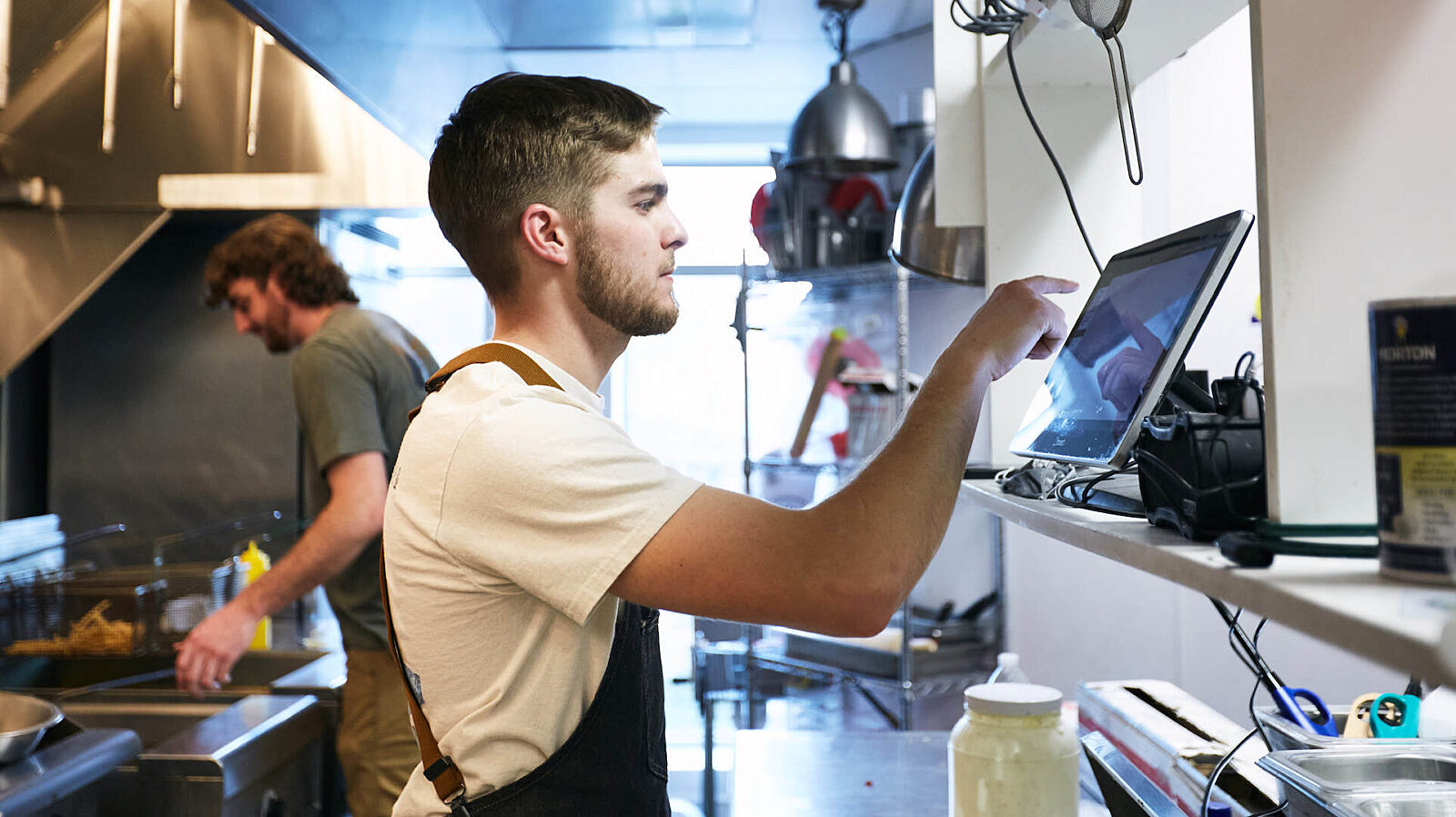
6 Benefits of Restaurant Kitchen Display Systems
Learn the top ways restaurant kitchen order systems, or KDS, can improve back- and front-of-house operations.
Author
 RESOURCE
 Back of House Management Guide and Resource Kit
This guide and resource kit will help you develop an efficient back of house management system to ensure quality and consistency in your restaurant’s kitchen.
Get Free DownloadYou don’t have to be a quick-service restaurant or run a massive kitchen to benefit from kitchen display systems, also known as a KDS system.
In truth, kitchens of all shapes and sizes can realize critical value from the operational advantages that a user-friendly, touchscreen digital solution offers for modern restaurant management.
First, let’s cover the basics.
Key takeaways
Real-time order visibility: A KDS tracks fulfillment times and eliminates missing orders, giving you real-time insight into kitchen performance and staff efficiency.
Smarter prep, faster cooking: The "all-day" display simplifies prep by showing chefs total order quantities at a glance, reducing confusion and speeding up cooking.
No more bottlenecks: Ticket routing and color-coding keep turn times fast and your team accountable, and can directly reduce labor costs.
Seamless service, no matter what: Instant alerts to servers and customers ensure food is delivered the moment it's ready — and with built-in offline backup, food production never stops even when the internet does.
Save money, save the planet: Going paperless with a KDS cuts printing costs, reduces food waste from miscommunication, and has a measurable environmental impact.
Online orders, fully integrated: Third-party and online delivery orders route directly to your KDS with no manual re-entry, keeping off-premise operations as smooth as your in-house ones.
What is a kitchen display system?
A kitchen display system, or KDS, is a centralized digital ordering system. Its primary function in most restaurants is to replace printed tickets in the kitchen and help streamline communication and efficiency in both your front-of-house (FOH) and back-of-house (BOH).
But that’s not the only reason restaurants are using them. Here are six key benefits of using kitchen order systems according to the restaurants using them, as well as important ways your KDS can save your restaurant time and money.
1. Accurately track fulfillment times (and no more missing orders!)
Data is everything. The more you know, the better you can optimize your restaurant kitchen for order accuracy.
KDS screens can track the time it takes your kitchen staff to fulfill each ticket, helping you identify order errors before they reach the guest. And with Kitchen Reports, you’ll gain valuable insight into which areas you should focus on to streamline processes and further improve kitchen operations.
These metrics — such as average fulfillment and wait times (by day of the week and time of day) — can help you readily identify your most efficient kitchen staff members, and those who may benefit from additional training. It also gives you the insight you need to effectively anticipate and staff peak hours.
Morgan & York, an artisan wine and cheese shop and sandwich deli, struggled with missing and unfulfilled tickets during busy shifts. Now, with a KDS in place, owner Jody Klein has seen significant improvements to service and fulfillment times, allowing more customers to be served and satisfied.
"The KDS helps a lot,” Jody said. No orders go missing, because “tickets are going straight to the system. It’s easier for the food staff to stay organized while making sure all orders are fulfilled as soon as possible,” she added.
Allowing your kitchen to view orders in real-time, while empowering yourself or your restaurant manager to view ticket times, can improve both the staff and guest experience.
2. Streamline prep and cooking
For chefs in a busy kitchen, planning ahead makes all the difference for a smooth shift. Knowing they have to prepare 42 wings total, rather than seven individual orders, simplifies food preparation and gives your chefs more time to do what they do best. Digital displays ensure that all order information is clear and legible, removing the mental math and "paper trail" confusion of traditional kitchens.
Toast’s Kitchen Display System has an "all-day" display, so rather than having to guess, chefs know exactly how many patties need to be on the grill, how many orders of fries need to be in the fryers, and how many cheese pizzas should be in the oven.
If you’ve ever seen a Restaurant Wars episode of Top Chef, you know that paper tickets can quickly lead to disorganization and are often the downfall of the entire operation. Paper tickets can lead to confusion for cooks, unlike kitchen display systems, where allocations and responsibilities are laid out. With paper tickets, it's easy for two cooks to see an order of grilled chicken being prepped, and for each to think it's for the Caesar salad they were working on. With a KDS, the screen can display orders and remove that confusion.
3. Improve kitchen efficiency
A good KDS allows tickets to be routed directly to specific kitchen screens and prep stations. This helps eliminate bottlenecks during a busy shift and optimizes complex kitchen workflows. Because these systems are built for heat and grease, the durable hardware—often paired with a tactile bump bar for easy navigation—keeps your turn times fast and your team accountable.
Color coding tickets makes this even easier, with tickets changing colors when they are not fulfilled within a designated amount of time. This keeps your turn times fast and your team accountable. Steakhouse 1894 Lodge shared that a kitchen display system doubled its sales, all thanks to kitchen efficiency.
The routing feature helps your kitchen staff easily keep track of the different tickets they need to address and prioritize accordingly. You also have the opportunity to increase the number of tickets each chef can fulfill in a given period and, in turn, cut down on your restaurant's labor costs.
4. Streamline FOH and BOH workflows
If the kitchen display system is used in a full-service environment and your POS vendor also offers handheld tablets, your servers can get instant notifications on their tablet's interface when tickets are marked as fulfilled on the KDS.
No handhelds in your restaurant? No problem.
Some KDS options will send text messages to servers when food is in the window in a full-service restaurant, or to customers in a quick-service restaurant who are waiting for pick-up, take-out, or in-store orders.
Instant alerts to servers or customers streamline operations and ensure your guests receive their food as soon as it is ready. In other words, dishes are never delivered cold.
And if your internet goes down? In-store orders still fire to the kitchen and the proper stations via your local network, so food production never stops, even when the internet does.
5. Go paperless and reduce waste
The benefit of going paperless is two-fold. First, restaurant kitchen order systems help to reduce food waste by helping your kitchen operations be more focused and efficient, and because they eliminate miscommunication between the front and back of house.
Second, you cut back drastically on your printing costs when you eliminate paper tickets.
That’s not a small thing; given the current pricing of thermal paper rolls, many owners find the switch to be a financial no-brainer. Brandon Hunt, the Co-Owner of Via 313, decided to switch to KDS because “the cost of paper is insane. At almost $50-60 a case, we were going through about a case a week, so it was a no-brainer for us to use kitchen display screens in the kitchen and go paperless in the front of the house as well."
Of course, the benefit to the environment is obvious, too. Kitchen display systems eliminate the need for paper ticket printers entirely, reducing paper waste across every shift, every service, every day. As the ReFED's 2026 U.S. Food Waste Pact Report puts it:
It points to the need for more collaboration across the supply chain to leverage simple solutions with high returns.
Pete Pearson
VP of Food Loss and Waste at World Wildlife Fund
6. An integrated online ordering process
With online ordering more popular than ever, you need a way to handle all off-premise orders seamlessly. Orders from your online ordering system can be routed directly to kitchen display screens without requiring a staff member to manually re-enter the order into the restaurant POS system.
If you prefer to have online orders approved before they are sent to the kitchen, some POS systems will allow you to set permissions so a manager must approve all online orders or cash-only orders before they are sent. Toast is built with a built-in offline backup that activates automatically, designed to support your restaurant's operations during outages — so you can continue placing orders while offline with the confidence your kitchen won't miss a beat.
In either case, online orders are now fully integrated into your operations and don’t require extra manual effort from your staff to be completed.
With Toast Third-Party Delivery Integrations, your third-party online orders are sent straight to your KDS as well, with no need for manual double entry or the dreaded tablet farm taking up space on your counter.
A KDS can improve operations for any restaurant
A KDS is the unsung hero of a well-run kitchen. Implementing a KDS in your restaurant can increase efficiency, revenue, and productivity. From providing your kitchen with better insight into prep times and highlighting modifiers for a better guest experience to helping your expeditor do their job better, implementing a KDS that directly connects to your point of sale platform could be the most important thing you can do for your restaurant operations.
How much does a kitchen display system cost?
KDS pricing typically combines a monthly software subscription per screen with the upfront cost of the display hardware. Bundling a KDS with your POS platform is usually cheaper than buying standalone, and many providers offer tiered plans based on restaurant size. When comparing options, weigh installation fees, ongoing support, and POS integration alongside the base price.
Kitchen Display System FAQ
Is a kitchen display system worth it for a small restaurant?
Yes — even small kitchens see fast returns from a KDS. The core benefits (fewer missed tickets, less waste, faster fulfillment, cleaner FOH-BOH communication) apply at any volume. Thermal paper savings alone — currently $50–60 per case — often offset a meaningful portion of the monthly cost.
What's the difference between a KDS and a POS system?
A POS takes orders and processes payments; a KDS displays those orders in the kitchen and routes them to the right prep stations. The two work as a connected system: the POS captures the order, and the KDS executes it. Most modern KDS platforms are designed to integrate directly with a POS rather than run standalone.
Will a kitchen display system work if my internet goes down?
Usually, most modern KDS platforms keep in-house orders flowing during an outage by routing them over your local network. What pauses is anything cloud-dependent: online ordering, third-party delivery integrations, and live reporting. Offline capabilities vary by provider, so confirm specifics before committing.
How long does it take to install a KDS and train staff?
Hardware setup usually takes a few hours per screen; full configuration (station routing, color-coding rules, menu mapping) takes longer. Most kitchen staff learn the interface within a shift or two since the screens are built to be intuitive. Plan for a slower first week, with efficiency gains appearing shortly after.
Is this article helpful?
DISCLAIMER: This information is provided for general informational purposes only, and publication does not constitute an endorsement. Toast does not warrant the accuracy or completeness of any information, text, graphics, links, or other items contained within this content. Toast does not guarantee you will achieve any specific results if you follow any advice herein. It may be advisable for you to consult with a professional such as a lawyer, accountant, or business advisor for advice specific to your situation.

Subscribe to On the line
Sign up to get industry intel, advice, tools, and honest takes from real people tackling their restaurants' greatest challenges.
By submitting, you agree to receive marketing emails from Toast. We’ll handle your info according to our privacy statement. Additional information for California residents available here.