
Restaurant Payroll: The Complete Guide for Operators
Here’s how to run restaurant payroll accurately, step by step, from new-hire paperwork to your last recordkeeping requirement.
Author
 RESOURCE
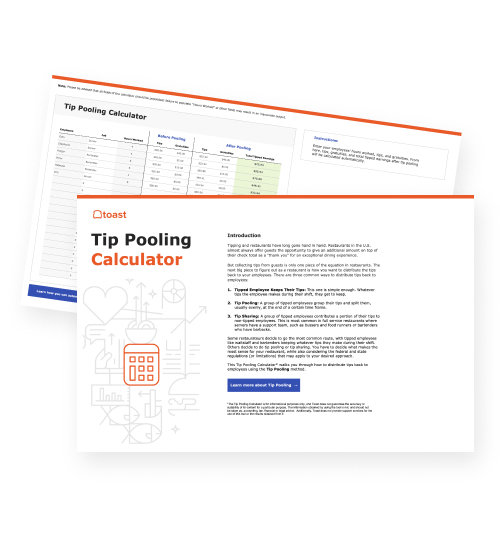
 Tip Pooling Calculator
Use the Tip Pooling Calculator to learn how to distribute tips back to your restaurant’s employees using the tip pooling method.
Get Free DownloadRestaurant payroll is about a lot more than cutting paychecks. It means tracking hours across roles, recording every tip, calculating tipped overtime the right way, and filing taxes on time — all for a team of servers, line cooks, bartenders, and managers who might each get paid differently.
The busier your restaurant gets, the more there is to keep track of. That's why Toast Payroll & Team Management is designed to seamlessly sync hours and tips directly from Toast POS into payroll.
This guide breaks down how restaurant payroll works, starting with the most restaurant-specific part: paying tipped employees.
You'll learn how tip credits and tipped overtime work (with worked examples), the paperwork and pay schedules you'll need to get set up, which payroll taxes and forms apply, how long to keep records, and what to look for in restaurant payroll software.
Note: This guide is for educational purposes only and does not constitute legal advice. Restaurant owners and managers should consult with legal counsel and/or a qualified payroll professional for specific advice and support. For payroll and payroll tax-related advice, consult an accountant or contact the Internal Revenue Service (IRS) directly.
Key takeaways
Restaurant payroll is the process of paying a restaurant team: calculating wages and tips, withholding taxes, and paying employees accurately and on time.
Tip credits let employers pay tipped employees a cash wage as low as $2.13 an hour under federal law, as long as tips bring them up to the $7.25 minimum wage. If tips fall short in a workweek, the employer pays the difference.
Tipped overtime is calculated from the full minimum wage, not the cash wage. Under federal law, when an employer takes the full tip credit, that's $5.76 in cash wages for every overtime hour.
Payroll taxes apply to both wages and reported tips. Employers withhold income tax and FICA from employees' pay, then pay their own share of FICA plus unemployment taxes.
Payroll records need to be kept for at least three years under federal labor law, and employment tax records for at least four years under IRS rules.
Restaurant Labor Cost Calculator
Unlock the power of data-driven labor management with our free Restaurant Labor Cost Calculator. Stop guessing and start optimizing your staffing decisions today.

What is restaurant payroll?
Restaurant payroll is the process restaurants use to pay their teams. It covers calculating wages and tips, withholding taxes, managing deductions, and making sure every employee is paid accurately and on time.
It's the same process most businesses follow, but payroll for restaurants comes with a few unique considerations: tipped employees, tip credits, and team members who work more than one job (at more than one pay rate).
We'll dig into each one later in this guide, but here are the key components of restaurant payroll.
Wages and salaries
Your restaurant team gets paid in one of two ways:
Hourly wages: Most restaurant employees (like servers, line cooks, dishwashers, and hosts) are paid for every hour they work. Their pay changes each pay period depending on how many hours they put in.
Salaries: Some roles (like a general manager or executive chef) earn a fixed annual amount. That salary is split evenly across pay periods, so their paycheck stays the same, no matter how busy the week was.
Either way, payroll starts by figuring out what each person earned that pay period before any taxes or deductions come out. That number is called gross pay, and we'll show you exactly how to calculate it later in this guide.
Tip management
For a lot of your restaurant team, tips are a big part of their pay. Guests at Toast restaurants tipped an average of 19.1% at full-service restaurants and 15.8% at quick-service restaurants as of Q2 2026. Tip management can also be incredibly complex. Payroll has to track every tip (cash, card, online, and tip pool), then report it and withhold taxes on it.
A POS system with built-in payroll and tip management is designed to help save time and support accurate pay tracking across your restaurant.
Tip credits
A tip credit lets a restaurant pay tipped employees a lower cash wage, provided those employees’ tips bring them up to at least minimum wage. We’ll break down exactly how tip credits work below.
Multi-rate shifts
In restaurants, employees often work multiple roles in a single week, with each role potentially having a different pay rate and method of earning tips.
A server might pick up a host shift at a different rate. A bartender might cover a barback shift and get paid out of the tip pool instead of earning tips directly. A prep cook might jump on the line for a double.
Each shift needs to be tracked under the correct job, since the role an employee works determines how they’re paid.
For example:
Tip credits only apply to tipped work. Restaurant employers can only take a tip credit for hours spent in a tipped role. If a tipped employee also works a separate non-tipped job, those hours have to be paid at that job's full rate. This is known as the dual jobs rule, which we discuss later.
Overtime uses a blended rate. When someone works more than one role at different pay rates in the same week, their overtime rate isn't based on the higher rate or the lower one. It's a weighted average of every rate they earned that week.
Payroll taxes and withholdings
Every pay period, an employer will withhold:
Federal income tax
State tax
Local income tax (where applicable)
The employee’s share of FICA taxes, which fund Social Security and Medicare. (The employer matches that FICA contribution.)
Each of these pieces is manageable on its own, but in a restaurant, they overlap.
A single server's paycheck can involve a tip credit, cash and card tips, overtime at a blended rate, and tax withholding on tip income they already took home the night they earned it.
That's why a restaurant needs its own payroll playbook, starting with tipped employees.
Restaurant payroll laws and regulations
Restaurant payroll is governed by a mix of federal, state, and local laws that set minimum wage, overtime, tip, and tax rules. Federal law sets the baseline, and state and local laws can add stricter requirements on top of it.
Fair Labor Standards Act (FLSA) is the federal law that sets the core rules for minimum wage, overtime, and recordkeeping, plus restaurant-specific rules like tip credits and tip pooling.
State and local laws can require higher minimum wages, limit or ban tip credits, or add rules like daily overtime and predictive scheduling. When state minimum wages are higher than federal law, employers have to follow the stricter rule.
Federal tax law sets how wages and tips are taxed and reported, including the new “No Tax on Tips” deduction for eligible tipped workers.
Because these laws vary by location and change often, check with the state labor department, state tax agency, and city or county labor office for the rules that apply.
Why payroll for restaurants can be harder than other industries
Every business has to pay its people accurately and on time. But a few things about the way restaurants work make payroll a bigger job than it is in most industries.
Tipped employees
Most businesses never have to track income their employees earn directly from customers — but restaurants do. And because so many of your team members earn tips, the extra rules around tip credits, tip reporting, and taxes on tips impact a big share of payroll.
A mixed team
A single restaurant might have servers, bartenders, line cooks, dishwashers, hosts, and managers. Those positions have different pay structures across hourly, tipped, salaried, full-time, and part-time. On top of that, each type of employee comes with its own pay rules and tax implications, and some team members even switch between roles in the same week.
High turnover
Hiring is top of mind for operators, according to Toast's 2026 Voice of the Restaurant Industry Survey. It was the second-biggest challenge restaurant operators identified — cited by 22% of operators, up 6 points year over year.
Every new hire means another round of paperwork and payroll setup, and every departure means a final paycheck to get right.
Pay plays a big role in who stays. In Toast's survey of 624 U.S. restaurant employees, 37% said good pay was what they valued most in a restaurant job, and 33% named poor hourly pay as a workplace pain point.
Thin margins
Labor is one of the highest costs a restaurant carries, so good payroll management isn't only about compliance. It also protects an employer’s bottom line. And with improving profitability listed as operators' top goal in 2026 — named by 37% in the same survey — it pays to track labor costs against sales every pay period.
None of this means payroll has to be a headache. It just means that restaurants can benefit from a payroll process built for the way they actually work.
Restaurant New Hire Onboarding Checklist
Bringing new employees onto your team can be both exciting and challenging. Use this free PDF checklist to set your staff up for success.
How much should payroll be for a restaurant?
There's no single right amount a restaurant should spend on payroll. Operators typically track labor cost as a percentage of sales (total labor cost divided by net sales) and set a target based on their service model, location, wage structure, and past performance.
Want benchmarks and a full walkthrough of the math? Check out our guides to restaurant payroll percentage and how to calculate labor cost percentage.
What is the 30-30-30 rule for restaurants?
The 30-30-30 rule is a budgeting rule of thumb that splits a restaurant's revenue into three buckets: about 30% for food and beverage costs, 30% for labor, and 30% for overhead like rent, utilities, and insurance. That leaves 10% as profit.
It's a helpful starting point, but many restaurants don't fit neatly into it. You can use it as a quick gut check, then build your budget around your own numbers.
Restaurant Profit Margin Calculator
Use this free Restaurant Profit Margin Calculator to see how efficiently you turn sales dollars into profits.
Tipped employee payroll: tip credits, tipped overtime, and the dual jobs rule
We'll get into the day-to-day details of running payroll later in this guide. But first, let's look at the most important (and most restaurant-specific) part of it: paying tipped employees.
Tipped employee payroll is where federal wage law, state law, and tax rules all meet.
Employers are balancing a lower cash wage against tips they don't control, overtime that's calculated from a rate they don't actually pay, and reporting rules that changed in 2026. Getting it right here makes everything else in this guide easier.
This matters to employees, too. In Toast's survey of 624 U.S. restaurant employees, 28% of tipped workers said they were unsure how much of their wages came from tips.
What is a tipped employee?
Under federal law, a tipped employee is anyone who works in a job where they typically (and regularly) receive more than $30 a month in tips. In a restaurant, tipped employees are usually servers, bartenders, and bussers.
For each tipped employee, a restaurant’s payroll has to account for:
Their cash wage, or the hourly rate the employer actually pays
The tip credit, if the employer takes one
Their tips, including cash tips, card tips, and tip pool shares
Overtime, calculated the tipped-employee way
Taxes on their reported tips
What is a tip credit?
A tip credit is the part of a tipped employee's minimum wage that their tips cover. Federal law allows operators to pay a tipped employee a cash wage as low as $2.13 an hour — and then apply up to $5.12 an hour of the employee’s tips toward the $7.25 federal minimum wage.
A few rules come with it:
Employees must be told first. Employers have to inform tipped employees about the tip credit before taking it, including their hourly cash wage and the amount of tip credit to be claimed.
Tip credit can't exceed the tips they actually received. For example, if an employee earns $300 in tips in a week, the employer can't claim more than $300 in tip credit for that week.
Tips belong to the employee, except for what goes into a valid tip pool (if applicable).
Note: Federal law is just the minimum of what’s allowed. Many states require a higher cash wage paid by employers, and some don't allow a tip credit at all.
State and local tip credit rules
State and local laws can raise the cash wage employers owe to tipped employees, or ban the tip credit entirely. Federal rules are the floor, and whichever rule is more generous to the employee is the one employers must follow.
Because these rules can change mid-year and vary across federal, state, and local levels, employers should check the Department of Labor's state tipped minimum wage table and their state labor department at least once a year (as well as anytime they open a new restaurant)
Restaurant Opening Calculator
This calculator lays out some of the fundamental financial costs of opening a restaurant, so you can start planning and bring your dream restaurant to life.
Example: how to calculate a tipped server’s weekly pay
Christian is a server at Sarah's Restaurant in Texas. He worked a standard 40-hour week with no overtime, earned the $2.13 federal minimum cash wage, and made $750 in tips. He didn't receive any other compensation this week.
Cash wage | Hours | Tips |
$2.13/hr | 40 | $750 |
Note: For this example, the restaurant is in a state that follows the federal minimum wage and allows a tip credit.
Christian's cash wage is $2.13 an hour, but his real minimum wage is still $7.25 an hour. So for a 40-hour week, he has to earn at least $290. Sarah's Restaurant pays $85.20 of that in cash wages, and his tips have to cover the other $204.80. That $204.80 is the tip credit Sarah's Restaurant takes toward its minimum wage obligation.
Here's the math for Christian's week:
Minimum wage for the week: 40 hours × $7.25 = $290
Cash wages from Sarah's Restaurant: 40 hours × $2.13 = $85.20
Tip credit needed to reach minimum wage: $290 − $85.20 = $204.80
Check the tips: Christian earned $750 in tips, well above $204.80, so no extra pay is owed. (If he'd only earned $100 in tips, Sarah's Restaurant would owe him the $104.80 difference.)
Gross pay: $85.20 + $750 = $835.20
Result: Christian's gross pay is $835.20, and Sarah's Restaurant pays $85.20 of it in cash wages.
Common mistake to avoid: Using this same math in a state that doesn't allow a tip credit. If Christian worked this same week in a state that doesn’t allow a tip credit, Sarah's Restaurant would owe him the full state minimum wage for every hour, before tips.
What happens when tips don’t cover minimum wage
If a tipped employee's cash wages plus tips don't add up to at least minimum wage for the week, the employer has to pay the difference. This extra pay is sometimes called tip makeup.
Two things to keep in mind:
The check happens every workweek. A strong week can't make up for a slow one, even if they fall in the same pay period.
The tip makeup is paid as wages on that pay period's regular paycheck.
How to calculate tipped overtime
Overtime for a tipped employee is calculated from the full minimum wage, not their cash wage. That's because, for overtime purposes, a tipped employee's regular rate is the full minimum wage. The tip credit is just how the employer covers part of it.
To calculate tipped overtime, figure out time and a half at the full minimum wage first, then subtract the tip credit (if the state allows one). Multiplying the cash wage by 1.5 instead is a common tipped payroll mistake. The example below shows what it costs.
This is also where a payroll system that's integrated with your POS earns its keep. When hours, job codes, and tips flow straight from your POS into payroll, overtime gets calculated from the right numbers, not from someone re-entering them by hand at the end of a long week.
Example: tipped overtime, calculated correctly
Scenario: Maria is a server at Sarah's Restaurant in Texas. She worked 55 hours this week, including 15 hours of overtime.
Cash wage | Tip credit | Hours | Tips |
$2.13/hr | $5.12/hr | 55 (15 overtime) | $800 |
Note: For this example, the restaurant is in a state that follows the federal minimum wage and allows a tip credit.
Here’s how to calculate Maria’s tipped overtime:
Cash wages for regular hours: 40 × $2.13 = $85.20
Overtime cash wage: ($7.25 × 1.5) − $5.12 = $5.76 an hour
Cash wages for overtime hours: 15 × $5.76 = $86.40
Total cash wages: $85.20 + $86.40 = $171.60
Check the tips: The tip credit Sarah's Restaurant took is 55 × $5.12 = $281.60. Maria's $800 in tips covers it.
Gross pay: $171.60 + $800 = $971.60
Result: Maria's gross pay is $971.60, and Sarah's Restaurant pays $171.60 of it in cash wages.
The common mistake (and what it costs): Paying overtime at 1.5 x $2.13 ($3.20 an hour) instead of $5.76 shorts Maria by $2.56 for every overtime hour, or $38.40 this week. If that happens every week, it adds up to nearly $2,000 a year for a single employee. And if it comes up in a Department of Labor investigation, Sarah’s Restaurant could owe back wages plus liquidated damages.
Tipped vs. non-tipped wage calculation (including overtime)
The easiest way to see how differently tipped employees get paid is side by side, with overtime included.
Here's how Maria's week compares to a line cook who worked the same 55 hours at Sarah's Restaurant:
Tipped vs. Non-tipped wages | Server (Maria) Tipped | Line cook Non-tipped |
Cash wage | $2.13/hr | $18.00/hr |
Tip credit | $5.12/hr | None |
Rate used to calculate overtime | $7.25/hr | $18.00/hr |
Overtime rate | $10.88/hr ($5.76 paid in cash) | $27.00/hr |
Cash wages paid by the employer | $171.60 | $1,125.00 |
Tips | $800.00 | $0 |
Total (gross) pay | $971.60 | $1,125.00 |
Note: For this example, the restaurant is in a state that follows the federal minimum wage and allows a tip credit.
Both employees are paid time and a half for overtime. The difference between the two employees is what that time and a half is based on: the line cook's full hourly rate, or the full $7.25 federal minimum wage for the server.
What is the dual jobs rule?
The dual jobs rule is a federal rule that says an employer can only take a tip credit for the hours a tipped employee spends working in their tipped job. If a server also picks up a separate, non-tipped job for the restaurant (like a prep cook shift), the employer can take the tip credit for their serving hours only. Their prep hours have to be paid at that role's full rate.
What is the 80/20 rule?
The 80/20 rule was a stricter version of the dual jobs rule that limited how much side work a tipped employee could do while the employer took the tip credit. If an employer wanted to use the tip credit for an employee, side work that supported the tipped job (like rolling silverware or restocking) couldn't take up more than 20% of the employee's workweek, or more than 30 minutes in a row. Past either limit, employers had to pay the full minimum wage for that time.
A federal appeals court struck the rule down in 2024. Some courts (and several states) still apply their own versions of the rule, so check state rules before determining pay rates.
Example: One employee, two roles, one workweek
Scenario: Andre is a server at Sarah's Restaurant in Texas who also picked up two prep shifts in the kitchen this week.
Role | Hours | Rate | Tips |
Server | 28 | $2.13/hr + tip credit | $500 |
Prep cook | 10 | $15.00/hr | None |
Note: For this example, the restaurant is in a state that follows the federal minimum wage and allows a tip credit.
Here’s how to calculate Andre’s payroll when he worked two roles in one week:
Server cash wages: 28 × $2.13 = $59.64
Prep cook wages: 10 × $15.00 = $150.00
Check the tips: The tip credit only applies to Andre's 28 serving hours (28 × $5.12 = $143.36). His $500 in tips covers it.
Gross pay: $59.64 + $150.00 + $500 = $709.64
Result: Andre's gross pay is $709.64, and Sarah's Restaurant pays $209.64 of it in cash wages.
Common mistake to avoid: Paying all 38 hours at the $2.13 tipped wage. That would short Andre $128.70 on his prep shifts alone.
What if Andre works overtime? Let’s update his example: Andre serves for 35 hours and preps for 10, for a total of 45 hours worked this week. His overtime rate is based on a weighted average of both roles' rates, with his serving hours counted at the full $7.25 minimum wage:
Straight-time pay: (35 × $7.25) + (10 × $15.00) = $403.75
Regular rate: $403.75 ÷ 45 hours = $8.97 an hour
Overtime premium: 5 hours × ($8.97 ÷ 2) = $22.43
Sarah's Restaurant still takes the $5.12 tip credit only on his 35 serving hours.
Tip pooling rules
Tip pooling is when employees combine their tips and split them according to a set formula (like by hours worked or by role).
Who can join the pool depends on whether the employer takes a tip credit:
If the employer takes a tip credit: the pool can only include employees who customarily and regularly receive tips, like servers, bartenders, and bussers.
If the employer pays everyone the full minimum wage: the pool can also include back-of-house staff like cooks and dishwashers.
Other tip pool rules to keep in mind:
Managers and supervisors can never receive tips from a tip pool.
Employers can't keep any portion of employees' tips, regardless of whether (or not) they take a tip credit.
Tip Pooling Calculator
Use the Tip Pooling Calculator to learn how to distribute tips back to your restaurant’s employees using the tip pooling method.
Service charges vs. tips
A tip is money a guest chooses to leave; a service charge is a mandatory fee the restaurant adds to the bill (like an automatic 20% gratuity for parties of eight or more). Even if every dollar of a service charge goes to staff, it still isn't a tip. It counts as restaurant revenue, and when the restaurant pays it out to employees, it counts as regular wages.
That difference impacts payroll in three ways:
Tip credit: Service charges can count toward the employer’s minimum wage obligation, but not as tips toward a tip credit.
Overtime: Service charges paid to employees have to be included in their regular rate when calculating overtime.
No Tax on Tips: Service charges don't count as qualified tips for the new federal tax deduction.
How to set up restaurant payroll: paperwork checklist
To set up restaurant payroll, you'll need a federal tax ID, state tax and unemployment accounts, workers' compensation insurance, and a set of forms for every new hire. Here's what to get in place before you run your first payroll.
1. Get an Employer Identification Number (EIN). Your EIN is your federal tax ID, and almost every business with employees needs one. You can apply for free on the IRS website.
2. Register with your state. Set up an unemployment insurance (SUTA) account with your state labor department, and a withholding account with your state tax agency if your state has an income tax.
3. Get workers' compensation insurance. Most states require it to cover employees for job-related injuries and illnesses.
4. Collect new hire forms. For every new employee, you'll need:
Form W-4, which determines how much federal income tax to withhold.
Form I-9, which verifies their identity and eligibility to work in the U.S. You and the employee both complete it.
State withholding forms, if applicable. Not all states require additional withholding, so check with your state.
A direct deposit authorization (optional). You only need this if you offer direct deposit (and if an employee opts in).
5. Report new hires to your state. Federal law requires employers to report every new hire to their state's Directory of New Hires within 20 days of the hire date, and some states set shorter deadlines.
6. Create and share an employee handbook. Your restaurant employee handbook should spell out pay schedules, tip policies, benefits, and expectations, so there's no confusion about how your team gets paid. Give it to every new hire, and update it when your policies change.
Employee Handbook Template
Outline your restaurant’s staff policies in this customizable Word doc to help restaurant management and staff get on the same page.
Note: While this checklist can be a great jumping off point, legal and paperwork-related payroll requirements may vary by location. If you’re unsure of the required restaurant payroll paperwork and/or legal setup in your area, consider seeking professional help from a local accounting or payroll professional. These professionals can offer more specific guidance on how to set up your payroll and ensure compliance across all your restaurant payroll processes.
How to choose a restaurant pay schedule
A pay schedule is how often you pay your employees: weekly, biweekly, semimonthly, or monthly. The right one balances what your team needs (steady, predictable paychecks) with what your business can manage (the time and cost of running payroll).
Here's how the four most common schedules compare:
Schedule | Pay periods per year | Pros | Cons | Best fit |
Weekly | 52 | Employees get paid often, which may help with retention. Final paychecks are quick to process when someone leaves. | Most admin work, since you run payroll every week. | Teams with lots of hourly and tipped staff, or high turnover |
Biweekly | 26 | Regular paychecks without running payroll every week. | Two months a year have three paydays, so budget for them. | Most restaurants are looking for a middle ground |
Semimonthly | 24 | Fixed pay dates (like the 15th and last day of the month) make budgeting easier. | Pay periods vary in length, which complicates hourly and overtime calculations. | Mostly salaried teams |
Monthly | 12 | Least admin work. | Long waits between paychecks are hard on hourly staff, and some states don't allow monthly pay. | Rarely a good fit for restaurants |
Before you decide on which payroll schedule to use in your restaurant, check your state's pay frequency rules. Many states set a minimum for how often you have to pay hourly employees.
How predictive scheduling affects payroll
Predictive scheduling laws (also called Fair Workweek laws) are state or local rules that set requirements for how employers schedule their teams. Depending on location, they might require an employer to:
Post schedules a set number of days in advance
Pay employees extra when their schedules change on short notice
Give employees a minimum amount of rest time between shifts
Offer additional hours to current employees before hiring new ones
These laws don't apply everywhere, and some only cover certain types or sizes of businesses. If a restaurant is covered, any extra pay these laws require (often called "predictability pay") counts as wages. That pay needs to show up on the employee's paycheck for the pay period when the schedule change happened, so it's important for scheduling and payroll systems to stay connected.
How to do restaurant payroll: step-by-step
Here's how to do restaurant payroll: collect hours and tips, calculate each employee's gross pay, withhold taxes, pay your team, and then file and deposit those taxes.
Here's how each step works.
Collect and approve timecards. Review hours, breaks, and job codes for every employee before the pay period closes. Hours logged under the wrong job can throw off tip credits and overtime.
Collect tip data from your POS. Pull card tips, reported cash tips, and tip pool payouts, and keep service charges separate.
Calculate gross pay*. Gross pay is everything an employee earns before taxes and deductions:
Hourly employees: (Regular hours × regular rate) + (overtime hours × overtime rate) + any other pay, like bonuses
Tipped employees: The same formula, plus tips
Salaried employees: Annual salary ÷ pay periods per year + any other pay
Withhold taxes and deductions to get net pay. Net pay, or take-home pay, is what's left after taxes and deductions:
Net pay = gross pay − (federal income tax + state and local income tax + FICA taxes + other deductions).
Other deductions can include things like health insurance premiums or retirement contributions.
Calculate employer taxes. That includes your share of FICA plus federal and state unemployment taxes.
Pay your team. Pay by direct deposit or check on your scheduled payday. Direct deposit gets employees their money faster and saves you the time of printing checks.
File and deposit your taxes. Deposit the taxes you withheld, plus your employer taxes, on the schedule the IRS assigns you, and file your payroll tax forms on time.
Keep records. Save timecards, tip records, and payroll reports for as long as required.
* If you pay a bonus that was promised ahead of time, like a sales incentive, include it in the employee's regular rate when you calculate overtime.
Note: Actual tax liabilities and withholdings may vary. For more detailed information on federal tax withholding requirements, visit IRS Publication 15 (2026), (Circular E), Employer's Tax Guide. For state withholding requirements, visit your state's Department of Revenue or tax agency website.
Training Manual Template
Use this restaurant training manual template, a customizable Word Doc, to provide your staff with the rules, guidelines, and clarity they need to do their jobs efficiently.
Example: how to calculate gross pay (with overtime and a bonus)
Monica is a line cook at Sarah's Restaurant who earns $18 an hour. This week, she worked 45 hours and won a $150 bonus in a recipe contest Sarah's Restaurant announced at the start of the month.
Hourly rate | Hours | Bonus |
$18/hr | 45 (5 overtime) | $150 |
Because the bonus was promised ahead of time, it has to be included in Monica's regular rate when calculating overtime:
Straight-time pay: 45 hours × $18 = $810
Add the bonus: $810 + $150 = $960
Regular rate: $960 ÷ 45 hours = $21.33 an hour
Overtime premium: 5 overtime hours × ($21.33 ÷ 2) = $53.33
Gross pay: $960 + $53.33 = $1,013.33
Result: Monica's gross pay for the week is $1,013.33.
Example: How to calculate net pay
Here's Monica's take-home pay for the same week. Sarah's Restaurant is in Texas (which has no state income tax), and Monica's health insurance premium is $150 a week.
Gross pay | Federal income tax | State income tax | FICA | Health insurance |
$1,013.33 | 12% | None (Texas) | 7.65% | $150 (after tax) |
Note: To keep the math simple, this example uses a flat federal income tax rate. Actual withholding is based on each employee's Form W-4 and the IRS withholding tables.
Federal income tax: $1,013.33 × 12% = $121.60
State income tax: $0 (Texas doesn't have a state income tax)
FICA taxes (6.2% Social Security + 1.45% Medicare): $1,013.33 × 7.65% = $77.52
Health insurance premium: $150
Net pay: $1,013.33 − $121.60 − $77.52 − $150 = $664.21
Result: Monica takes home $664.21 for the week.
Common mistake to avoid: Withholding only 6.2% for FICA. That covers Social Security, but not the 1.45% for Medicare.
Restaurant payroll taxes
Restaurant payroll taxes are the federal, state, and sometimes local taxes employers withhold from employees' wages and tips, plus the taxes employers pay on top of those wages. Employers are responsible for withholding, paying, and reporting all of them — even the ones that come out of employees' paychecks.
How "No Tax on Tips" changes tipped payroll reporting in 2026
"No Tax on Tips" is a federal income tax deduction that lets eligible tipped workers deduct up to $25,000 in qualified tips from their taxable income through 2028, with income limits. It only applies to federal income tax, so tips are still subject to Social Security and Medicare taxes.
Employees claim the deduction on their own tax returns, but employers supply the numbers. Starting with 2026 wages, Form W-2 reports:
Box 12, code TP: The total tips each employee reported to their employer
Box 14b: Up to two Treasury Tipped Occupation Codes for the employee's tipped job(s)
The IRS gave employers a break on this reporting for 2025, but 2026 is the first year it's required.
For employers, getting ready before year-end means:
Matching each tipped job in the payroll system to its occupation code.
Keeping tips separate from service charges, which don’t count as tips.
Confirming the payroll provider supports the new W-2 fields.
State and federal payroll taxes restaurants need to withhold
Here are the payroll taxes most restaurants handle every pay period:
Tax | Level | What it's for | Who pays |
Federal | The employee's federal income tax, based on their Form W-4 | Employee (employer withholds it) | |
Social Security (FICA) | Federal | Social Security benefits for retirees, disabled workers, and survivors | Employee 6.2% + employer 6.2%, on wages up to $184,500 in 2026 |
Medicare (FICA) | Federal | Medicare health insurance | Employee 1.45% + employer 1.45%, no wage cap |
Federal | An extra Medicare tax for high earners | Employee 0.9% on wages over $200,000 | |
Federal unemployment (FUTA) | Federal | Federal unemployment programs | Employer only. 6.0% on the first $7,000 of each employee's wages, but most employers get a credit of up to 5.4%, for a net rate of 0.6% |
State unemployment (SUTA) | State | State unemployment benefits | Employer only (a few states also withhold from employees). Rates vary by state |
State and local income tax | State/local | The employee's state and local income taxes, where applicable. Not all states have income tax. | Employee (employer withholds it) |
Taxes on reported tips | Federal and state/local | Income tax and FICA on the tips employees report to their employer. Tips are taxed like wages, though eligible employees may be able to deduct qualified tips from their federal taxable income under No Tax on Tips | Employee's share is withheld from their wages. Employers pay the employer share of FICA, and may be able to claim a tax credit for part of it |
Note: While this section provides general information about payroll recordkeeping, it is not financial or legal advice. For more insight into your personal payroll obligations and to ensure compliance with all relevant tax laws, make sure to consult with a tax professional.
Federal payroll tax forms and due dates
Restaurant employers file five main federal payroll tax forms: Form 941 every quarter, and Forms 940, W-2, 1099-NEC, and 8027 once a year.
These forms report the wages you paid as the restaurant employer, the taxes you withheld and owe, and (for many restaurants) your employees' tips to the IRS and the Social Security Administration (SSA). You’ll also send employees and contractors copies of some of these.
Form | What it reports | Filed by and with | Due |
Form 941 | Wages paid, federal income tax withheld, and FICA taxes | Employer to IRS | Quarterly: April 30, July 31, October 31, and January 31 |
Form 940 | Annual federal unemployment (FUTA) taxes | Employer to IRS | January 31 of the following year |
Form W-2 | Each employee's annual wages, tips, and taxes withheld, including the new tip reporting fields for No Tax on Tips | Employer to employee and SSA | January 31 of the following year |
Form 1099-NEC | Payments of $2,000 or more to independent contractors (for payments made in 2026; adjusted for inflation thereafter) | Employer to contractor and IRS | January 31 of the following year |
Form 8027 | Total receipts and tips for large food and beverage businesses where tipping is customary | Employer to IRS | Last day of February (paper) or March 31 (electronic) of the following year |
Note: While this section provides general information about payroll taxes, it is not financial or legal advice. For more insight into your personal payroll obligations and to ensure compliance with all relevant tax laws, make sure to consult with a tax professional.
If a due date falls on a weekend or holiday, the due date moves to the next business day. Your state will have its own forms, too, usually quarterly returns for state income tax withholding and unemployment taxes, so check with your state tax and labor agencies.
Taxes on tips (including withholding on reported tips, the FICA tip credit)
Tips are taxable income, so the same federal income tax and FICA withholding that applies to wages also applies to the tips employees report to their employer.
Here's what to know:
Tip reporting: Employees who receive $20 or more in tips in a month must report them to their employer by the 10th of the following month.
Withholding: Employers usually take the taxes owed on tips out of the employee's regular wages. For tipped employees with low cash wages, those wages might not cover everything, and IRS Publication 15 explains how to handle the difference.
The FICA tip credit: Employers may be able to claim a federal income tax credit for part of the Social Security and Medicare taxes they pay on employees' tips, using Form 8846.
Allocated tips: If a restaurant files Form 8027 and its employees' reported tips add up to less than 8% of its gross receipts, it may need to allocate the difference among employees. Allocated tips are reported on the employee's W-2 but aren't subject to withholding.
Restaurant payroll recordkeeping: how long to keep records
Restaurants generally need to keep payroll records for at least three to four years, depending on the agency. The Department of Labor requires most payroll records for three years, and the IRS requires employment tax records for four. Some states might require longer.
Keeping good records protects an employer in two situations:
Audits: If the IRS or Department of Labor audits a restaurant, they'll likely ask for timecards, tip records, and payroll reports.
Pay disputes: If an employee says they were underpaid, the restaurant’s records are how they show what an employee worked and what the restaurant paid.
Our recordkeeping retention table breaks down how long each agency requires employers to keep records:
Agency | What to keep | How long to keep |
Department of Labor (under the FLSA) | Payroll records, like employee information, hours worked, pay rates, and wages paid | At least 3 years |
Department of Labor (under the FLSA) | Records used to calculate wages, like timecards, work schedules, and records of additions to or deductions from pay | At least 2 years |
Internal Revenue Service (IRS) | Employment tax records, like tip reports, W-4s, tax deposits, and filed returns | At least 4 years after the tax is due or paid, whichever is later |
U.S. Citizenship and Immigration Services (USCIS) | Form I-9 | 3 years after the hire date or 1 year after employment ends, whichever is later |
Specific state | State payroll and tax records | Varies by state |
Note: While this section provides general information about payroll taxes, it is not financial or legal advice. For more insight into your personal payroll obligations and to ensure compliance with all relevant tax laws, make sure to consult with a tax professional.
How to choose restaurant payroll software
Restaurant payroll software and restaurant payroll services automate the work of paying your team: pulling in hours and tips, calculating wages and taxes, paying employees, and filing payroll taxes. The right one handles restaurant-specific rules like tip credits and tipped overtime, not just standard hourly pay.
Your options for running restaurant payroll include some of the following:
Option | How it works | Notes |
Do it yourself | You (or your accountant) calculate pay, cut checks, and file taxes | Lowest cost, but every tip credit and overtime calculation is manual |
General payroll software or services | A payroll provider calculates pay, pays employees, and files taxes for any type of business | Tip credits, tip pools, and POS data may need extra setup or manual entry |
Payroll connected to your restaurant POS | Payroll pulls hours, job codes, and tips directly from your POS | Designed around restaurant pay rules, but typically works best with that provider's POS |
What to look for in restaurant payroll software
Whichever option you're considering, ask these questions before you sign on:
Does it check tip credits every workweek and flag when tips don't cover minimum wage?
Does it calculate tipped overtime from the full minimum wage, not the cash wage?
Can employees clock in under different jobs so dual jobs and blended overtime rates are handled automatically?
Does it track every kind of tip (card tips, cash tips, and tip pools) and keep service charges separate?
Does it file your payroll taxes and year-end forms, including the new No Tax on Tips W-2 fields?
Does it connect to your POS and scheduling, so no one has to re-enter hours and tips by hand?
Does it store the records you're required to keep?
Toast Payroll & Team Management
Toast Payroll & Team Management is built to connect hours, tips, pay rates, overtime, and tip makeup with sales recorded in Toast POS — helping operators streamline payroll reconciliation. That means the numbers behind your tip credits, tipped overtime, and labor cost percentage all come from the same place your team rings in orders. You can spend less time reconciling payroll and more time running your restaurant.
For more information on how to navigate restaurant payroll and set up compliant payroll processes that benefit your restaurant and your employees, contact an experienced payroll, accounting, or tax specialist and/or visit the IRS’ small business tax resource page.
FAQs about restaurant payroll
How do restaurants pay their employees?
Payroll for restaurant employees depends on how each person is paid: hourly employees earn pay for every hour worked, salaried employees receive a fixed amount each pay period, and tipped employees receive their tips on top of their cash wage. Paychecks usually go out weekly or biweekly by direct deposit, paper check, or pay card.
What is the minimum wage for tipped employees?
Under federal law, restaurants can pay tipped employees a cash wage as low as $2.13 an hour, as long as tips bring them up to the $7.25 federal minimum wage. Many states require a higher cash wage, and some don't allow a tip credit at all.
Are tips included in payroll?
Tips employees report to their employer are taxable wages, so they're included in tax withholding and on each employee's Form W-2. But guest-paid tips aren't a labor cost for the restaurant; only the wages it pays are.
Who pays taxes on tips?
Both the employee and the employer. Employers withhold the employee's income tax and share of FICA taxes on reported tips, and pay the employer share of FICA.
How often should a restaurant run payroll?
Most restaurants run payroll weekly or biweekly. Weekly pay may help with retention on hourly and tipped teams, while biweekly cuts down on admin work. Check your state's rules, since many set a minimum for how often employers have to pay hourly employees.
Can managers share in a tip pool?
No. Under federal law, managers and supervisors can't receive tips from a tip pool, whether or not the restaurant takes a tip credit.
What's the difference between restaurant payroll software and restaurant payroll services?
Restaurant payroll software lets restaurants run payroll themselves, with automated calculations and tax filing. Restaurant payroll services typically handle more of the process for them, sometimes including HR support. Many providers offer both.


Is this article helpful?
DISCLAIMER: This information is provided for general informational purposes only, and publication does not constitute an endorsement. Toast does not warrant the accuracy or completeness of any information, text, graphics, links, or other items contained within this content. Toast does not guarantee you will achieve any specific results if you follow any advice herein. It may be advisable for you to consult with a professional such as a lawyer, accountant, or business advisor for advice specific to your situation.

Subscribe to On the line
Sign up to get industry intel, advice, tools, and honest takes from real people tackling their restaurants' greatest challenges.
By submitting, you agree to receive marketing emails from Toast. We’ll handle your info according to our privacy statement. Additional information for California residents available here.