

The short answer: they combined accurate prep and FIFO inventory discipline, close distributor relationships, repeatable SOPs, a flexible 13-person team trained to wear multiple hats, and proactive expectation management to keep service smooth and avoid sellouts.
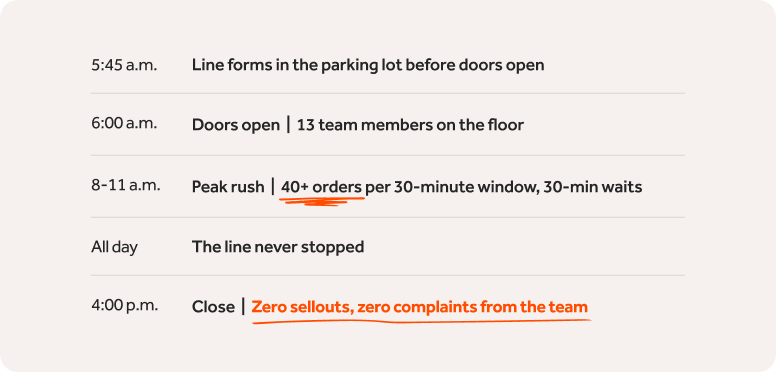
At 6 a.m on a Thursday in Pinecrest, Florida, the doors to a new H&H Bagels opened. The line was already forming, and for the next ten hours, it barely let up.
By day’s end, the team had processed more than 900 orders. More than 500 included bacon, egg, and cheese sandwiches. Wait times hit 30 minutes at peak. They didn’t sell out of a single item. It was H&H’s first location in Miami, and by any measure, it was a milestone day.
Ryan Klepper, who oversees operations for H&H Bagels, walked us through exactly how it happened.
By the Numbers
H&H Bagels, Pinecrest
Opening day · Thursday · 6 a.m. to 4 p.m.
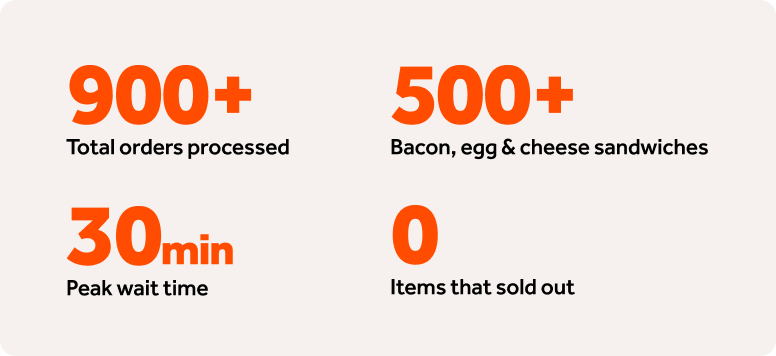
Bacon, egg, and cheese sandwiches: 500+ served
At peak, more than 500 orders included bacon, egg, and cheese sandwiches, H&H’s signature item and a clear customer favorite on opening day.
Market preparation and pre-opening strategy
H&H wasn’t new to South Florida. Locations in West Palm Beach and Boca Raton had already taught the team something useful: When you open a New York institution in a city full of people who grew up eating New York bagels, you’d better be ready.
Miami was its own thing, though. Denser market, more noise, a culinary culture with strong opinions. The team knew the press attention would be high, and it was, drawing attention from Miami New Times and Eater. What they didn’t fully predict was a 900-order Thursday.
“Anytime you’re entering a market with traditional New York cuisine that has a lot of transplants,” Ryan said, “you’re going to attract a lot of attention.”
What made the day work started long before the doors opened: prep decisions made days earlier, staffing choices made weeks before that, and a service model H&H has spent years making repeatable.
Staffing and cross-training for signature sandwich service
Thirteen team members worked that day: nine crew, three shift leaders, one GM. For a grand opening in a major market, Ryan calls it “all hands on deck,” but headcount alone doesn’t explain how a team that size runs 900 orders without a breakdown.
“A major part of training is trying to have some individual time with every person, or from afar, watch people individually, to get a gauge of where in our service model they will thrive,” Ryan said. “Trusting store leadership’s judgment to put people in positions where they’re going to succeed. It all comes together to create a really healthy environment with a lot of great output.”
Everyone was trained to wear different hats. The team that showed up that Thursday also happened to be a strong one: fast, process-oriented, and able to move quickly without getting sloppy. “You can educate on process,” Ryan said, “but you can’t educate on speed.”
“You can educate on process, but you can’t educate on speed.”
Ryan Klepper
H&H Bagels
Service model for high-volume bagel and sandwich service
H&H operates out of small-footprint locations. That means that when volume spikes, there’s no room for wasted movements.
“Everything that you need to maximize the potential of where you are needs to be right where you are,” he said. “Anytime someone has to turn and look for something, or go to the back to get something, you’re hurting yourself. Think about that happening 25, 30 times in a three-hour window at max capacity. That’s the difference between you going into the weeds.”
That’s where SOPs come in. Standard operating procedures make the work easier to repeat, easier to teach, and easier to correct before small mistakes become bigger slowdowns. Over the course of a day like this one, all of it adds up.
Despite a line from open to close, Ryan said the day felt smooth.
“It felt like we were just blocking and tackling,” Ryan said. “Everyone was playing both sides of the ball. Because of that, no one fell behind. There was no hostility in the service model whatsoever.”
Managing customer expectations for high-wait items
At peak, egg sandwiches were running 30-minute waits, which is a long time to stand in line with rising expectations. H&H’s approach was to get ahead of it.
“The worst thing somebody can do is blindly take an order and not let somebody know how long it’s going to take,” Ryan said. “You have to give them the out.”
In practice, that meant every guest-facing team member was trained to communicate egg sandwich wait times at the moment of order, and to use that moment as an opportunity to steer guests toward something else on the menu. “Maybe it gives you an opportunity to try one of our spreads or our salads. You’re introducing people to new things and managing their expectations at the same time.”
The philosophy is straightforward: under-promise, over-deliver. “You say 15 minutes, and you get it out in 12. Now the person’s leaving thinking, wow, that was faster than they projected. And it’s such a better feeling.”
Inventory prep and FIFO practices to avoid sellouts
One of the most striking details of the day was that, despite the volume, H&H didn’t run out of a single item.
“The more stores you open, the clearer your gauge of what to prepare for,” Ryan said. “We try to make a new mistake every time. We're not looking to go over the same pothole twice.”
Prep for an opening like Miami comes down to deep familiarity with walk-in capacity, strong distributor relationships, and disciplined “First In, First Out” (FIFO) practices. Knowing that a Wednesday delivery needs to arrive before a Thursday grand opening. Understanding that a Friday delivery has to account for the weekend ahead.
It’s operational muscle built over many openings, and on this particular Thursday, it held.
Lessons from a high-volume opening
One unexpected takeaway from Miami: Don’t overthink the small things. Like the location’s unusually low ceilings.
“This store had lower ceilings than any I’d had before, and I was very concerned they would create an environment that wasn't as appealing,” Ryan said. “I now have a lot more confidence in low ceilings. I will not walk away from a great location because the ceilings are too low. For our model, it clearly does not matter.”
The broader lesson Ryan takes from every opening is the same: Keep improving, and don’t make the same mistake twice. “The answer is to never stop looking for ways to get better. Never stop building out new processes. Never stop making the program more teachable.”
Measuring opening-day success beyond order count
Ryan likes to say it’s H&H’s civic duty to introduce the entire country to what a bacon, egg, and cheese on a New York bagel is supposed to taste like. On opening day in Miami, they made that case 500 times over.
But order count alone doesn’t tell the whole story. Ryan shared this advice: “What do your Google reviews look like after your first day? Did you get any emails into your info box? What was the interaction like on site? You want to judge it as a whole.”
And when one negative review comes in after 900 orders? “You cannot let that take away from the 899 you crushed. And you also cannot put that on a team that did an incredible job.”
By that measure, the Miami opening was a rousing success: 900 orders, zero sellouts, and, maybe most importantly, a city that now has a definitive idea of what a New York bagel should be.
Subscribe to Data by Toast
Use Toast’s data insights to get ahead of the curve and track market trends on menu pricing, industry patterns, and more.
By submitting, you agree to receive marketing emails from Toast. We’ll handle your info according to our privacy statement. Additional information for California residents available here.
DISCLAIMER: This information is provided for general informational purposes only, and publication does not constitute an endorsement. Toast does not warrant the accuracy or completeness of any information, text, graphics, links, or other items contained within this content. Toast does not guarantee you will achieve any specific results if you follow any advice herein. It may be advisable for you to consult with a professional such as a lawyer, accountant, or business advisor for advice specific to your situation.