Guests are largely comfortable with AI in restaurants, but comfort doesn't mean they want to see it.
In July 2026, Toast surveyed 850 restaurant guests via Pollfish about AI in the dining experience, specifically the kinds of AI a guest can see or interact with directly, like chatbots, automated ordering, and personalized recommendations.
The short answer: guests aren't opposed to AI in restaurants, but they're specific about where it belongs, and they don't want it positioned as the main event. That leaves a separate, and arguably larger, category untouched by this survey: AI that improves the guest experience without the guest ever knowing it's there.
Quick insights
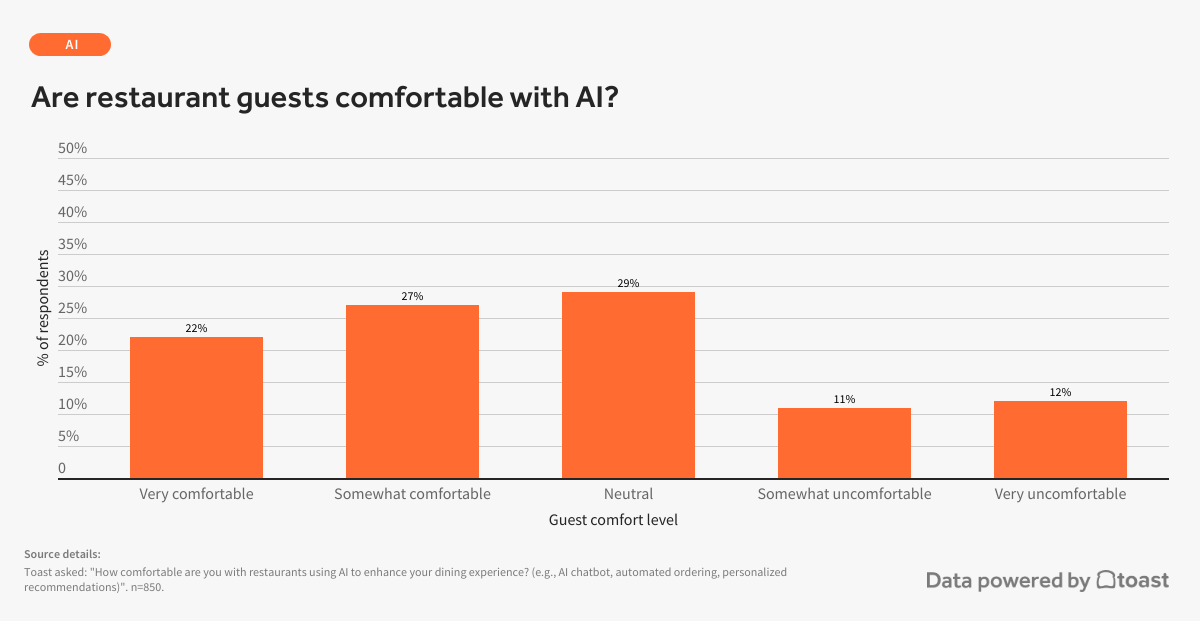
48% of guests say they're comfortable with restaurants using visible AI, like chatbots, automated ordering, or personalized recommendations, to enhance the dining experience (combination of very comfortable at 27% and somewhat comfortable at 22%), versus 23% who say they're uncomfortable.
81% of guests who say they've knowingly interacted with that kind of restaurant-implemented AI before rate that experience positively.
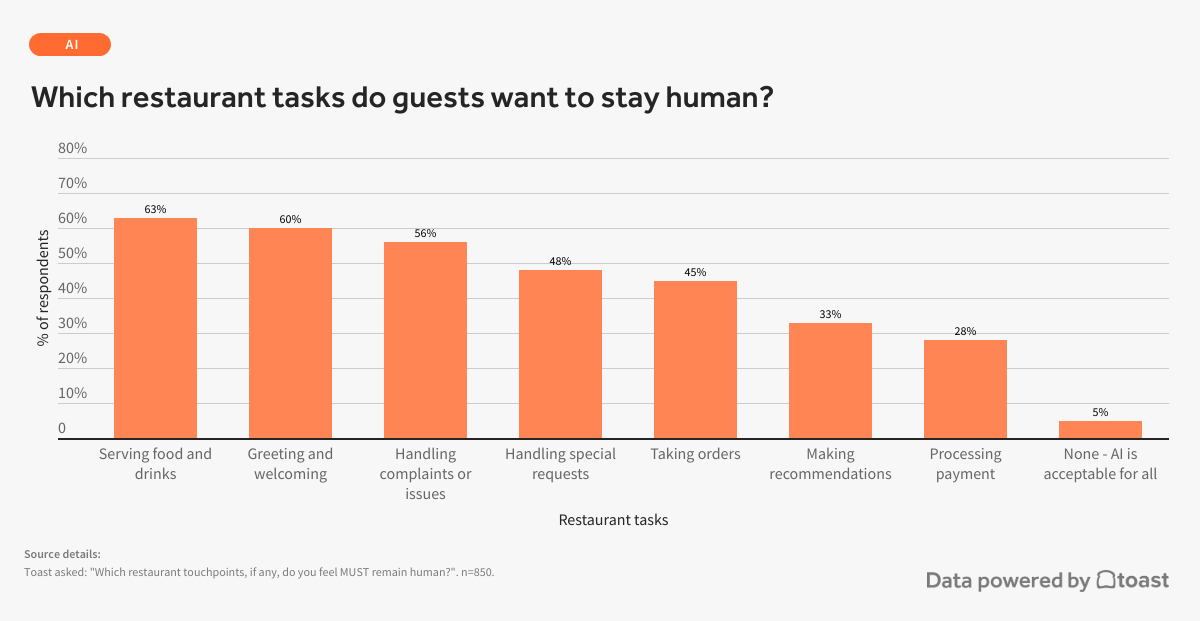
63% say serving food and drinks must stay human; only 28% feel that way about processing payment.
Guests are roughly twice as likely to say heavy AI use would make them less likely to dine somewhere (40%) as more likely (19%).
46% say they'd tip less if AI assisted with their service.
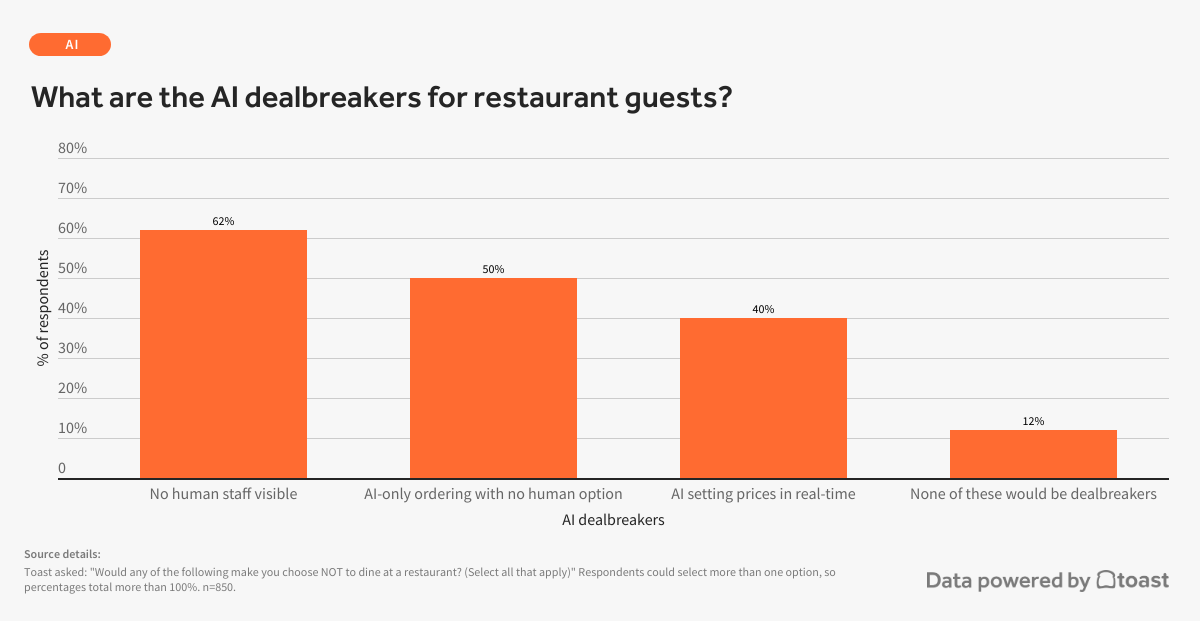
62% say a restaurant with no visible human staff would be a dealbreaker.
Are restaurant guests comfortable with AI?
Nearly half of guests, 49%, describe themselves as comfortable with restaurants using AI, more than double the 23% who say they're uncomfortable. Another 29% are neutral, which leaves a meaningful swing group still forming an opinion. The survey defined this kind of AI specifically as the visible, guest-facing kind, chatbots, automated ordering, and personalized recommendations, not the AI tools guests might use on their own (like asking ChatGPT for restaurant reviews) and not the AI a restaurant might run behind the scenes without a guest ever knowing.
That comfort question asked how guests feel about the idea of restaurants using AI. A separate question asked whether guests have actually experienced it.
Among the 38% of guests who say they've knowingly interacted with that same kind of restaurant-implemented AI, chatbots, automated ordering, or personalized recommendations, 81% rate the experience as very or somewhat positive, against just 5% negative. Direct experience, in other words, appears to land even better than guests' general comfort level would predict. Whether that's because good implementations get remembered or because expectations were modest to begin with, the pattern in the data is that trying it tends to land better than guests may expect going in.
Which restaurant tasks do guests want to stay human?
Guests appear to sort restaurant tasks into two buckets: moments of human presence, and functional steps that get them fed. Asked which touchpoints must stay human, guests most often named serving food and drinks (63%), greeting and welcoming (60%), and handling complaints (56%). Processing payment (28%) and making recommendations (33%) ranked lowest.
The feature preferences run the same direction. Faster order taking (39%) and restaurant discovery or recommendations (34%) topped the list of AI features guests say they'd value, while personalized menu suggestions (25%) and AI-assisted order customization (16%) trailed. Read together, guests seem to want AI to remove friction, not necessarily to know them.
Positioning AI as the draw may work against the restaurant
One finding worth sitting with: guests are largely fine with AI in the abstract, but that doesn't translate into AI being a draw. When told a restaurant uses AI extensively, guests were roughly twice as likely to say they'd be less inclined to visit (40%) as more inclined (19%). The largest group by far, 41%, said they'd be indifferent.
That suggests a possible distinction between AI as infrastructure and AI as marketing. Guests who've had a good hands-on experience report liking it. Guests told in the abstract that a restaurant uses AI "extensively" skew skeptical. If that holds, the safer implementation may be one guests notice through speed rather than through signage.
What do guests worry about most with restaurant AI?
When guests are asked what worries them most about restaurant AI, the concerns cluster less around the technology and more around the people behind it. Social and human concerns, most notably loss of personal connection or human touch (23%) and job losses for restaurant workers (33%), combine for 56% of responses. Technical worries like technology errors (14%), data privacy (12%), and dynamic pricing (4%) combine for only 29%.
The comfort-driver data points the same way. "Always having a human option available" is the single strongest comfort driver at 61%, and "knowing that staff jobs are protected" comes in second at 45%, both ahead of anything about accuracy or security. Messaging that reassures guests about staff and human access may be doing more work than messaging that reassures them about the technology's reliability, at least based on what guests say concerns them.
Do guests tip less when AI helps with service?
When AI assists with service in ways a guest would notice, like taking their order or making a recommendation, 46% of guests say they'd tip less than usual, compared with 23% who'd tip the same and just 7% who'd tip more. Another 24% say it depends on what the AI actually did.
It's also worth being careful about why guests say they'd tip less. The survey doesn't tell us whether guests believe the tip is less deserved, or whether they're simply unsure the tip still reaches a person. If it's the latter, a clearly stated policy, that tips go to the service team regardless of what AI assisted with, could be worth testing.
Will guests pay more for AI-enhanced restaurant service?
Guests are lukewarm on paying a premium for AI-enhanced service: 52% say they'd pay the same either way, 38% say they'd expect to pay less, and only 10% say they'd pay more.
Meanwhile, the dealbreaker data sets a floor rather than a ceiling: 62% say no visible human staff would keep them away, and 50% say AI-only ordering with no human option would do the same. Guests don't appear to be asking AI to earn a premium. They're asking it not to remove the human option entirely.
What About AI Guests Never Notice?
Every finding above is about AI a guest can see or knowingly interact with: a chatbot, an automated ordering flow, a recommendation on a screen. But a lot of restaurant AI, tools that help a server make a better recommendation, flag a table that needs attention, or analyze feedback to improve service, runs entirely out of guest view.
Often, it's just not something guests have an opinion on, the same way they don't have one about a restaurant's point-of-sale system or inventory software. It's a tool, not an experience.
What this means for restaurant operators
Taken together, the data points toward a specific shape of implementation: AI that works quietly on tasks guests already consider transactional (order taking, discovery, wait times), paired with a visible, always-available human option and some acknowledgment that staff aren't being displaced.
The friction shows up when AI touches presence-oriented moments, when it's marketed as the headline feature rather than a background improvement, or when it removes the human option rather than supplementing it. What matters to guests isn't the AI itself, but whether a human is still part of the picture.
Toast conducted a blind survey of 850 U.S. adults ages 18+ on this topic on July 29th, 2026. Respondents were not made aware that Toast was fielding the study. Using a standard margin of error calculation, at a confidence interval of 95%, the margin of error on average is +/- 3-5%.