Restaurant Kitchens: What Every Restaurateur Should Know
Learn how to design an efficient restaurant kitchen from layout types and equipment to staffing, food safety, and kitchen technology like KDS systems that keep service running smoothly.
Autor
 RESOURCE
 Restaurant Prep List Template
Use this free template to organize daily tasks for prep cooks, keep your team aligned, and make sure your kitchen runs smoothly from open to close.
Obtener descarga gratisA restaurant kitchen is a commercial workspace where employees receive, store, prepare, cook, plate, and clean up food for dine-in and off-premise orders. The best kitchen isn’t necessarily the largest or most expensive—it’s the one designed around your restaurant’s menu, service model, and team.
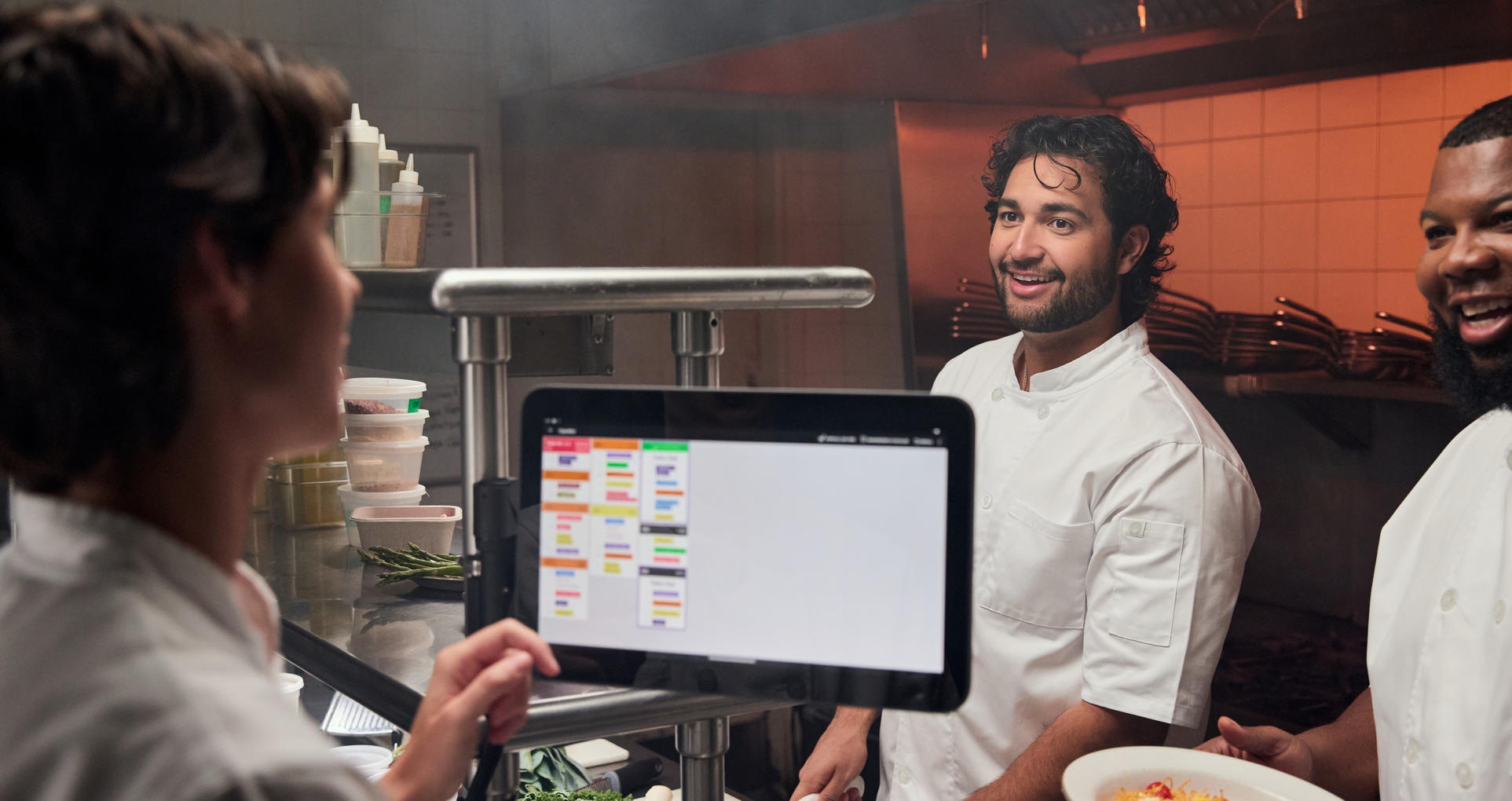
Toast Kitchen Display System sends orders from the POS to the appropriate kitchen stations. This helps teams manage tickets without relying entirely on printed slips or verbal communication.
In this guide, we’ll cover common restaurant kitchen models, layout options, equipment, staffing, technology, and practical ways to improve efficiency.
Key takeaways
Restaurant kitchens should be designed around the menu, service model, peak volume, and team.
The right kitchen layout helps reduce congestion and keeps food moving through each stage of production.
Equipment decisions should account for capacity, energy use, maintenance, and total ownership cost.
Clear roles, preparation standards, and communication protocols support more consistent service.
Connected tools like Toast KDS, xtraCHEF, Sling, and Online Ordering can improve visibility across kitchen operations.
Lista de verificación de limpieza para restaurantes
Descarga la Lista de verificación de limpieza para restaurantes, creada en colaboración con RestaurantSupply.com, para llevar un registro de las tareas de limpieza que deben realizarse en tu restaurante.

What is a restaurant kitchen?
A restaurant kitchen is the back-of-house space where food moves from delivery and storage through preparation, cooking, plating, and cleanup.
The term can also refer to the employees responsible for producing the restaurant’s food. Depending on the concept, that team may include chefs, line cooks, dishwashers, and other specialists.
Restaurant kitchen area | Primary function |
Receiving | Accepts deliveries and checks product condition and quantities |
Storage | Holds dry, refrigerated, and frozen inventory |
Preparation | Washes, cuts, portions, and organizes ingredients |
Cooking | Produces menu items using ranges, ovens, grills, fryers, and other equipment |
Plating and expo | Checks, finishes, and organizes completed orders |
Warewashing | Cleans dishes, cookware, utensils, and equipment |
Waste area | Manages trash, recycling, compost, and used cooking oil |
Common restaurant kitchen models
The right kitchen model depends on where food is prepared, how customers receive it, and whether the space supports one business or several.
Kitchen model | What it is | Best suited for | Main consideration |
Traditional on-site kitchen | A full back-of-house kitchen connected to the restaurant | Full-service, fast-casual, and quick-service restaurants | Must balance dine-in and off-premise demand |
A delivery- or pickup-focused kitchen without a traditional dining room | Virtual brands and delivery-focused concepts | Depends heavily on digital ordering and fulfillment | |
Commissary kitchen | A shared or centralized commercial production space | Food trucks, caterers, and small food businesses | Storage, access, and production schedules may be shared |
Catering kitchen | A kitchen designed for large batches and event fulfillment | Caterers, banquet venues, and hotels | Requires packing, holding, and transportation capacity |
Pop-up kitchen | A temporary kitchen used for a limited period or event | Concept testing, festivals, and seasonal service | Utilities, permits, and equipment may be limited |
Traditional on-site kitchen
A traditional restaurant kitchen supports the dining room and may also produce takeout, delivery, and catering orders. It usually includes dedicated cooking stations, food storage, preparation areas, expo, and warewashing.
Because so many restaurants now serve multiple channels, traditional kitchens increasingly need space for packing and staging as well as plating. In 2025, 47% of adults said they picked up restaurant takeout at least weekly, while 42% used drive-thrus and 37% ordered delivery each week.
Ghost kitchen
A ghost kitchen prepares food for delivery or pickup without operating a conventional dining room. Removing guest seating can reduce front-of-house space, but the kitchen still needs efficient production, order routing, packaging, and driver pickup areas. Ghost kitchens may operate one brand or several virtual concepts from the same facility.
Commissary kitchen
A commissary kitchen is a licensed commercial space shared by multiple businesses or used as a centralized production facility. Food trucks may use one for prep and storage, while restaurant groups may use a commissary to prepare sauces, baked goods, or other products for several locations.
Catering kitchen
A catering kitchen is designed to produce larger batches that may be served somewhere else. Operators need enough refrigeration, holding equipment, assembly space, packaging materials, and transportation storage to move food safely and efficiently.
Unlike standard takeout, catering orders may involve dozens or hundreds of portions that need to arrive together and remain organized.
Pop-up kitchen
A pop-up kitchen operates temporarily inside an event space, existing restaurant, market, or other venue. Pop-ups allow operators to test menus and markets with less permanent infrastructure, but they still need suitable refrigeration, handwashing, cooking equipment, storage, and local approvals.
Restaurant kitchen layout options
A model describes how the operation functions, while the kitchen layout determines how work moves through the physical space.
Kitchen layout | How it works | Best suited for | Potential challenge |
Assembly-line layout | Food moves through stations in a fixed sequence | Pizza, sandwiches, bowls, and high-volume QSRs | Less flexible for varied menus |
Zone-style layout | Each area handles a specific cooking method or task | Full-service restaurants with broad menus | Requires enough room between stations |
Island layout | A central cooking block is surrounded by prep and storage | Larger kitchens with collaborative teams | Can create traffic around the center |
Galley layout | Equipment runs along two parallel walls | Narrow or compact kitchens | Limited passing and storage space |
Open-kitchen layout | Some or all food production is visible to guests | Chef-driven and experience-focused concepts | Noise, clutter, and mistakes stay visible |
Opening a Ghost Kitchen Checklist
So many things go into opening a ghost kitchen. With this free PDF checklist, you'll set your new business up for success.
Essential restaurant kitchen equipment
You should select your restaurant kitchen equipment according to your menu, production volume, available utilities, employee skills, and service model.
Equipment category | Common examples | What determines the need |
Cooking | Ranges, ovens, fryers, grills, griddles, broilers | Menu and cooking methods |
Refrigeration | Walk-ins, reach-ins, prep tables, freezers | Inventory volume and delivery frequency |
Food preparation | Mixers, slicers, processors, scales, prep tables | Recipe complexity and batch size |
Holding | Steam tables, warming cabinets, heat lamps | Service model and ticket pacing |
Ventilation and fire safety | Hoods, exhaust, make-up air, suppression systems | Cooking equipment and local requirements |
Warewashing | Commercial dishwashers, compartment sinks, drying racks | Dish volume and sanitation process |
Storage | Shelving, ingredient bins, racks, dunnage | Available space and order volume |
Smallwares | Pans, knives, cutting boards, utensils, thermometers | Menu and station requirements |
Technology | POS terminals, printers, KDS screens, scales | Order flow and reporting needs |
Consider total ownership cost
The lowest purchase price does not necessarily make a piece of equipment the least expensive option over time.
Judges for the 2025 National Restaurant Association Show Kitchen Innovations Awards recommended evaluating production capacity, energy use, labor impact, parts availability, servicing, training, warranties, and total operating cost. Cracker Barrel facilities executive Cha Nye Farley summarized the parts issue directly:
“If I can’t get parts, it doesn’t make sense to acquire the equipment.”
Review energy use
Cooking, ventilation, refrigeration, dishwashing, and hot-water production can make a commercial kitchen energy-intensive.
The EPA estimates that outfitting an entire kitchen with ENERGY STAR-certified commercial foodservice equipment could save about 330 million BTUs and more than $5,100 per year, although actual savings depend on equipment, utility rates, and usage.
Operators should compare estimated operating costs alongside the purchase price, especially for equipment that will run for long hours every day.
Match capacity to realistic demand
Undersized equipment can slow service, while oversized equipment can consume unnecessary space and energy.
Calculate capacity using realistic peak periods rather than average daily sales. A fryer that works during a slow lunch may not keep up when dine-in, takeout, and delivery orders arrive simultaneously.
Restaurant kitchen staffing and roles
Restaurant kitchen staffing divides supervision, production, quality control, and cleaning among defined roles. The traditional brigade system remains a useful reference, but many restaurants combine or modify positions according to their size and service model.
In Toast’s 2025 survey of 712 restaurant decision-makers, 41% reported moderate or extreme hiring challenges. Among the responses operators were considering, 47% planned to increase staff efficiency, 42% planned new retention strategies, and 39% planned to optimize scheduling.
Clear job descriptions, cross-training, realistic station assignments, and dependable schedules can help teams make better use of available labor without expecting one employee to cover several poorly defined roles at once.
Kitchen role | Main responsibility |
Leads kitchen operations, menus, standards, and staff | |
Manages daily service and supports the head chef | |
Operates a specific station during service | |
Prepares and portions ingredients before service | |
Checks orders and coordinates the kitchen-to-FOH handoff | |
Cleans dishes, equipment, utensils, and work areas |
Restaurant kitchen food safety and compliance
Every restaurant kitchen must follow the food-safety, sanitation, building, fire, and employee-training requirements that apply in its jurisdiction.
Compliance area | Baseline kitchen practice |
Temperature control | Monitor cooking, cooling, holding, and storage temperatures |
Cross-contamination | Separate raw proteins from ready-to-eat food |
Allergen management | Use clear communication and dedicated procedures |
Handwashing | Keep designated sinks accessible and stocked |
Cleaning and sanitation | Follow written schedules for surfaces and equipment |
Pest prevention | Inspect deliveries, close entry points, and manage waste |
Employee training | Complete required food-handler and manager training |
Recordkeeping | Maintain temperature, cleaning, and maintenance logs |
Local requirements vary, so operators should confirm specific rules with their health department, fire authority, building officials, and qualified professionals.
How technology improves restaurant kitchen operations
Restaurant kitchen technology should connect orders, production, food costs, and staffing rather than create another isolated workflow.
Organize order flow with a kitchen display system
A kitchen display system replaces or supplements printed tickets with digital screens. Toast Kitchen Display System integrates with Toast POS and sends orders directly to configured kitchen stations without requiring third-party syncing or manual re-entry.
Digital routing means a grill station can receive grill items while a cold station sees salads and other applicable tickets. The expo can then monitor the overall order instead of relying on separate paper slips.
Park Burger reported reducing ticket times by 20% after implementing Toast handhelds and KDS screens across its locations. Because the result was reported by one customer, individual outcomes will vary by restaurant and workflow.
Monitor food costs with xtraCHEF by Toast
xtraCHEF by Toast automates invoice processing and provides line-item information on ingredient, category, recipe, and supplier costs. It can also sync invoice, sales, and payroll data with accounting systems.
Underbelly Hospitality reported reducing food costs by an average of 3% across its concepts, representing more than $330,000 in annualized savings, after combining xtraCHEF data with consulting and more disciplined recipe-costing processes. The results were self-reported and should not be attributed to software alone.
Coordinate staffing with Sling by Toast
Sling by Toast supports scheduling, shift swaps, time-off requests, alerts, and real-time team communication. Toast reports that 63% of surveyed customers using the integrated Toast POS and Sling platform saved an average of one to five hours per week, although individual results vary.
For kitchens, a connected schedule can help managers compare planned labor with demand and communicate changes without relying on separate texts and paper schedules.
Route direct digital orders into the kitchen
Toast Online Ordering connects direct orders with Toast POS and kitchen workflows. That means employees don’t need to monitor an unrelated tablet and manually transfer every online order.
Menu updates and modifiers can also remain aligned across the restaurant’s ordering channels. This connection matters as kitchens handle more off-premise demand alongside dine-in service.
How to improve restaurant kitchen efficiency
Kitchen efficiency comes from repeatable preparation, clear station design, accurate information, and early visibility into bottlenecks.
Standardize mise en place: Define what each station must prepare, portion, stock, and check before service.
Organize stations around frequency of use: Keep frequently used ingredients, tools, pans, and equipment within easy reach.
Create clear communication protocols: Standardize how employees call, confirm, modify, fire, hold, and complete orders.
Track ticket times: Review ticket data by station, menu item, order channel, and daypart. A recurring delay may point to an overloaded station or menu item that doesn’t fit the rest of the production flow.
Maintain equipment before it fails: Create a preventive maintenance schedule for refrigeration, cooking equipment, ventilation, dishwashers, and other essential systems.
Track food waste: Restaurants and foodservice businesses generated an estimated 12.5 million tons of surplus food in 2024, and more than 85% went to landfill or incineration.
Build a restaurant kitchen around the way your team works
A successful restaurant kitchen connects menu design, equipment, employees, food safety, order flow, and cost control. When those systems support one another, the kitchen can produce more consistent food without creating unnecessary complexity for the team.
Toast connects orders from the dining room and digital channels with kitchen production. The Kitchen Display System keeps tickets visible across stations, while Toast POS, Online Ordering, xtraCHEF, and Sling help operators connect the kitchen with the wider business.
Restaurant Equipment Checklist
Opening or upgrading a restaurant? Don't miss any essential equipment! Download our free, comprehensive restaurant equipment checklist.
FAQ
What is the most efficient restaurant kitchen layout?
The most efficient layout is the one that matches your menu, service model, peak volume, equipment, and employee workflow.
How much does it cost to build out a restaurant kitchen?
Restaurant kitchen buildout costs vary widely based on size, equipment, utilities, ventilation, permits, and the condition of the space.
What are the most important food safety rules in a restaurant kitchen?
Key rules include controlling temperatures, preventing cross-contamination, managing allergens, maintaining handwashing stations, and following cleaning procedures.
What is a ghost kitchen?
A ghost kitchen is a delivery- or pickup-focused commercial kitchen that operates without a traditional dining room.
How many staff does a restaurant kitchen need?
Staffing needs depend on the menu, service model, order volume, kitchen size, and how many stations must operate at once.
What technology do restaurant kitchens use?
Restaurant kitchens use POS systems, kitchen display systems, online ordering, scheduling tools, inventory software, and food-cost management platforms.


¿Es útil este artículo?
AVISO LEGAL: Esta información se proporciona solo con fines informativos generales y su publicación no constituye un aval. Toast no garantiza la precisión ni la integridad de la información, el texto, los gráficos, los enlaces y otros elementos que incluye este contenido. Toast no garantiza que alcanzarás ningún resultado específico si sigues los consejos que aparecen aquí. Te recomendamos consultar con un profesional, como un abogado, contador o asesor comercial, para recibir asesoramiento específico para tu situación.

Subscribe to On the line
Sign up to get industry intel, advice, tools, and honest takes from real people tackling their restaurants' greatest challenges.
Al enviar, aceptas recibir correos electrónicos de marketing de Toast. Trataremos tu información de acuerdo con nuestra declaración de privacidad. Información adicional disponible para residentes de California aquí.