
6 Catering Menu Ideas for Group Meals and Events in 2027
Great group meals start with a menu that fits the event. Explore catering menu ideas, with sample dishes and practical planning tips.

Autor
 RESOURCE
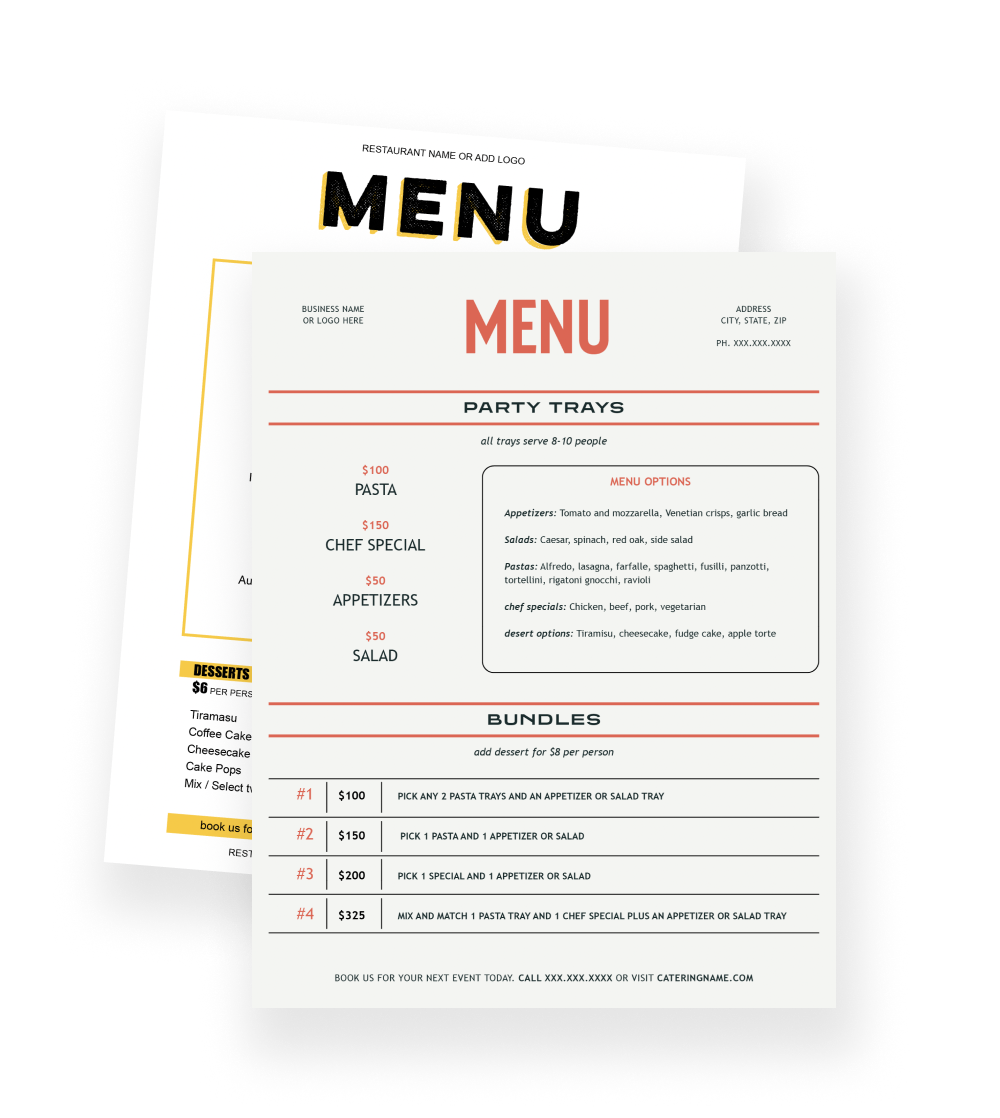
Catering Menu Templates
Use these catering menu templates as a starting point for your menu design or to give your menu a refresh.
Obtener descarga gratisA catering menu lists the dishes and packages available for group orders, along with serving sizes, prices, and service options. A well-organized menu makes it easy for customers to compare choices, order enough food, and find a package that fits their event and budget.
Behind each package, your team needs to coordinate quantities, preparation, fulfillment, and payment. Toast Catering & Events connects catering orders, event details, invoices, and payments, helping you keep that work organized from booking through payment.
Here are catering menu ideas for different occasions, with practical steps for building and pricing your packages.
Key takeaways
Catering menu ideas include boxed meals, buffet or family-style meals, build-your-own bars, finger-food platters, plated meals, and dessert trays.
A catering menu should clearly list food choices, serving sizes, prices, ordering requirements, and service options.
Catering formats should match the event, venue, guest count, and how guests will eat.
Opening a Catering Business Checklist
So many things go into opening a catering business. With this free PDF checklist, you'll set your new business up for success.

What should a catering menu include?
A catering menu should tell customers what they’ll receive, how many people it feeds, what it costs, and how to order. Clear menu descriptions help customers compare packages and give your team fewer details to explain.
“Pasta tray” leaves plenty of questions unanswered. Naming the pasta and sauce, explaining the serving count, and listing what comes with it gives customers a clearer basis for ordering.
Food and package contents: List the mains, sides, desserts, and beverages included.
Serving sizes: State how many guests each tray or package serves, distinguishing main-course portions from sides.
Prices: Explain whether you charge per person, tray, or package.
Ordering requirements: Show minimum quantities and how much advance notice you need.
Service options: Clarify pickup, delivery, setup, and staffed service.
Dietary information: Describe available choices and how customers should request accommodations.
Supplies and extras: Identify included utensils, serving equipment, and additional charges.
Catering menu ideas for different events
The right catering format depends on how guests will eat, where you’ll serve the food, and what your kitchen can prepare consistently. Someone eating between meetings needs a different setup from a guest sitting down to a formal dinner.
Package type | Example foods | Suitable occasions | Main planning consideration |
Boxed meals | Sandwiches, wraps, sides, fruit, cookies | Meetings and training sessions | Individual portions, labeling, and packaging |
Buffet trays and family-style meals | Pasta, chicken, vegetables, shared sides | Team meals and group celebrations | Quantities, serving equipment, and setup |
Build-your-own bars | Taco, rice bowl, or baked potato components | Informal parties and workplace meals | Component quantities and serving space |
Platters and finger foods | Mini sandwiches, skewers, dips, fruit | Receptions and networking events | Whether the food replaces a meal |
Plated meals | Entrées, coordinated sides, individual desserts | Formal dinners and staffed events | Staffing, equipment, and service timing |
Dessert trays and sweet tables | Brownies, cookies, mini cheesecakes | Office celebrations and meal add-ons | Portion sizes, presentation, and transport |
1. Boxed lunches and individually packaged meals
Boxed meals give each guest a complete portion and make distribution straightforward. Keep the package structure consistent, with a few choices that are easy for customers to select and your kitchen to prepare.
What to serve: A chicken wrap or chickpea salad sandwich with slaw, fruit, and a cookie. Grain bowls and entrée salads offer alternatives, with dressings packed separately.
Best for: Office meetings, training sessions, and events where guests have limited time to collect and eat their meals.
Plan for: Clear labels, an accurate count of each selection, and food that travels well. Test the complete box to see how its components hold up together.
Tocaya followed a defined package structure with its individual catering boxes introduced in 2024. Customers could choose a torta or mini burrito, chips or salad, and a cookie or fruit. That gives guests variety while keeping the offer easy to understand.
2. Buffet trays and family-style meals
Shared dishes let you serve groups through a focused selection of mains and sides. Buffet service places food at a central station, while family-style service brings shared dishes to each table.
What to serve: Baked ziti, roasted chicken, green salad, and garlic bread. Adapt the format to your cuisine with options such as barbecue and shared sides or curries with rice and vegetables.
Best for: Team lunches, group celebrations, and seated gatherings where guests can help themselves to shared dishes.
Plan for: Tested batch quantities, serving utensils, and any equipment needed at the venue. Use a kitchen prep list to assign quantities and preparation responsibilities.
The format can also shape the atmosphere. Bill Hansen of Bill Hansen Catering has described family-style meals at weddings as a way to encourage sharing and interaction among guests.
3. Build-your-own catering bars
Build-your-own bars give guests choices through a shared set of ingredients. The key is to define the package clearly enough that customers know what they’re buying and your kitchen knows what to prepare.
What to serve: A taco bar with tortillas, chicken, beans, roasted vegetables, rice, salsa, and toppings. Rice bowl and baked potato bars offer other ways to use the format.
Best for: Informal parties and workplace meals where guests want to assemble their own plates.
Plan for: Quantities for every component, separate containers, serving utensils, and enough space for the station. Consistent recipes and portion costs are essential.
Sweetgreen’s 2026 catering bar combined bases, proteins, toppings, and dressings in increments of 10 servings. It’s a useful example of offering ingredient choices within a standardized package size.
4. Sandwich platters, appetizers, and finger foods
Appetizers, platters, and finger foods suit gatherings where guests want to mingle. Before deciding on quantities, establish whether the order provides light refreshments or replaces a meal.
What to serve: Mini sandwiches, vegetable skewers, hummus with pita, and a fruit platter.
Best for: Networking events, receptions, and gatherings where guests eat while standing or moving around.
Plan for: Food that’s comfortable to pick up or eat from a small plate. Consider how sauces and garnishes will behave during transport and service.
Ask about the event’s length, timing, and other food being served. An afternoon reception with snacks and an evening gathering replacing dinner need different quantities, even with the same guest count.
5. Plated catering meals
Plated meals give each guest an individually arranged dish and let you coordinate the meal’s sequence. The food, staffing, and venue setup all need to work together.
What to serve: Mixed-green salad, roast chicken or stuffed portobello mushroom with potatoes and vegetables, and an individual dessert.
Best for: Formal dinners and events with the staff and facilities needed for table service.
Plan for: Final meal selections, preparation and plating space, equipment, staffing, and service timing. A banquet event order, or BEO, helps document those details.
The proposal should also explain whether the price includes setup, servers, tableware, and cleanup.
6. Dessert trays and sweet tables
Dessert packages can stand alone for an office celebration or accompany a larger meal. Start with sweets your team already produces consistently, then build a defined assortment.
What to serve: Brownies, cookies, and mini cakes in shared trays. Other individual dessert formats can add variety.
Best for: Office celebrations, afternoon gatherings, and customers adding a sweet finish to a meal package.
Plan for: The number and size of each piece, transport, and presentation. Explain whether desserts arrive ready to display or need arranging at the venue.
A simple format still leaves room for distinctive flavors. Abigail Kirsch’s spring and summer 2026 catering menu included raspberry-hibiscus cake bites and miso-caramel cookies.
How to build and price your catering menu
Building a catering menu means turning appealing food into packages your team can prepare, price, and deliver consistently.
Choose dishes and define your packages
Start with dishes guests already enjoy, then check how they perform in larger quantities and after transport. Use menu engineering to review popularity and profitability before deciding what to include.
Set the portions: Define serving sizes, package quantities, and minimum orders.
Limit the decisions: Specify included dishes, available substitutions, and optional upgrades.
Test the complete order: Prepare, pack, transport, and set it up as your team would for a customer.
A focused selection can make that work more manageable. Anthony Lambatos, CEO of Footers Catering, summed up his approach to refining the company’s menu: “We don’t need 10 chicken dishes; we need three great ones.”
Calculate costs and set clear prices
The ingredients are only part of the cost of a catering order. Account for the work and materials needed to get the food from your kitchen to the event.
Food and preparation: Ingredients, recipe yields, and preparation labor.
Packing and fulfillment: Containers, serving supplies, transport, and setup.
Event service: Staffing, equipment, rentals, and cleanup where applicable.
Overhead: An allocated share of rent, utilities, insurance, and administrative costs.
Then choose per-person, per-tray, or package pricing based on how customers will order. Make upgrades and additional charges clear so they can understand the total.
Keep recipe costs current as supplier prices change. xtraCHEF by Toast helps restaurants track ingredient costs and cost recipes. Customers save on average 1 to 5 hours per week using xtraCHEF.¹
Set up ordering and event coordination
Clear ordering requirements help customers plan and give your team time to prepare. Set ordering deadlines around what your kitchen can realistically handle. A package needs to work for the team preparing it as well as the customer ordering it.
Before customers order: Show lead times, minimums, pickup or delivery options, and payment expectations.
When confirming an order: Collect the date, location, guest count, menu selections, dietary requests, and service needs.
Before production begins: Confirm final quantities, assign responsibilities, and communicate changes to the kitchen and delivery or service team.
Toast Catering & Events supports digital orders, calendar views, BEOs, and invoicing, helping your team keep event details organized. The Pro tier adds custom online catering ordering, including options for longer lead times and larger minimums. Emily Sands, Private Event Sales Director at Elicit Brewing, describes the difference in booking administration:
“Since switching to Toast, I have maintained about the same amount of events monthly, but they are much less time consuming to book.”²
50-guest catering menu example
To build a budget-conscious catering menu for 50 guests, start with a focused selection, calculate portions from tested recipes, and define the service included. Baked pasta, green salad, rolls, and brownies offer one package to explore, with a protein available as an upgrade.
The table below illustrates how to translate guest count into preparation quantities. These yields are examples; use your own recipes and portion sizes for an actual order.
Menu item | Example serving size | Quantity for 50 guests |
Baked pasta | 10 main-course servings per tray | 5 trays |
Green salad | 10 side servings per bowl | 5 bowls |
Rolls | 1 per guest | 50 rolls |
Brownies | 1 per guest | 50 brownies |
Next, calculate the cost per serving and multiply by the guest count. If ingredients hypothetically cost $5 per person, 50 meals would use $250 in food. Your selling price also needs to cover labor, packaging, transport, any event service, overhead, and profit.
Turn your catering menu into bookings
Whether you’re booking full-service events or selling trays for pickup, focus on catering packages you can price confidently and execute consistently.
Once those packages become bookings, the details need to stay connected. Toast Catering & Events helps you manage that work with catering orders, event details, BEOs, and invoicing in one place.
¹ Based on a survey of 79 xtraCHEF Pro and Essentials customers from 11/2/24 to 11/29/24. Individual results may vary.
² These results are self-reported by the customer. Individual results will vary.
Restaurant Banquet Event Order (BEO) Template
This free BEO template can help your restaurant optimize incoming catering requests and streamline documentation.
FAQ
What is a catering menu?
A catering menu lists dishes and packages for group orders, including serving sizes, prices, ordering requirements, and service options.
What is a typical catering profit margin?
There’s no single standard catering profit margin. Food costs, labor, overhead, and service requirements determine how much revenue remains as profit.
How do you price catering per person?
Add food, labor, packaging, transport, service, and overhead costs. Divide the total by the guest count, then add your desired profit per person.
What are the most popular catering menu formats?
Common catering formats include boxed meals, buffet or family-style meals, build-your-own bars, finger-food platters, plated meals, and dessert trays.
How do you build a catering menu from your existing restaurant menu?
Choose popular dishes that scale well and hold up during transport. Group them into packages with clear portions, prices, and service options.


¿Es útil este artículo?
AVISO LEGAL: Esta información se proporciona solo con fines informativos generales y su publicación no constituye un aval. Toast no garantiza la precisión ni la integridad de la información, el texto, los gráficos, los enlaces y otros elementos que incluye este contenido. Toast no garantiza que alcanzarás ningún resultado específico si sigues los consejos que aparecen aquí. Te recomendamos consultar con un profesional, como un abogado, contador o asesor comercial, para recibir asesoramiento específico para tu situación.

Subscribe to On the line
Sign up to get industry intel, advice, tools, and honest takes from real people tackling their restaurants' greatest challenges.
Al enviar, aceptas recibir correos electrónicos de marketing de Toast. Trataremos tu información de acuerdo con nuestra declaración de privacidad. Información adicional disponible para residentes de California aquí.