
What Is a Good EBITDA for a Restaurant (and Does It Matter?)
A good EBITDA shows how efficiently your restaurant turns sales into profit, beyond taxes and financing. Learn how to calculate and improve yours.
Autor
 RECURSO
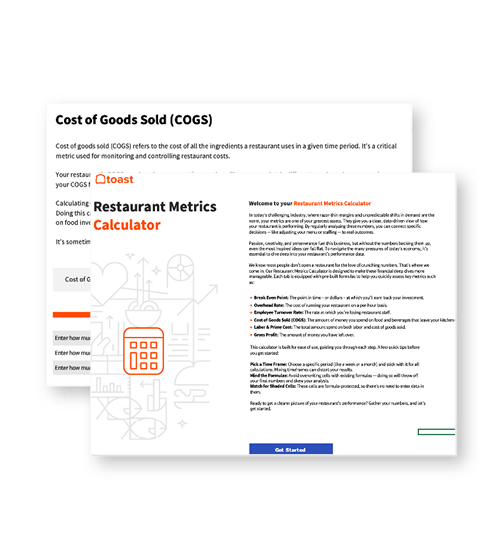
 Calculadora de métricas para restaurantes
Usa esta calculadora gratuita para calcular las métricas clave de un restaurante necesarias para comprender el estado y el éxito de tu negocio.
Obtener descarga gratisAsk most restaurant owners how business is going, and you’ll probably hear about last weekend’s sales or the cost of eggs this month. But behind the scenes, the smartest operators are paying close attention to a less flashy number: EBITDA.
It might sound like finance jargon, but EBITDA is one of the clearest ways to measure how well your restaurant is actually performing. By focusing purely on operations—before loans, taxes, and accounting quirks get involved—it helps you understand the profitability you can actually control.
Keep reading to learn what EBITDA is, how to calculate it, and why it’s worth knowing about if you want to run a more profitable restaurant.
Key takeaways
EBITDA helps measure operational profitability by stripping out financing, taxes, and non-cash expenses, giving you a clearer view of day-to-day performance.
It’s especially useful for benchmarking across restaurants with different ownership models, tax structures, or stages of growth.
Improving EBITDA is often within your control, through better labor management, pricing strategy, vendor contracts, and tech adoption.
EBITDA margins vary by restaurant type, with fast-casual concepts typically achieving higher margins than full-service or franchise operations.
It’s a strong metric—but not a complete one. Pair EBITDA with other indicators like cash flow and net profit for a more accurate financial picture.
Calculadora de métricas para restaurantes
Usa esta calculadora gratuita para calcular las métricas clave de un restaurante necesarias para comprender el estado y el éxito de tu negocio.

What is EBITDA?
EBITDA stands for Earnings Before Interest, Taxes, Depreciation, and Amortization. It’s a financial metric that measures your restaurant’s profitability based purely on operations—before factoring in financing costs, taxes, or long-term asset depreciation.
In other words, EBITDA helps you understand how well your restaurant is performing day-to-day, regardless of how it's funded or taxed.
EBITDA includes:
Revenue from food, beverages, and other sales.
Operating expenses like labor, food costs, rent, and utilities.
EBITDA excludes:
Interest payments on loans.
Income taxes.
Depreciation of equipment or property.
Amortization of intangible assets (like franchise fees or branding costs).
How is EBITDA different from net income or gross profit?
EBITDA is often viewed as a middle ground: more comprehensive than gross profit, but less affected by individual financial structures than net income.
Gross profit = Revenue minus COGS. It ignores overhead like payroll and rent.
Net income = Revenue minus all expenses, including taxes and loan payments—making it harder to compare across restaurants with different financing or ownership models.
EBITDA, by contrast, strips out those external factors so you can benchmark operational performance more consistently across locations or concepts.
Why does your restaurant’s EBITDA matter?
EBITDA is a go-to metric for understanding operational health and long-term potential. Here’s why it matters:
Simplifies comparisons: Whether you’re benchmarking against industry peers or evaluating different locations in a multi-unit operation, EBITDA helps level the playing field by stripping away variables like ownership structure or tax strategy.
Helps attract investors or buyers: Lenders, investors, and potential buyers often rely on EBITDA to gauge how profitable and scalable your business might be before committing capital.
Supports smarter decision-making: By focusing on what you can control—like labor efficiency, food cost, and rent—EBITDA helps you identify areas for improvement and assess whether changes are driving real results.
Improves loan eligibility: Banks and lenders may evaluate your EBITDA when assessing whether your restaurant can reliably service debt or expand operations.
How to calculate your restaurant’s EBITDA
Calculating EBITDA is relatively straightforward once you have your financial statements on hand. The basic formula is:
EBITDA = Net Income + Interest + Taxes + Depreciation + Amortization
Each component reflects a line item from your restaurant’s income statement or cash flow statement:
Net Income: Your bottom-line profit after all expenses.
Interest: What you’ve paid on loans or credit lines.
Taxes: Income taxes owed to local, state, and federal governments.
Depreciation: The gradual expense of wear and tear on tangible assets like ovens, refrigerators, or furniture.
Amortization: The expense of intangible assets, such as licensing fees, branding costs, or long-term leasehold improvements.
Example calculation
Let’s say your fictional restaurant has the following annual figures:
Net Income: $120,000
Interest: $15,000
Taxes: $20,000
Depreciation: $25,000
Amortization: $5,000
EBITDA = $120,000 + $15,000 + $20,000 + $25,000 + $5,000 = $185,000
In this case, your restaurant’s EBITDA is $185,000. This number gives you a clearer sense of your operating profitability—without being skewed by your financing or tax situation.
What affects your restaurant’s EBITDA?
Since EBITDA focuses on operational profitability, anything that impacts your day-to-day performance will affect this number. The good news? That means most of it is within your control. Here are the biggest factors that influence your restaurant’s EBITDA:
Cost of goods sold (COGS): Your ingredient and beverage costs directly impact margins. Rising supplier prices, food waste, or poor portion control can shrink EBITDA fast.
Labor costs: Wages, benefits, and turnover-related expenses often make up the largest share of operating costs. Overstaffing or inefficient scheduling can drag down profitability.
Menu pricing and engineering: Smart pricing and a well-designed menu can boost check averages and steer customers toward high-margin items—raising EBITDA without cutting costs.
Location and rent: Fixed costs like rent, property taxes, and utilities can vary widely. A prime location might drive traffic, but high rent can also erode your margin if not offset by strong sales.
Operational efficiency: Everything from energy use and food waste to tech adoption and kitchen workflow plays a role. The smoother your operation, the stronger your EBITDA.
Franchise or royalty fees: If you’re part of a franchise, recurring fees will reduce EBITDA. These costs are operational in nature, so they’re included in your EBITDA calculation.
What’s a good EBITDA for a restaurant?
There’s no universal EBITDA target that applies to every restaurant, but looking at raw EBITDA numbers from major chains can provide some context.
Wendy’s expects to hit $650 million to $700 million in adjusted EBITDA by 2028, fueled by new development, international expansion, and operational upgrades like its energy-efficient Global Next Gen design.
Red Robin, by contrast, reported $38.8 million in adjusted EBITDA for 2024, down 43.7% from the previous year. Despite cost-cutting efforts and improved guest traffic, the brand still posted a net loss of $77.5 million and is in the process of evaluating 70 underperforming locations.
These figures offer scale, but they don’t tell the whole story—especially for independent operators or smaller chains. That’s why many restaurant owners focus on EBITDA margin, which expresses EBITDA as a percentage of total revenue.
What is EBITDA margin?
EBITDA margin helps normalize profitability so you can compare restaurants of different sizes more accurately.
EBITDA Margin = (EBITDA ÷ Revenue) × 100
Let’s say your restaurant earns $185,000 in EBITDA on $1.2 million in annual revenue:
EBITDA Margin = ($185,000 ÷ $1,200,000) × 100 = 15.4%
This percentage makes it easier to assess how efficiently you're turning sales into profit, regardless of your restaurant’s size or structure.
For example, Shake Shack reported an adjusted EBITDA of $175.6 million on roughly $1.05 billion in revenue for 2024—an EBITDA margin of about 16.7%. That’s above average for the industry, driven by improvements in labor management, operational efficiency, and pricing strategy. They expect margins around 22% in 2025.
Restaurant industry EBITDA benchmarks
A 10%–15% EBITDA margin is generally considered healthy in the restaurant industry. Hitting this range typically signals that your restaurant is running efficiently and generating a sustainable profit. However, margin potential can vary based on the type of restaurant:
Fast-casual and quick-service restaurants (QSRs) tend to operate with leaner models—lower labor costs, smaller footprints, and streamlined menus. These efficiencies often translate into EBITDA margins at the higher end of the range.
Full-service and fine dining restaurants usually carry higher overhead. From skilled labor and premium ingredients to more expensive real estate and décor, these added costs can shrink margins—sometimes closer to 5%–10%.
Franchised restaurants often operate on thinner margins due to ongoing royalty fees, marketing fund contributions, and vendor requirements set by the franchisor. However, their access to established branding and systems can help offset these costs.
EBITDA margin expectations also shift depending on your stage of growth. Early-stage restaurants or those investing heavily in expansion may operate with lower margins temporarily as they reinvest in operations.
For instance, Sweetgreen—a fast-casual brand with a strong digital footprint—closed 2024 with an adjusted EBITDA margin of just 3%. While that might seem low, it marked the company’s first year of EBITDA profitability, improving by over $21 million from the prior year.
With 25 new restaurant openings and 16% annual revenue growth, Sweetgreen is still in a high-growth phase where profitability is emerging as scale and efficiency improve. Their 2025 outlook projects adjusted EBITDA between $32–$38 million, which would further expand their margin.
How to improve your restaurant’s EBITDA
Improving your EBITDA doesn’t require a complete overhaul—it’s all about refining what you already do, and doing it more efficiently. Here are five practical ways to boost EBITDA in your restaurant:
Reduce COGS through better vendor contracts or portion control: Reevaluate your supplier agreements and negotiate better rates when possible. In the kitchen, tighten portioning and track waste to make sure every dollar spent on ingredients ends up on the plate.
Optimize labor scheduling and reduce turnover: Labor is often your largest controllable expense. Use scheduling tools to match staffing levels to demand, and invest in retention efforts to avoid the high cost of churn.
Increase check averages with upsells or menu changes: Encourage servers to suggest add-ons like appetizers, drinks, or desserts. Review your menu regularly and highlight high-margin items that contribute more to EBITDA.
Leverage tech to reduce waste and improve efficiency: Tools like POS systems, scheduling software, and inventory management platforms help you monitor margins in real time and catch issues early.
Adjust pricing based on margin analysis: Use your sales and cost data to identify items with shrinking margins and adjust pricing accordingly. Even small tweaks—like rounding up high-cost dishes by $0.50—can make a meaningful difference over time.
Limitations of EBITDA
While EBITDA is a helpful snapshot of your restaurant’s operational profitability, it’s not a perfect metric. That’s why EBITDA should be used alongside other metrics—like net profit, cash flow, and revenue per labor hour. Here are some key limitations to keep in mind:
Ignores capital expenditures: EBITDA doesn’t account for the cost of new equipment, renovations, or other large purchases that may be necessary to keep your restaurant running or growing.
Excludes debt service: If you’ve taken out loans to fund your restaurant, EBITDA won’t show how much of your cash flow is going toward interest or principal repayments. A restaurant might have a healthy EBITDA but still struggle to meet its financial obligations.
Can mask cash flow issues: Since EBITDA doesn’t reflect when cash actually leaves your account, it may not align with your real-time liquidity. You can’t pay bills with EBITDA—you need actual cash on hand.
Doesn’t reflect owner-specific costs: Owner salaries, personal guarantees, or one-off legal or consulting fees may be significant—but are left out of EBITDA.
May overlook deferred maintenance: Restaurants with older equipment or aging facilities may look profitable on paper but could be heading for costly repairs or replacements that EBITDA doesn’t factor in.
Doesn’t work well for asset-heavy or growth-stage businesses: Marcia Williams, founder of USM Supply Chain Consulting, notes that EBITDA often overstates profitability for companies with significant fixed assets or capital needs:
“Profits are not cash… Without considering depreciation and amortization, companies with significant fixed assets will be overstating earnings. The only context that EBITDA applies is for mature businesses with little or no capital.”
EBITDA is a solid side dish, but not the full meal
By stripping away financing and tax complexities, EBITDA lets you focus on what really matters: day-to-day performance. Whether you’re running a neighborhood bistro or scaling a multi-unit chain, tracking and improving your EBITDA can help you make smarter decisions, attract investors, and build a more resilient business. Just remember: it’s not the whole story. Use EBITDA alongside other metrics like cash flow, net profit, and labor efficiency to get the clearest picture of your restaurant’s financial health.
¿Es útil este artículo?
AVISO LEGAL: Esta información se proporciona solo con fines informativos generales y su publicación no constituye un aval. Toast no garantiza la precisión ni la integridad de la información, el texto, los gráficos, los enlaces y otros elementos que incluye este contenido. Toast no garantiza que alcanzarás ningún resultado específico si sigues los consejos que aparecen aquí. Te recomendamos consultar con un profesional, como un abogado, contador o asesor comercial, para recibir asesoramiento específico para tu situación.
 Tendencias


Subscribe to On the line
Sign up to get industry intel, advice, tools, and honest takes from real people tackling their restaurants' greatest challenges.
Al enviar, aceptas recibir correos electrónicos de marketing de Toast. Trataremos tu información de acuerdo con nuestra declaración de privacidad. Información adicional disponible para residentes de California aquí.