
Restaurant Market Research: Your Complete Guide To Opening With Confidence
From target demographics to financial projections, here’s how to conduct effective restaurant market research before you open.

Autor
 RECURSO
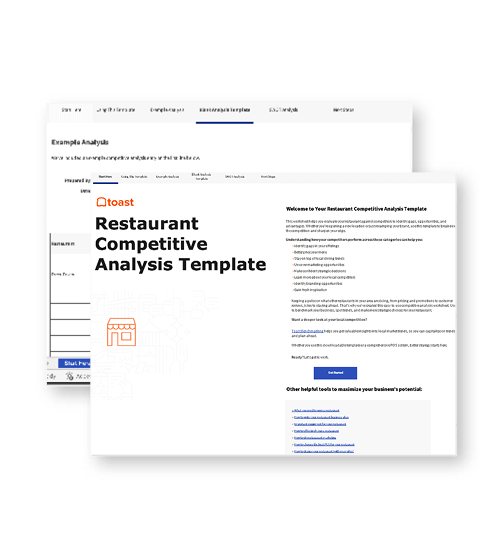
 Plantilla de análisis competitivo de restaurantes
Usa esta plantilla gratuita para evaluar a tus competidores, analizar tu mercado e identificar los puntos fuertes de tu restaurante, todo en un solo lugar.
Obtener descarga gratisOpening a restaurant without proper market research is like cooking blindfolded — you might get lucky, but the odds are stacked against you. With 1 in 3 restaurants failing within their first year, comprehensive market research becomes your roadmap to success. This guide provides actionable steps to analyze your market, understand your customers, and position your restaurant for profitability.
Key takeaways
Set clear, measurable research goals to guide every decision and avoid wasted effort.
Analyze target demographics, psychographics, and local growth trends to understand your market.
Study competitors and locations to identify market gaps and maximize customer potential.
Test your concept through small-scale pilots to validate demand and refine your strategy.
Start with clear research objectives
Establish specific, measurable goals
Before diving into data collection, establish specific, measurable goals for your research. Vague objectives lead to scattered information that won't inform critical business decisions. Your research should answer fundamental questions about viability, competition, and customer demand that will determine whether your concept can succeed.
Define exactly what you need to learn
Are you validating a restaurant concept, choosing between potential locations, or determining optimal pricing strategies? Market research helps 95% of businesses see positive ROI, making this initial clarity essential for meaningful results.
Write down key questions
List the questions your research must answer before you can confidently move forward. Examples include:
Target demographic: Size and spending power
Competitor analysis: Pricing strategies and market positioning
Peak dining patterns: Seasonal trends and busiest times
For example, if you’re considering opening a family-friendly pizza restaurant, your research might focus on how many families live in the area, how often they dine out together, and what they typically spend. These insights directly shape your pricing and positioning strategy.
Concrete objectives will guide every aspect of your research process and ensure you gather actionable intelligence rather than general market information.
Plantilla de plan de negocio para restaurantes
No importa en qué punto de tu recorrido como dueño de restaurante estés, el plan de negocio será tu estrella guía. Organiza tu visión y asegúrate de no pasar nada por alto con esta plantilla gratuita.

Understand your target market demographics
Know who will eat at your restaurant
Demographics, psychographics, and behavioral patterns determine everything from menu pricing to marketing channels, making this analysis crucial for strategic decision-making.
Start with basic demographic analysis
Use U.S. Census data and the Census Business Builder for your target area. Focus on age distribution, household income levels, family composition, and population density. These factors directly influence dining frequency, spending patterns, and cuisine preferences in your market.
Move beyond basic demographics
Look at psychographic data that reveals lifestyle preferences, values, and dining motivations. Recent trends show younger demographics prefer health-conscious options, while working professionals prioritize convenience and speed of service. Use online surveys, focus groups, and observational research to gather this behavioral intelligence that competitors often overlook.
Consider demographic shifts and growth patterns
Watch for new residential developments, office complexes, or university expansions that could significantly change your customer base over the next few years. Understanding these trends helps you position your restaurant for sustained growth rather than short-term gains.
For example, if you’re planning to open a fast-casual Mediterranean spot, your research might reveal a large population of young professionals in the area who value healthy, quick meals — along with new apartment developments nearby that signal long-term growth in your target customer base.
Analyze your competition systematically
Understand the impact of your competitive landscape
Your competitive landscape directly impacts your restaurant's potential success and profitability. Systematic competitor analysis reveals market gaps, pricing strategies, and operational best practices you can leverage while identifying potential threats to your concept.
Map all direct and indirect competitors
Direct competitors offer similar cuisine and service style, while indirect competitors compete for the same dining occasions or customer segments. Include high-end grocery chains with prepared meal options as indirect competition, since they increasingly compete for convenience-focused dining occasions.
Visit and observe competitors
Check out competitors during different times and days to assess:
Customer volumes and peak hours: Identify their busiest periods.
Demographics and group sizes: Note who’s dining there and in what numbers.
Service patterns and wait times: Observe speed, efficiency, and staff interactions.
Pricing structures and menu offerings: Compare prices and variety.
Portion sizes and food quality: Gauge value and consistency.
Document findings and review online feedback
Record your observations systematically, then check Google, Yelp, and social media reviews to understand customer satisfaction and identify common complaints that present opportunities for differentiation.
Create a SWOT analysis for each major competitor
Assess their strengths, weaknesses, opportunities, and threats. This framework helps pinpoint market positioning opportunities and operational strategies that could set your restaurant apart.
Study marketing and social media strategies
Look at how successful competitors promote themselves. With 72% of restaurateurs using Facebook for marketing, social media analysis can reveal effective strategies for engaging customers.
For example, if you’re opening a neighborhood café and notice that nearby coffee shops have long wait times during the morning rush and poor online reviews for customer service, you could position your business around faster service and friendlier staff — turning competitor weaknesses into your competitive advantage.
Plantilla de análisis competitivo de restaurantes
Usa esta plantilla gratuita para evaluar a tus competidores, analizar tu mercado e identificar los puntos fuertes de tu restaurante, todo en un solo lugar.
Evaluate location and trade area potential
Recognize the power of location
Location often determines restaurant success more than any other factor. Thorough trade area analysis is essential for site selection and concept validation. Understanding traffic patterns, accessibility, and demographic concentration around potential sites helps predict customer volume and revenue potential.
Define your trade areas
Break your market into three zones based on driving distance and customer behavior:
Primary trade area: Generates 65% to 75% of customers within a 3 to 5 minute drive.
Secondary trade area: Contributes 15% to 25% of customers from 5 to 10 minutes away.
Tertiary trade area: Provides remaining customers from longer distances, often for special occasions or unique offerings.
Analyze accessibility factors
Consider elements that directly impact customer traffic:
Vehicle and pedestrian traffic patterns: Gauge visibility and activity levels.
Public transportation access: Check proximity to transit stops.
Parking availability: Ensure spaces are sufficient and convenient.
Physical barriers: Identify highways, construction, or difficult intersections that may limit access.
Visibility and signage opportunities: Look for locations with strong exposure from main roads.
Factor in current and future changes
Assess both present patterns and planned infrastructure developments that could alter accessibility and customer flow in the future.
Study the demographic composition
Use mapping tools to overlay population density, income levels, age distributions, and lifestyle segments within each trade area. This spatial analysis shows whether enough target customers live within practical driving distances and helps predict market reach for different customer segments.
For example, if you’re considering opening a family-style restaurant, your analysis might show that one potential location has heavy evening traffic, ample parking, and growing residential developments nearby — while another location is more central but harder to access, helping you clearly see which site offers stronger long-term potential.
Gather primary research through direct customer feedback
Understand the value of primary research
Primary research gives you direct insights from potential customers about their preferences, behaviors, and likelihood of choosing your restaurant. This firsthand data fills gaps that secondary research and observation cannot address while validating assumptions about customer demand.
Conduct online surveys
Target residents and workers in your trade area using platforms like SurveyMonkey or Google Forms. Focus on collecting quantifiable data about:
Dining frequency: How often people eat out.
Preferred cuisines: Styles and flavors they’re most interested in.
Price sensitivity: Willingness to pay for certain types of meals.
Service expectations: Speed, friendliness, and convenience preferences.
Distribute questionnaires through social media, local online groups, and email lists to reach representative sample sizes for statistically meaningful results.
Organize focus groups
Bring together 8 to 12 participants representing your target demographics to uncover deeper motivations and preferences that surveys can’t capture. Focus groups reveal underlying attitudes and decision-making factors that influence dining choices. Present your restaurant concept, menu ideas, and pricing to gather honest reactions and improvement suggestions.
Document and analyze participant data
Record demographic details from all participants, including age, gender, income bracket, and dining habits, to ensure your sample matches your target market. Record sessions for later review and look for patterns in responses that highlight important market insights or unmet customer needs your restaurant could address.
For example, if your survey results show that most local residents dine out two to three times a week but focus group participants say they struggle to find affordable, healthy options, you’ll know there’s demand for a concept that balances nutrition with value — insights you couldn’t have gathered from secondary research alone.
Apply industry trends to your local market
Understand the importance of industry trends
Keeping up with broader industry trends helps position your restaurant concept within current market dynamics and reveals opportunities competitors may overlook. Data and projections also provide valuable context for local market conditions and help validate your concept’s viability.
Research authoritative sources
Consult resources like Toast's restaurant trend reports and the National Restaurant Association's State of the Industry report. The restaurant industry is projected to reach $1.5 trillion in sales, indicating continued growth opportunities for well-positioned concepts.
Focus on relevant trends
Pay attention to trends that align with your concept and target market:
Plant-based options: The vegan fast-food market is projected to reach $161.6 billion by 2032.
Technology adoption: Continues to accelerate, with 95% of restaurateurs saying tech benefits business growth.
Health-conscious dining and experiential concepts: Increasingly popular among younger demographics.
Off-premises dining: Remains key for convenience-focused customers.
As industry demands evolve, chefs and owners are expected to adapt far beyond the kitchen. Chef D’Andre Carter, owner of Soul & Smoke, explains, “Being a chef these days is not just about cooking the food. You've got to learn how to work with technology. You have to learn. You have to be comfortable with social media. You have to be a mentor. You have to be a community activist. [There are] so many different layers of being a chef in today's world. It shows that the industry is growing and evolving.”
Calculate realistic financial projections
Use industry benchmarks alongside your local market data to build accurate forecasts:
Startup costs: Average restaurant startup costs reach $375,000, requiring detailed capital planning.
Revenue per available seat hour (RevPASH): Estimate sales based on seating capacity, operating hours, and projected customer volume.
Scenario planning: Develop conservative, realistic, and optimistic projections to assess risks and opportunities.
Operating expenses: Factor in monthly costs, break-even timelines, and cash flow expectations.
For example, if you’re opening a fast-casual restaurant, applying national trends to your local market might reveal that younger diners in your area value plant-based meals and mobile ordering options. Combining that insight with financial benchmarks like average startup costs and realistic sales projections helps you design a concept that feels current while staying financially sustainable.
Test and validate your concept
Start small before launching
Before committing to a full restaurant launch, test your concept through smaller-scale pilot programs that provide real-world validation of your research findings. These trials offer invaluable insights, minimize financial risk, and allow for concept refinement.
Explore flexible testing options
Consider pop-up events, food truck operations, or catering services to test menu items and gather direct customer feedback. These approaches let you validate demand without major capital investments while building brand awareness in your target market.
Monitor key performance metrics
Track critical data during pilot programs to confirm your assumptions:
Sales data and average ticket sizes: Gauge revenue potential.
Customer satisfaction scores and feedback: Measure experience quality.
Repeat business rates and customer retention: Assess long-term appeal.
Operational efficiency and service speed: Identify workflow improvements.
Food costs and waste management: Maintain profitability and reduce loss.
Refine based on real behavior
Use trial results to adjust pricing strategies, portion sizes, and service processes based on actual customer behavior rather than research assumptions. Document all findings to guide final business plan adjustments and avoid costly mistakes in full-scale operations.
Turn research into strategy
Transform your insights into a concrete implementation plan for your opening and early operations.
Unique value proposition: Address market gaps and validated customer preferences.
USP (unique selling proposition): Differentiate your restaurant from competitors.
Menu and pricing strategies: Align with demographic insights and customer feedback.
Marketing approach: Build campaigns around research-validated customer behaviors — note that 61% of delivery customers consider loyalty programs when choosing restaurants, making them a strong acquisition tool.
For example, if you launch a weekend pop-up and find that customers consistently order one particular dish, provide feedback about portion sizes, and return the following week with friends, those insights validate demand, highlight adjustments you can make before opening, and give you confidence in refining your menu and marketing strategy.
Final thoughts
Restaurant market research isn’t just a box to check before opening — it’s the foundation for every decision you make, from choosing a location to setting your menu prices. By following these steps, you’ll enter the market with clarity, confidence, and a plan grounded in real data rather than guesswork.
The most successful restaurateurs don’t just research once — they keep learning, listening, and adjusting as the market evolves. Start with the right insights, and you’ll be in a far better position to turn your vision into a thriving, long-lasting business.
Frequently asked questions
How long should restaurant market research take?
Comprehensive market research typically takes 4 to 8 weeks, depending on scope and complexity. Budget additional time for focus groups, surveys, and detailed location analysis. Rushing research increases the risk of missing critical insights that could prevent costly mistakes later.
What's the difference between market research and a feasibility study?
Market research gathers information about customers, competition, and market conditions. A feasibility study analyzes whether your specific restaurant concept can succeed financially in your chosen market, using that research data to make go/no-go recommendations.
How much should I budget for professional market research?
Professional restaurant feasibility studies typically cost $5,000 to $25,000, depending on scope and location complexity. DIY research can be conducted for under $2,000 using online tools, surveys, and public data sources, though professional expertise often provides more actionable insights.
Should I research multiple locations simultaneously?
Yes, if possible. Comparing multiple locations provides better decision-making data and helps identify the most promising opportunity. Since location often determines success more than concept, comparative analysis proves valuable for risk mitigation.
How often should I update my market research?
Conduct major research updates annually or when considering significant changes like menu overhauls or expansion. Monitor competitors and industry trends quarterly to stay current with market shifts, since consumer preferences evolve rapidly in today's dynamic market environment.


¿Es útil este artículo?
AVISO LEGAL: Esta información se proporciona solo con fines informativos generales y su publicación no constituye un aval. Toast no garantiza la precisión ni la integridad de la información, el texto, los gráficos, los enlaces y otros elementos que incluye este contenido. Toast no garantiza que alcanzarás ningún resultado específico si sigues los consejos que aparecen aquí. Te recomendamos consultar con un profesional, como un abogado, contador o asesor comercial, para recibir asesoramiento específico para tu situación.
 Tendencias



Subscribe to On the line
Sign up to get industry intel, advice, tools, and honest takes from real people tackling their restaurants' greatest challenges.
Al enviar, aceptas recibir correos electrónicos de marketing de Toast. Trataremos tu información de acuerdo con nuestra declaración de privacidad. Información adicional disponible para residentes de California aquí.