
How Much Do Restaurant Owners Make in 2026?
The honest answer is "it depends," so here's exactly what it depends on: what restaurant owners really take home, and how your margins, structure, and season shape your paycheck.

Autor
 RECURSO
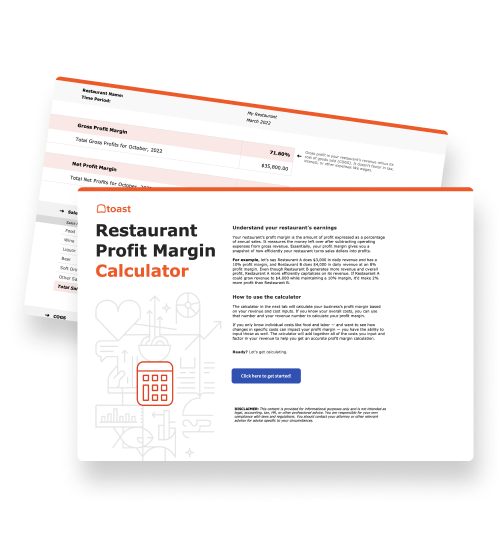
Calculadora de margen de ganancia para restaurantes
Esta calculadora gratuita de margen de ganancia para restaurantes te ayudará a determinar con qué nivel de eficiencia estás transformando tus ingresos por ventas en ganancias.
Obtener descarga gratisRestaurant owners can earn a salary for their work, receive income from business profits, or both, depending on the business structure. How much they make depends on the restaurant’s performance, their ownership share, and how much cash the business needs to keep running.
Figuring out what to pay yourself starts with understanding those expenses, including the cost of your team. Toast Payroll connects employee hours, tips, and payroll records, making compensation costs easier to review alongside your other financial commitments.
Here’s what restaurant-owner earnings data shows, how salary differs from profit, and how to plan pay your business can support.
Key takeaways
Restaurant owner income depends on profitability, ownership share, responsibilities, and available cash.
Business earnings benchmarks are not the same as an owner’s salary or take-home pay.
Your business structure determines whether salary, draws, or distributions are appropriate.
Base your pay on the work you perform and what the restaurant can consistently afford.
Leave enough cash for operating expenses, debt payments, reinvestment, and slower months.
Plantilla de estado de resultados para restaurantes
Evalúa las fortalezas y debilidades financieras de tu restaurante con la plantilla gratuita de estado de resultado y pérdidas y ganancias.

How much do restaurant owners make?
Restaurant businesses sold through BizBuySell in 2025 reported median owner discretionary earnings of $126,500. That’s a useful reference point, but it isn’t an average restaurant-owner salary.
The figure measures seller’s discretionary earnings, or SDE: business earnings adjusted to include owner compensation and certain other expenses. It doesn’t tell you exactly how much an owner received in wages, took home after taxes, or could withdraw without affecting the business.
In Toast’s 2026 restaurant industry survey, 37% of operators ranked improving profitability among their top three goals.
Restaurant owner salary vs. restaurant profit
A restaurant owner’s salary pays for work performed. Restaurant profit is what remains after business expenses. Depending on the business structure, an owner may receive a salary, draws, distributions, or a combination of appropriate payment types. Keeping those categories separate is an important part of restaurant accounting:
Revenue: Money generated by sales before expenses.
Salary: Compensation for work performed, where appropriate for the business structure.
Profit: Revenue remaining after business expenses.
Draws and distributions: Money owners withdraw from the business; these are not automatically payroll expenses or equal to the current period’s profit.
For example, suppose a restaurant pays its working owner a $60,000 annual salary, included in its expenses. After those expenses, the business reports $40,000 in pretax profit.
That doesn’t automatically give the owner $100,000 to spend. The restaurant may have other owners, loan payments, equipment needs, or cash reserves to maintain. Taxes also affect the final amount available.
The IRS explains that how you pay yourself depends on your business structure. For example, an S corporation pays a working owner a reasonable salary before distributing profits, while a sole proprietor takes money out as an owner’s draw rather than a paycheck.
What affects how much a restaurant owner earns?
Two restaurants with similar sales can support very different owner incomes. What matters is how much each business retains, what the owner does, and how the remaining money is allocated.
Sales and margins: Higher revenue helps when it leaves enough after operating costs, including food, labor, rent, and other expenses.
Owner responsibilities: Running the kitchen or managing daily operations involves different work from holding a passive ownership stake.
Ownership share: Partners and investors may share profits according to their agreements.
Restaurant maturity: A new business may need to retain more cash while sales and operating routines develop.
Debt and reinvestment: Loan payments, repairs, equipment purchases, and expansion can reduce the cash available for distributions.
Seasonality: Busy months may need to help cover payroll and other obligations during quieter periods.
The opening months can be particularly tight. In Eater’s reporting, Saint-Germain co-owners Trey Smith and Blake Aguillard explained that the owners paid themselves only enough to cover personal rent during their first five to six months, while prioritizing employee pay and business expenses.
That’s one restaurant’s experience, not a standard waiting period. It illustrates why startup cash planning should account for the owner’s living needs as well as the restaurant’s bills.
How owner earnings vary by restaurant type
The type of business affects both its earning potential and the costs owners need to cover before paying themselves. A smaller operation may have lower overhead, but it can also depend more heavily on the owner’s daily work.
Business type | What shapes owner earnings |
Guest volume, average check size, food and labor costs, rent, and service model | |
Customer volume, average order size, staffing, rent, and the mix of drinks and food sold | |
Production labor, ingredient costs, unsold products, and the balance of retail, custom, and wholesale orders | |
Location, event bookings, seasonality, commissary fees, and vehicle operating costs |
How to decide what to pay yourself
Start with two questions: What work do you perform, and what can the restaurant consistently afford? A reasonable compensation plan considers both.
Hospitality accountant Stephanie O’Rourk put it this way in an Eater interview: “Your salary should be determined by what you do to serve the organization based on the current market.” Use that principle alongside the restaurant’s financial position:
Value your role: List your responsibilities and consider what hiring someone to perform that work would cost.
Review profit and cash flow: Look beyond the bank balance. Use cash-flow projections to account for expected receipts, payroll, supplier payments, taxes, debt payments, and other upcoming obligations.
Protect operating cash: Leave room for slower periods, repairs, and planned investments. For new restaurants, include these needs in the startup and working-capital budget.
Confirm the payment method: Work with an accountant to determine whether salary, draws, or distributions are appropriate for your business structure and circumstances.
Review regularly: Revisit owner compensation as responsibilities and financial performance change. Toast IQ lets you ask plain-language questions about sales, labor, and menu performance, helping you investigate changes before deciding whether the business can support higher owner pay.
Plan for your paycheck
Industry earnings figures give you a starting point, but your restaurant’s numbers tell you what you can pay yourself. Build that pay into your plans alongside employee wages, everyday expenses, and money set aside for slower months.
Keeping those costs organized makes the decision easier. Toast Payroll connects employee hours, tips, and payroll records so you can spend less time pulling compensation details together. Alongside your other financial records, that helps you see what the restaurant can afford now—and when there’s room to give yourself a raise.
Calculadora de métricas para restaurantes
Usa esta calculadora gratuita para calcular las métricas clave de un restaurante necesarias para comprender el estado y el éxito de tu negocio.
FAQ
How much does a small restaurant owner make?
A small restaurant owner’s income varies with profitability, ownership share, responsibilities, and the cash needed to keep the business running.
Do restaurant owners make more than their employees?
Not always—owners may earn less than employees during startup or slow periods when the business has limited cash available.
What's the difference between gross revenue and net profit for a restaurant owner's salary?
Gross revenue is sales before expenses, while net profit is what remains after expenses; neither automatically equals the owner’s salary or take-home pay.
How do restaurant owners decide how much to pay themselves?
Owners should consider the market value of their work, available cash, upcoming expenses, and the payment method appropriate for their business structure.
¿Es útil este artículo?
AVISO LEGAL: Esta información se proporciona solo con fines informativos generales y su publicación no constituye un aval. Toast no garantiza la precisión ni la integridad de la información, el texto, los gráficos, los enlaces y otros elementos que incluye este contenido. Toast no garantiza que alcanzarás ningún resultado específico si sigues los consejos que aparecen aquí. Te recomendamos consultar con un profesional, como un abogado, contador o asesor comercial, para recibir asesoramiento específico para tu situación.
 Tendencias



Subscribe to On the line
Sign up to get industry intel, advice, tools, and honest takes from real people tackling their restaurants' greatest challenges.
Al enviar, aceptas recibir correos electrónicos de marketing de Toast. Trataremos tu información de acuerdo con nuestra declaración de privacidad. Información adicional disponible para residentes de California aquí.