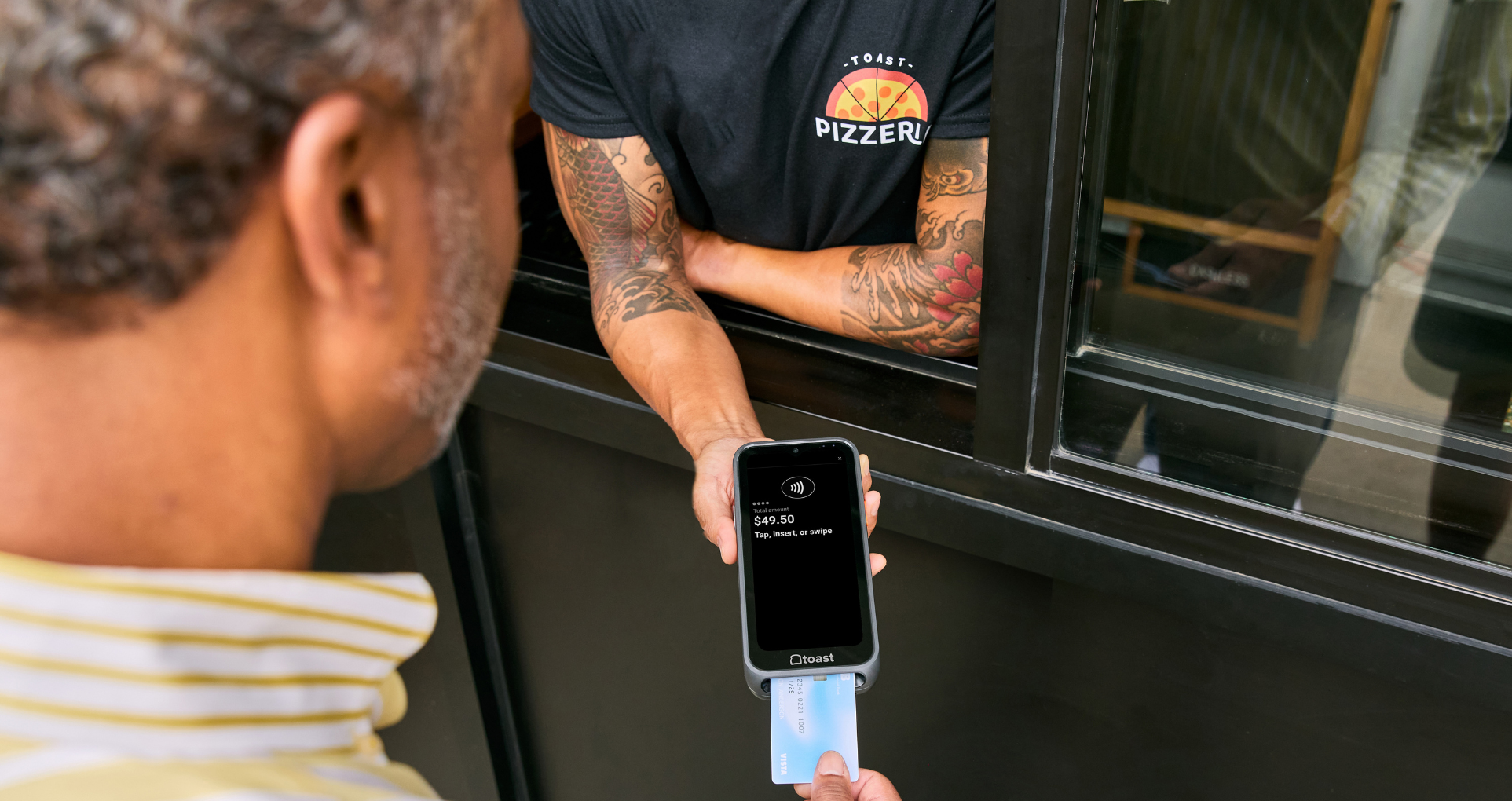
Introducing a Fully Connected, All-in-One Handheld POS
See what a fully connected, all-in-one handheld POS really means for UK restaurants and why it’s becoming core infrastructure.
Author
Handheld devices are moving from peripheral tools to something closer to operational infrastructure. They are no longer just helping service happen faster. They are increasingly shaping how service is structured in the first place.
This shift matters because of the pressure UK operators are under. According to Toast’s Voice of the UK Restaurant Industry report, 48% of restaurants identify profitability as their biggest challenge, while 80% say inflation continues to impact their business. At the same time, 77% of UK diners are more focused on value for money than ever before. In that environment, consistency and control become as important as speed.
This is where the idea of a fully connected, all-in-one handheld POS starts to take on a different meaning.
The shift from tools to infrastructure
The phrase “fully connected” is often used loosely, but in a restaurant context it describes something very specific. It refers to how well different parts of the operation stay aligned in real time.
In a disconnected setup, service gets broken up. An order might be taken at the table, re-entered at a terminal, and then interpreted again in the kitchen. Payment happens later, often through a separate step, and reporting lives somewhere else entirely. Each of those handoffs adds friction, and with it, the potential for things to go wrong.
A fully connected system brings those moments together. Orders, payments, menu updates, and kitchen workflows move through one continuous flow. The handheld becomes the point where it all happens, not just a quicker way to take an order.
That’s where the real tension sits. You need to move quickly, especially when the restaurant is full, but the faster things move, the easier it is for mistakes to slip in. At the same time, guests expect everything to feel smooth and considered. The challenge isn’t just speed. It’s staying accurate and consistent when the pressure is on.
Why this shift is happening now
Several forces are converging in the UK hospitality sector, making this shift more urgent.
Economic pressure is forcing operators to extract more value from existing locations rather than expanding. Only 36% of UK restaurants say they are very likely to expand this year, down from previous years, while increasing revenue at existing sites has become a top priority (source: Voice of the UK Restaurant Industry report). That puts operational efficiency under the spotlight.
At the same time, labour constraints are reshaping how service is delivered. The issue is not just staffing levels, but how work is structured during a shift. As many operators have found, asking teams to move faster within the same fragmented systems tends to increase stress rather than improve outcomes.
Guest expectations are shifting. Diners are more conscious of what they spend, but they’re also quicker to notice when something feels off. A delayed dish, a corrected order, or a slow payment process can change how the entire experience is judged, even if the food itself is excellent.
That pressure is pushing operators to look for more consistency in how service runs. Systems that reduce variation from one table to the next are becoming more important. Fully connected handheld POS sits at the centre of that shift because it keeps information moving smoothly across the whole operation.
What “all-in-one” actually means in practice
The “all-in-one” aspect is less about having multiple features on a device and more about removing the need to move between systems.
In a traditional setup, front-of-house and back-of-house tend to run alongside each other rather than together. Servers take orders, kitchens interpret tickets, and managers piece everything together afterwards through reports. It works, but it depends heavily on good communication and experienced teams.
An all-in-one approach brings those parts into a single flow. Orders go straight from the table to the kitchen without being re-entered. Menu updates appear instantly across every device. Payments happen in the same moment and place as service, rather than as a separate step.
This does not remove complexity from the operation, but it changes where that complexity sits. Instead of being managed through human coordination, it is handled by the system itself.
That shift introduces another tension. The more the system handles, the more important reliability becomes. If connectivity drops or devices fail, the impact is immediate.
This is why connectivity has become a defining feature of modern handheld POS.
Connectivity as operational resilience
One of the less visible but most critical aspects of a fully connected system is how it handles connectivity.
Many restaurants still rely on Wi-Fi as the backbone of their POS environment. In practice, that creates blind spots. Outdoor seating areas, older buildings, and peak service loads can all introduce instability.
Newer handheld systems are built to go beyond the limits of Wi-Fi alone by combining it with cellular connectivity. This allows devices to switch between networks seamlessly, so service can continue even if one connection drops.
Devices like the Toast Go® 3 have built-in cellular connectivity, offline capabilities, and cross-network printing. The device is designed to maintain operational flow even when conditions are less than ideal.
The impact isn’t just technical. It changes how confident your team feels during a shift, especially when things get busy. When staff trust that orders will go through, that payments will process, and that tickets will reach the kitchen without delay, they can focus on the guest rather than the system.
Reframing handheld POS through real operations
To see how this shift shows up in practice, it helps to look at how UK operators are changing the way their teams work.
At Riding House Café in London, the challenge wasn’t just about speed. It was about keeping multiple locations aligned. Their previous system made menu updates difficult and created gaps between front-of-house and kitchen, leading to delays and inconsistencies during service. After moving to a more integrated system, menu changes could be pushed instantly, and order flow between front-of-house and kitchen became more reliable.
At Urban Leisure Group, reliability itself was the issue. Frequent crashes and payment failures were disrupting service and creating revenue loss. With a more stable, integrated setup, the group reported a significant reduction in support issues and improved service continuity.
In both cases, the shift was not about adding new capabilities. It was about removing friction from existing processes.
That distinction is important. Fully connected handheld POS is not introducing a new way of running a restaurant. It is allowing operators to execute their existing model more consistently.
The role of real-time intelligence in service
As systems become more connected, they also become more informative. Real-time data is no longer confined to end-of-day reports. It is increasingly part of the service itself.
This is where the concept of real-time intelligence enters the conversation. Rather than analysing performance after the fact, systems can surface insights during service. Suggestions for menu pairings, prompts for modifiers, and visibility into kitchen timing all become part of the workflow.
There is a balance to strike here. Too much automation risks overwhelming staff or diluting the human element of service. Too little leaves teams reliant on memory and experience alone.
The most effective implementations tend to sit in the middle. They support staff without replacing their judgement. They reduce cognitive load rather than adding to it.
The operational trade-offs operators are navigating
The rise of fully connected handheld POS highlights several trade-offs that UK operators are actively managing.
There’s a constant balance to manage between efficiency and hospitality. Technology can take friction out of service, but it shouldn’t make the experience feel mechanical or impersonal.
There’s also a balance between automation and control. Systems can take on more of the day-to-day workload, but operators still need clear visibility into what’s happening and the ability to step in when needed.
And then there’s the balance between investment and return. With margins under pressure, every technology decision has to prove its value, whether that’s through time saved, fewer errors, or more consistent revenue.
These are not new tensions, but they are becoming more visible as technology moves closer to the centre of operations.
What this means for the future of UK hospitality
The idea of a fully connected, all-in-one handheld POS isn’t really about a single device. It’s about the direction the industry is moving in.
Restaurants are shifting toward systems that are more connected, more reliable, and able to respond in real time. The handheld just makes that shift visible, because it sits right where service actually happens.
For operators, the question is no longer whether handheld POS can improve speed or accuracy. It is how connected their operation needs to be to deliver consistent value in a more demanding market.
According to our Voice of the UK Restaurant Industry report, 69% of UK restaurants plan to increase their technology spend in the next 12 months. That suggests this shift is not slowing down.
What will matter is not just adopting new tools, but understanding how those tools reshape the way a restaurant runs.
In that context, a fully connected, all-in-one handheld POS is not just a piece of hardware. It is a signal of how the industry is redefining the relationship between service, systems, and the guest experience.
Where Toast Go® 3 fits into this shift
The Toast Go® 3 handheld is designed specifically around this idea of connection.
Rather than acting as a standalone device, it functions as part of a fully integrated platform that links front-of-house, back-of-house, payments, and reporting into a single workflow.
Its ability to switch seamlessly between Wi-Fi and cellular networks addresses one of the most common friction points in restaurant environments: unreliable connectivity. In practice, this means service can continue uninterrupted across dining rooms, terraces, and multi-floor venues.
Orders go straight to the kitchen in real time, exactly as they’re entered. Menu updates appear instantly across the system. Payments can be taken at the table without extra steps, including contactless and mobile wallet options.
Beyond these core workflows, tools like real-time insights and automated prompts help guide staff during service. They support better decisions in the moment, without making the process feel more complicated.
From a hardware perspective, the device is built for the realities of hospitality, with durability designed to handle spills, drops, and long shifts, alongside a battery life that supports extended service periods.
Taken together, these elements elevate the handheld beyond a tool. It becomes part of the infrastructure that underpins consistent, confident service every day.

Bring service closer to your guests
Toast Handheld POS helps your team take orders and payments right at the table, keeping service fast, accurate, and personal across every shift.

Is this article helpful?
DISCLAIMER: This information is provided for general informational purposes only, and publication does not constitute an endorsement. Toast does not warrant the accuracy or completeness of any information, text, graphics, links, or other items contained within this content. Toast does not guarantee you will achieve any specific results if you follow any advice herein. It may be advisable for you to consult with a professional such as a lawyer, accountant, or business advisor for advice specific to your situation.

Subscribe to On the line
Sign up to get industry intel, advice, tools, and honest takes from real people tackling their restaurants' greatest challenges.
By submitting, you agree to receive marketing emails from Toast. We’ll handle your info according to our privacy statement. Additional information for California residents available here.