What is a SKU Number? Your Guide to “Stock Keeping Units” in 2025
Keeping track of product variations can get complicated, but SKU numbers can help. Learn what SKUs are and how to use them for your retail business.
작성자
 RESOURCE
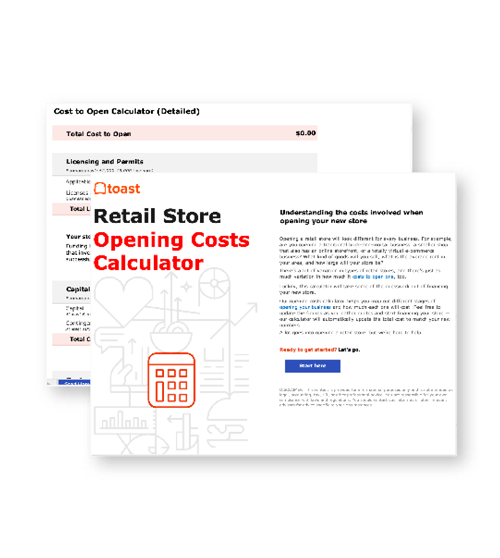
Retail Store Opening Costs Calculator
This free calculator lays out some of the fundamental financial costs of opening a retail store, so you can start planning and bring your dream business to life.
무료 다운로드 받기Running a retail business often means juggling hundreds—or even thousands—of moving parts. SKU numbers help bring order to the chaos. These customizable codes act like internal labels for every product variation you sell, making it easier to track inventory, spot trends, and keep your shelves stocked.
Whether you operate a boutique or a big-box store, SKUs are essential for staying organized. In this guide, we’ll break down what SKU numbers are, how they work, and how to make the most of them.
Key takeaways
SKU numbers are internal labels retailers create to track product variations like size, color, and brand.
They help streamline inventory management, sales tracking, restocking, and forecasting.
SKUs differ from barcodes, UPCs, serial numbers, and lot numbers, each of which serves distinct tracking purposes.
Real-world retailers use SKUs to manage complexity, prevent counterfeits, and improve operations—from Apple to Adidas.
A smart SKU system starts with structure: keep formats simple, consistent, and supported by your POS or inventory tools.
Restaurant Opening Calculator
This calculator lays out some of the fundamental financial costs of opening a restaurant, so you can start planning and bring your dream restaurant to life.

What is a SKU number?
A SKU number—short for Stock Keeping Unit—is a unique internal code that retailers assign to individual product variations. For example, a red hoodie in size medium will have a different SKU than the same hoodie in blue or large.
Retailers create SKU numbers to streamline product tracking, sales analysis, and inventory management. These codes aren’t standardized across businesses—each store designs its own system based on what matters most, whether it’s brand, size, color, or another feature. Think of SKUs as shorthand for your products—designed by you, for your team.
SKU number vs. UPC number
A UPC (Universal Product Code) is a standardized, manufacturer-assigned barcode used across all retailers. It’s what you scan at the register and what identifies a product universally—whether it's sold at your store or across the country.
A SKU number, on the other hand, is created by your business and used only within your internal systems. It helps you differentiate between products in ways a UPC can’t—such as tracking sales by size, color, or packaging variation. Most retailers use both:
UPCs for scanning and checkout.
SKUs for internal organization, analysis, and replenishment.
SKU number vs. barcode
A barcode is a visual, machine-readable code that stores data—often a SKU or UPC—that can be scanned for quick processing at checkout or in inventory systems.
A SKU number, on the other hand, is the internal alphanumeric label assigned by your business to identify a specific product variation. Unlike UPCs, SKUs aren’t standardized across retailers and don’t have to be included in a barcode (though they often are).
In short, barcodes are how you scan items, while SKUs are how you organize and manage them internally.
SKU number vs. serial number vs. lot number
A serial number tracks individual items—like TVs, mattresses, or other products—giving each unit its own unique identifier for warranty, ownership, or service records.
A lot number tracks a group of products that were produced or received together, commonly used for items like food, skincare, or textiles that share an expiration date or batch characteristics.
A SKU number identifies product variations for internal inventory purposes—such as a red shirt in size medium. It helps categorize and analyze product performance without tracking each unit or batch.
Why do retailers use SKU numbers?
SKU numbers are essential for organizing products and optimizing retail operations. Here’s how they benefit your business:
Inventory management: SKUs help you track stock levels by product variation, so you can avoid overstocking slow movers or running out of bestsellers.
Sales tracking: By assigning unique SKUs to each product variant (like color or size), you can analyze what’s selling—and what’s not—at a granular level.
Checkout efficiency: Scanning SKUs at the point of sale speeds up transactions and reduces human error during manual entry.
Forecasting and reordering: SKU-level sales data helps you forecast demand, plan seasonal inventory, and reorder items with precision.
Loss prevention: SKUs make it easier to identify shrinkage or discrepancies in stock, helping you catch theft, spoilage, or inventory errors before they become costly.
How do retailers use SKU numbers?
From organizing shelves to fighting counterfeits, SKU numbers quietly power all types of retailers. Let’s look at how businesses in different industries put them to work.
Electronics retailer SKUs
Electronics retailers rely heavily on SKU numbers to differentiate between a wide array of product variations. Take Apple, for example: each device category—like iPhones, MacBooks, or iPads—has multiple models, each available in different storage capacities and colors.
A single product line, such as the iPhone 16, may require distinct SKUs for the base model, Pro, and Pro Max versions, across storage tiers like 128GB, 256GB, and 512GB, and colors such as black or silver.
Big-box retailers like Best Buy take this complexity even further. In addition to Apple devices, they carry thousands of SKUs across numerous brands and categories—from Android phones and gaming consoles to smart TVs and accessories.
SKU numbers help these retailers track product availability, restock popular models, and avoid mix-ups between similar-looking devices. Without a structured SKU system, managing such a large and varied inventory would be nearly impossible.
Apparel retailer SKUs
In apparel retail, SKUs are essential for tracking products by model, size, and color. For example, Adidas assigns a unique 10-character SKU to each variation of its shoes—down to the exact design and colors. This SKU appears on both the shoebox and inside the shoe, making it easy to match the product to inventory records.
These precise identifiers aren’t just for internal use—they also help customers verify authenticity. Shoppers can search the SKU online to confirm that the product’s images and descriptions match. If the images don’t line up, it’s a red flag the item might be counterfeit.
For brands like Adidas, SKUs play a critical role in product tracking, anti-counterfeiting, and providing a consistent experience across stores and sales channels.
Food retailer SKUs
Grocery retailers often manage tens of thousands of SKUs to account for different brands, package sizes, and product variations. But sometimes, fewer SKUs mean better business.
In 2025, UK supermarket chain Asda announced plans to eliminate around 6,000 SKUs—cutting its total from roughly 30,000 to 24,000—in order to streamline operations, improve shelf presentation, and boost supplier volume per product.
By reducing “over-SKUing,” Asda aims to increase product availability and improve efficiency without relying on gimmicks or expansion. The shift highlights how SKU management isn’t just about tracking inventory—it’s also a strategic lever for optimizing retail performance.
SKUs for safety
SKU numbers are essential when precision matters most. From product listings to safety recalls, SKUs help retailers and suppliers track and identify each variation of a product quickly and accurately.
For example, in 2025, Thy Trading Company issued a recall on bamboo roll-up window blinds sold exclusively on Wayfair due to serious safety risks. To ensure an effective recall, the company listed specific SKU numbers tied to each product variation—such as color and size—including:
SKU TYCO1012 – Semi-Sheer Brown Outdoor Roll-Up Shade (Brown & Tan)
SKU TYCO1026 – Semi-Sheer Red/Brown Roll-Up Shade (Burgundy)
SKU TYCO1039 – Semi-Sheer White Roll-Up Shade (White)
With SKU-level detail, Thy Trading could communicate precisely which versions of the product were affected—making it easier for customers to identify items and request refunds.
Should your retail business use SKU numbers?
If you sell more than a handful of products—or offer variations like size, color, or brand—then yes, you should use SKU numbers.
They’re especially useful if you plan to scale, sell across multiple channels (like online and in-store), or want better insight into what’s driving your sales. Even small retailers can benefit from the added structure and clarity that SKUs provide.
Just keep in mind that more SKUs doesn’t always equate to more sales. In fact, the simpler you can keep your inventory, the better. As Rachel Dalton, head of retail insights at Kantar, explained:
“It’s really about balancing and prioritizing what’s going to kind of get to that fewer, bigger, better [strategy]... There’s a lot of strategic work that goes behind the analysis, but the idea of it is the simpler that you approach your brand and your business while still meeting your consumers’ needs, the better off you are.”
How to implement SKU numbers in your retail business
Creating a good SKU system starts with structure, simplicity, and consistency. Here’s how to get started:
Keep SKUs short, structured, and easy to read: A clear format helps avoid confusion and speeds up inventory tasks.
Use a consistent, readable naming convention: Stick to a logical structure like CATEGORY-BRAND-SIZE-COLOR (e.g., SHOE-NIKE-10-BLK) to make SKUs easy for your team to understand and manage.
Watch out for easily confused characters: If you use letters and numbers, skip characters like “O,” “I,” and “0” in positions where they could be misread—especially in longer codes or barcodes.
Keep digit lengths consistent: If you include numeric sequences (like style codes or item numbers), pad them for uniformity (e.g., 001, 002, 003). This helps with sorting and prevents confusion.
Use POS or inventory systems that support SKU generation: These tools can automate parts of the process and reduce manual errors.
Nothing compares to SKU
SKU numbers might seem insignificant, but they can make a big difference. With the right system in place, you’ll keep your inventory organized, spot trends faster, and create a smoother experience for your team and your customers. Start simple, stay consistent, and watch your business run smarter every day.
이 문서가 도움이 되었나요?
면책 조항: 이 정보는 일반 정보 제공 목적으로 작성되었으며 당사의 권고를 의미하는 것은 아닙니다. Toast는 본 콘텐츠에 포함된 정보, 텍스트, 그래픽, 링크 및 기타 항목의 정확성이나 완전성을 보장하지 않습니다. Toast는 본 문서의 조언을 따른다고 해서 특정한 결과를 얻을 수 있음을 보장하지 않습니다. 귀하의 상황에 맞는 조언이 필요한 경우 변호사, 회계사 또는 비즈니스 자문가 등 전문가와 상담하시기 바랍니다.
 트렌드