
POS Security: 9 Ways to Protect Your Restaurant POS System
From encrypted payments to theft-catching reports, here's what actually keeps a restaurant POS system secure, and how to tell if yours is doing the job.

작성자
 RESOURCE
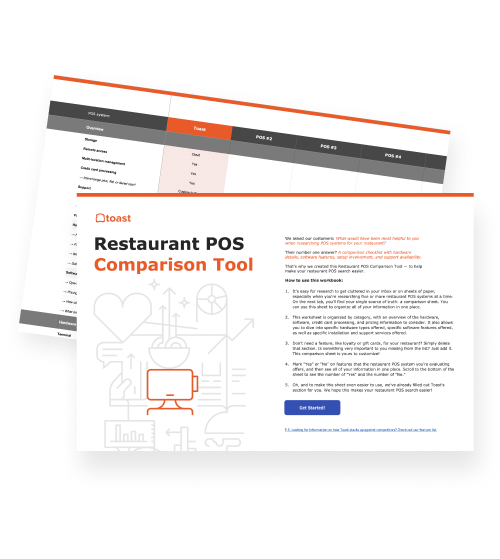
 Restaurant POS Comparison Tool
A free, customizable Restaurant POS Comparison Tool to research and compare point of sale systems in one Excel spreadsheet.
무료 다운로드 받기POS security is the combination of technology, controls, and employee practices used to protect payment data, restaurant information, transactions, and point-of-sale access. It covers everything from card encryption and PCI compliance to employee permissions, device security, software updates, and incident planning.
Because the POS connects so many parts of the operation, security is easier to manage when payments, employee activity, and reporting are not split across disconnected systems. Toast’s restaurant POS system brings those workflows together within a platform built specifically for restaurants.
This guide explains the leading POS security risks and the practical steps operators can take to protect every transaction.
Key takeaways
POS security protects payment data, restaurant records, employee access, devices, and daily service.
PCI compliance is the baseline, while encryption, tokenization, secure networks, and timely updates add broader protection.
Unique logins and role-based permissions limit access and make employee activity easier to trace.
Reviewing voids, comps, refunds, discounts, and time edits can reveal fraud or process problems early.
Toast connects payments, permissions, reporting, fraud monitoring, and offline capabilities, making POS security easier to manage.
Restaurant Incident Reporting Template
Use this free template to keep a clear, consistent record of accidents, employee issues, and guest complaints while protecting your business in the process.

What is POS security?
POS security protects every device, account, connection, and workflow involved in entering orders, accepting payments, and recording transactions. Its purpose is to prevent unauthorized access, payment-data exposure, transaction fraud, and operational disruption.
PCI compliance is one part of POS system security, but it’s not the entire picture. Restaurants must also control employee access, monitor sensitive transactions, maintain hardware and software, and prepare for disruptions.
The PLATE restaurant cybersecurity framework organizes these responsibilities around perceiving threats, limiting risk, attributing incidents, taking action, and evolving from experience.
Security area | What it protects |
Payment security | Cardholder and transaction data |
Access security | Employee and administrator accounts |
Transaction controls | Voids, refunds, comps, discounts, and cash activity |
Device security | Terminals, handhelds, kiosks, and card readers |
Network security | POS connections, routers, and restaurant Wi-Fi |
Software security | POS applications, updates, and integrations |
Business continuity | Orders, payments, records, and recovery during disruptions |
Why does POS security matter for restaurants?
A restaurant POS sits at the intersection of guest payments, employee access, sales records, and daily service. This means a security weakness can create operational and financial risks.
Guest trust: Customers expect restaurants to protect their payment and personal information.
Financial loss: Fraud, chargebacks, employee misuse, and interrupted sales can reduce already-limited margins.
Employee accountability: Individual accounts and transaction records show who completed or changed an action.
Operational continuity: An unavailable POS can interrupt ordering, kitchen communication, and payment collection.
Compliance: Restaurants that accept cards must meet the PCI DSS requirements applicable to their payment environments.
Reputation: A breach or prolonged outage can damage relationships with guests and business partners.
Common restaurant POS security threats
Restaurant POS threats can originate outside the business, through connected vendors, or from misuse of legitimate employee access. The Retail & Hospitality ISAC’s 2025 benchmark gathered input from nearly 200 cybersecurity leaders and identified ransomware, third-party supply-chain attacks, and phishing as the sector’s three leading threats.
Threat | How it can affect a restaurant |
Stolen or shared credentials | Unauthorized users can access sensitive POS functions or reports |
Phishing and social engineering | Employees may disclose credentials to someone impersonating a manager, vendor, or support representative |
POS malware and skimming | Attackers may attempt to capture payment information |
Excessive permissions | Employees can perform sensitive actions their positions do not require |
Transaction misuse | Voids, refunds, comps, or discounts may be used to conceal theft |
Device tampering | Card readers, terminals, or kiosks may be altered or replaced |
Insecure networks | Weak Wi-Fi or network controls can provide access to connected systems |
Outdated technology | Unsupported software and hardware may miss important security updates |
Vulnerable integrations | A compromised third-party connection can expose data or interrupt operations |
Card-not-present fraud | Online and phone orders carry greater verification and chargeback risks |
Connectivity or system outages | Ordering and payment workflows may stop or become difficult to reconcile |
Remember, digital security is only one part of restaurant loss prevention. Separate operational controls, such as preventing dine-and-dash incidents, address guest theft that occurs before payment is processed.
Restaurant Operations Manual Template
Use this free template to easily outline all of your operating procedures and make day-to-day operations as consistent as possible.
How to secure a restaurant POS system
Effective POS security uses several layers. A compliant payment platform protects card information, while access controls, reporting, updated equipment, and employee training protect the wider operation.
1. Choose a PCI DSS-compliant payment platform
PCI DSS establishes security requirements for organizations that store, process, or transmit payment-card information. Restaurant operators should confirm that their POS and payment provider follows the current standard. Before selecting a system, ask:
Compliance level: Is the provider a Level 1 PCI-compliant service provider?
Validation: How does the provider assess and document its compliance?
Restaurant responsibilities: Which PCI requirements must the operator complete or maintain?
Device security: Which terminals and card readers have been approved for the payment environment?
Ongoing support: How are security updates, vulnerabilities, and incidents handled?
PCI compliance provides an essential baseline, but it does not replace secure employee, device, and network practices. Toast Payment Processing is a Level 1 PCI-compliant service provider integrated with Toast POS.
2. Protect payment data throughout the transaction
Payment information should be protected from the moment the guest presents a card until the transaction is authorized and recorded. That limits the opportunity for readable card data to be intercepted or stored unnecessarily.
Encryption: Encrypt card information at the point of payment and while it moves through the payment process.
Tokenization: Replace stored card details with tokens that cannot be used as complete card numbers.
EMV and NFC: Use chip and contactless transactions instead of magnetic-stripe or manually keyed payments whenever possible.
Data storage: Do not keep complete card information in spreadsheets, paper records, or unrelated restaurant systems.
Integrated processing: Reduce the number of separate gateways and systems that handle transaction data.
Using integrated restaurant payments also keeps orders and payment records connected, reducing the manual reconciliation required after service. Toast Payments encrypts card information at the point of payment and supports tokenization, EMV chips, and NFC contactless transactions.
3. Give every employee unique POS access
Every employee should use an individual account, login, or passcode. Shared credentials prevent managers from determining who completed a transaction, changed a check, or accessed sensitive information.
Create individual accounts: Do not reuse one login across an entire position or shift.
Protect manager credentials: Employees should never borrow a manager’s code to approve a sensitive action.
Update access promptly: Disable accounts when employees leave and revise permissions when their responsibilities change.
Protect remote access: Use strong passwords and additional authentication for administrative accounts.
Connect activity to a person: Orders, payments, time clock records, and adjustments should identify the responsible employee.
Permissions should also remain consistent outside the restaurant. For example, a Toast Now user’s access mirrors their Toast Web permissions.
4. Limit permissions by job responsibility
Employees need access to the tools required for their positions—not every function available in the POS. Applying the principle of least privilege reduces opportunities for both accidental changes and intentional misuse.
Cashiers and servers: Limit access to normal order, payment, and service-recovery functions.
Shift leaders: Allow specific approvals without providing unrestricted administrative access.
Managers: Reserve refunds, post-close voids, larger discounts, and cash-management functions for appropriate leaders.
Administrators: Restrict user creation, permission changes, integrations, and financial reporting to designated employees.
Multi-location teams: Standardize sensitive settings so locations do not create inconsistent rules.
Clear comp, void, and receipt policies are an important part of preventing employee theft. Toast Multi-Location Management can also apply standardized void reasons and discount rules across restaurant groups.
SOPs Template
This template will help you create SOPs for your entire business, so you can create consistency and easily train employees.
5. Monitor employee and transaction activity
Access controls determine what employees are allowed to do. Transaction monitoring shows how those permissions are actually being used. Managers should regularly review:
Voids and deleted items: Look for unusual volume, timing, or concentration among specific employees.
Comps and discounts: Confirm that reason codes and approval requirements are being followed.
Refunds: Review the amount, payment method, employee, and original transaction.
Changed checks: Monitor checks reopened or adjusted after payment or closeout.
Receipt reprints: Investigate repeated activity that lacks a clear operational explanation.
Cash discrepancies: Compare drawer totals with cash transactions and closeout records.
Time-clock edits: Review unusual changes, repeated corrections, or activity outside scheduled shifts.
A report does not establish intent. Compare employees with similar positions and shifts, then investigate whether unusual activity reflects theft, a training issue, a system configuration problem, or legitimate service recovery.
Toast Reporting and Analytics gives operators access to transaction and operational reporting. Toast Payroll and Team Management connects POS timesheets with employee hours, breaks, tips, and job information, providing additional visibility into time and attendance records.
6. Protect POS hardware and restaurant networks
Physical devices and restaurant networks are part of the POS security environment. A secure payment platform cannot compensate for an unattended terminal, compromised router, or card reader that no one inspects.
Inspect equipment: Check terminals and card readers for unfamiliar attachments, damage, or configuration changes.
Control physical access: Store unattended handhelds securely and assign responsibility for shared devices.
Separate networks: Keep guest Wi-Fi separate from the network used by POS devices and operational systems.
Secure connections: Use strong router credentials, firewalls, and approved network configurations.
Restrict software: Do not install unapproved applications on POS terminals or restaurant tablets.
Track equipment: Maintain a current list of terminals, handhelds, kiosks, printers, and card readers.
Toast restaurant-grade hardware supports EMV and NFC transactions, while Device Hub gives operators centralized visibility into Toast terminals, handhelds, and printers. Its hardware is also designed to withstand the spills, drops, grease, and heat common in restaurant environments.
7. Keep software and integrations secure
Updates close known vulnerabilities, while integration reviews limit the number of systems and vendors with access to restaurant information. Both can be difficult to prioritize during a busy service schedule.
A 2026 VikingCloud survey of 50 security leaders, IT leaders, and franchise owners at QSR and fast-casual chains found that 78% delayed security patches to avoid disrupting service. Because the sample was small, the findings are best treated as directional rather than industry-wide estimates.
Understanding how POS integrations exchange information can help restaurants identify unnecessary or poorly controlled connections. Operators can reduce this exposure by taking several practical steps:
Install updates promptly: Do not postpone security patches indefinitely to avoid short-term downtime.
Use supported equipment: Replace hardware and operating systems that no longer receive security updates.
Remove unused access: Disconnect integrations, applications, accounts, and API connections the restaurant no longer needs.
Review permissions: Understand which information each connected product can access.
Evaluate vendors: Ask about authentication, updates, monitoring, and incident-response responsibilities.
Document ownership: Identify who will contact each vendor and disable its connection if a problem occurs.
Supported Toast equipment may receive automated software, firmware, security, and bug-fix updates under the Toast Product Lifetime Policy.
8. Protect online ordering and card-not-present payments
Online and manually keyed transactions don’t provide the same physical verification as a chip or contactless payment. That makes additional fraud controls and complete order records especially important.
Recorded Future’s 2024 Payment Fraud Intelligence Report found that restaurants were the most common merchant category among the common points of purchase identified in its 2024 analysis. It also connected a suspected breach of a restaurant ecommerce platform with stolen card records from approximately 50 merchants. Operators should watch for:
Repeated declines: Several attempts using different cards may indicate automated testing or fraudulent activity.
Unusual order values: Orders far above the restaurant’s normal check size deserve additional scrutiny.
Mismatched information: Billing, contact, and delivery details that do not align may require verification.
Rapid orders: Several transactions placed in quick succession from the same account or location can signal abuse.
Refund anomalies: Repeated refunds to different payment methods or accounts should be investigated.
Chargeback patterns: Track disputed orders by channel, reason, value, and fulfillment method.
Toast Payments uses real-time machine-learning fraud monitoring to help identify and block suspicious transactions, while Toast Online Ordering connects digital orders directly with the POS and kitchen.
9. Prepare for outages and security incidents
A response plan helps employees act quickly without improvising during a busy shift. It should distinguish an ordinary internet outage from a suspected security breach because the correct response may be different. Assign responsibility for:
Escalation: Identify who contacts the POS provider, payment processor, bank, insurer, or other partners.
Containment: Establish who can disable accounts, integrations, or affected devices.
Documentation: Preserve transaction records, system notifications, and other potential evidence.
Communication: Decide how managers will update employees, guests, and other affected parties.
Recovery: Document how the restaurant will restore service and reconcile offline activity.
Review: Record what happened and update controls, training, and procedures afterward.
Offline processing may keep service moving during an internet interruption, but employees should not continue using a device believed to be compromised. Conduct short outage and incident-response drills so the team understands the difference.
Restaurant Equipment Checklist
Opening or upgrading a restaurant? Don't miss any essential equipment! Download our free, comprehensive restaurant equipment checklist.
Make POS security easier to manage
POS security becomes harder when operators have to manage separate payment terminals, employee accounts, transaction reports, online-ordering tools, and software updates.
Every disconnected system introduces another set of permissions, records, and vendor responsibilities to oversee. Toast’s restaurant POS system connects those responsibilities within one restaurant-focused platform, combining:
Level 1 PCI-compliant payment processing with encryption
Tokenization
EMV and NFC hardware
Role-based permissions
Transaction reporting
Online-ordering fraud monitoring
Supported security updates
Offline capabilities
That connected approach gives operators fewer systems to secure and reconcile. More importantly, it helps restaurants protect guest payments, strengthen employee accountability, and keep service moving without turning security into another manual task during every shift.
FAQ
What is POS security?
POS security is the technology, controls, and employee practices used to protect payment data, restaurant information, transactions, devices, and system access.
Why are restaurants a common target for POS attacks?
Restaurants process high volumes of payment data across multiple employees, devices, ordering channels, and integrations, creating several potential points of attack.
What is PCI DSS, and does my restaurant need to comply?
PCI DSS is the payment-card industry’s data security standard, and every restaurant that accepts card payments must follow the requirements that apply to its payment environment.
What is the difference between encryption and tokenization?
Encryption makes payment data unreadable without the correct key, while tokenization replaces sensitive card information with a non-sensitive substitute.
How often should I update my POS software?
Install trusted POS software updates and security patches as soon as they become available, or use a cloud-based system that applies supported updates automatically.
Can a cloud-based POS system be more secure than a traditional one?
A cloud-based POS can be more secure because the provider can manage updates and security centrally, although protection still depends on the platform, configuration, network, and employee access controls.
이 문서가 도움이 되었나요?
면책 조항: 이 정보는 일반 정보 제공 목적으로 작성되었으며 당사의 권고를 의미하는 것은 아닙니다. Toast는 본 콘텐츠에 포함된 정보, 텍스트, 그래픽, 링크 및 기타 항목의 정확성이나 완전성을 보장하지 않습니다. Toast는 본 문서의 조언을 따른다고 해서 특정한 결과를 얻을 수 있음을 보장하지 않습니다. 귀하의 상황에 맞는 조언이 필요한 경우 변호사, 회계사 또는 비즈니스 자문가 등 전문가와 상담하시기 바랍니다.
