
Par Level Meaning: A Comprehensive Guide to Inventory Management
Uncover the importance of par levels in inventory management and how they help maintain optimal stock levels in your restaurant.

작성자
 RESOURCE
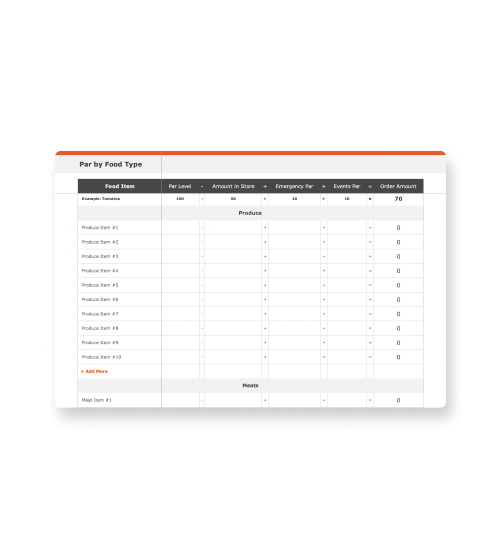
 Par Inventory Sheet Template
Seamlessly track inventory with the help of this customizable par inventory sheet template.
무료 다운로드 받기Par level inventory management is a fundamental concept that helps restaurants maintain optimal stock levels while maximizing profitability and minimizing waste. According to a report by Foodprint, up to 10% of food purchased by restaurants is wasted before reaching the customer, resulting in a depletion of inventory and a significant hit to profits. By setting the right par levels, restaurants can avoid overstocking or running out of essential items, ensuring consistent service.
This comprehensive guide explores the concept of par levels, how to calculate them, and their crucial role in modern inventory control systems.
What are par levels?
Par levels, also known as periodic automatic replenishment levels, represent the minimum amount of inventory a restaurant should maintain to meet customer demand while avoiding shortages. This inventory management strategy ensures that stock levels remain consistent and adequate across all inventory items, from perishable goods to durable products.
The importance of setting par levels
In the food service industry, setting accurate par levels is essential for several reasons. First, they help prevent overstocking, which can lead to excess inventory and increased carrying costs. This is particularly crucial for perishable items and products with limited shelf life, where spoilage and food waste can significantly impact food costs and overall profitability.
Second, proper par level inventory management helps restaurants avoid stockouts, which can result in lost sales and dissatisfied customers. By maintaining appropriate stock levels for both food costs and beverage inventory, restaurants can better meet customer demand while managing their supply chain efficiently. Be sure to account for various factors including:
Seasonal demand variations: Adjust par levels during peak seasons to ensure adequate stock without overordering.
Food waste reduction: Set appropriate par levels to minimize overstocking and reduce food waste, ensuring inventory is used efficiently.
Expiration dates monitoring: Regularly check expiration dates and adjust par levels to ensure products are used before they spoil.
Real-time inventory tracking: Track stock levels in real-time to adjust par levels and prevent shortages or excess inventory.

Par Inventory Sheet Template
Seamlessly track inventory with the help of this customizable par inventory sheet template.

Calculating par levels
Assess your restaurant’s average usage, lead time, and safety stock to determine the optimal quantity needed to meet customer demand without overstocking. Par level calculations typically involve several key metrics and factors:
Average inventory usage: Understanding how quickly items move through your system is crucial for determining appropriate par levels. This can be calculated using sales data and inventory turnover rate information.
Lead time: The time between placing purchase orders and receiving inventory must be factored into par level formula calculations. Longer lead times generally require higher par levels to account for potential supply chain disruptions.
Safety stock: This additional inventory serves as a buffer against unexpected demand fluctuations and supply chain issues. The amount of safety stock needed varies based on factors such as seasonality and historical sales patterns.
Par level formula
Par level = (average daily usage × lead time days) + safety stock
For example:
Let's say a restaurant serves an average of 100 burgers per day, and it takes 3 days for their supplier to deliver more patties (lead time). They also want to keep an additional 50 patties as safety stock to cover any unexpected demand or delays.
Par level calculation:
Average daily usage = 100 burgers
Lead time days = 3 days
Safety stock = 50 patties
Par level = (100 × 3) + 50 = 300 + 50 = 350 patties
In this case, the restaurant's par level for burger patties is 350, meaning they should always aim to have 350 patties in stock to meet demand and account for delivery time and unexpected events.
Factors affecting par levels
Seasonality and demand fluctuations
Seasonal demand can significantly impact optimal par levels. Restaurants must adjust their par level calculations to account for these predictable fluctuations while maintaining enough safety stock for unexpected demand spikes. Review areas such as:
Seasonal trends: Monitor historical sales data to identify patterns and anticipate fluctuations during peak seasons such as holidays or special events.
Popular items: Increase inventory for popular items during high-demand periods and reduce stock for slower seasons to optimize storage and reduce waste.
Local events: Stay informed about local events, festivals, or weather conditions that could drive temporary increases in demand.
Suppliers: Work closely with suppliers to ensure they can meet demand during busy seasons, allowing for timely restocking and minimizing stockouts.
Many restaurants experience seasonal increases in sales, particularly those that align their menus and promotions with changing consumer preferences during holidays and warmer months. For example, sales at Olive Garden rise during the winter holiday season and the "Never Ending Pasta Bowl" promotion in the fall, making it essential to have an inventory management system that can adapt to these fluctuations in demand and keep stock levels balanced.
Supply chain considerations
Supply chain considerations involve evaluating supplier reliability, delivery timelines, and inventory management practices to ensure consistent product availability and minimize disruptions. Modern restaurant supply chain dynamics require flexible par level management. Factors such as:
Lead times: Account for fluctuations in lead times from suppliers, as delays can impact inventory levels and disrupt the timely restocking of essential items.
Pricing changes: Monitor supplier price fluctuations and adjust your menu prices accordingly to maintain profitability while staying competitive in the market.
Market fluctuations: Monitor market changes, like raw material price shifts or supply shortages, to adjust inventory and pricing strategies.
Transportation delays: Account for potential transportation delays and adjust inventory or delivery schedules to ensure timely product availability.
Using par levels effectively
Streamlining operations
Streamlining operations is crucial for maximizing efficiency, reducing costs, and ensuring a smoother workflow in your restaurant. Implementing an effective inventory management system with par levels helps streamline operations by:
Automating purchase orders: Use automated systems to optimize inventory replenishment and ensure timely restocking.
Reducing time-consuming manual counts: Implement technology to automate inventory tracking and reduce the need for manual stock counts.
Improving inventory tracking accuracy: Use advanced inventory systems to improve accuracy, minimize errors, and maintain correct stock levels.
Facilitating periodic automatic replacement: Set up automatic reordering to maintain consistent stock levels and avoid shortages.
Technology and par level management
Before technology, restaurants typically managed par level inventory manually using paper-based systems, spreadsheets, or even simple written logs. Modern inventory management software has revolutionized the food service industry. These systems offer:
Real-time inventory tracking: Use technology to monitor stock levels in real-time, enabling immediate adjustments and ensuring timely replenishment.
Automated reorder notifications: Set up alerts to automatically notify when stock reaches reorder levels, ensuring timely restocking without manual oversight.
Sales report integration: Integrate sales data with inventory management systems to adjust your restaurant’s par levels based on real-time sales trends and demand fluctuations.
Par level calculations automation: Automate calculations based on historical sales data, ensuring accurate inventory levels and reducing manual effort.
Inventory turnover rate monitoring: Identify slow-moving items and adjust par levels to optimize stock and reduce excess inventory and food waste.
Kobeyaki, a New York-based Japanese fast-casual restaurant, switched to using xtraCHEF by Toast to automate and streamline its inventory management processes, creating more efficient operations. As Brian Kelly, partner, and co-founder, shared, "There's a million and one things to do when you run a restaurant. Not having to spend several hours a week managing paperwork is a game-changer and allows me to focus on the other million things." This technology solution freed up time and resources so Kobeyaki could focus on providing an exceptional dining experience.
Restaurant Food Inventory Template
Use this free Food Inventory Template to help your business stay organized and manage inventory with ease.
Best practices for managing par levels
Regular review and adjustment
Par levels shouldn’t be static. Regular review of your restaurant’s sales data and inventory metrics helps ensure par levels remain accurate and effective. Factors to consider during reviews include:
Customer demand: Regularly assess shifts in customer preferences and sales patterns to adjust par levels and ensure stock aligns with current demand.
Seasonal patterns: Review and adjust par levels based on seasonal trends to ensure adequate stock during peak periods and avoid overstocking during slower seasons.
Historical sales trends: Analyze past sales data to adjust par levels, ensuring optimal inventory levels based on previous demand and seasonal fluctuations.
Current market conditions: Monitor restaurant market trends and supply chain factors to adjust par levels and ensure inventory stability.
Avoiding common pitfalls
In order to effectively manage your restaurant’s inventory, it's essential to be aware of and avoid common pitfalls that can arise when using par levels. Keep track of:
Overstocking: Maintaining excess inventory ties up capital and increases the risk of spoilage for perishable items.
Understocking: Setting par levels too low can lead to food shortages and lost sales opportunities.
Improper calculations: Inaccurate par level calculations can result from poor sales data analysis or failure to account for seasonality.
Measuring Success
To effectively measure the success of your par level strategy, it's important to track key performance indicators that reflect the efficiency of your inventory management. Key metrics include:
Inventory turnover rate: Track inventory turnover to gauge the efficiency of stock management, ensuring products are sold and replaced at optimal rates.
Stock-out frequency: Monitor the frequency of stock-outs to identify inventory gaps and adjust par levels to maintain product availability.
Spoilage rates: Track spoilage rates to adjust par levels and minimize waste, ensuring inventory is fresh and cost-effective.
Carrying costs: Monitor carrying costs to ensure par levels are optimized, balancing inventory investment with storage and maintenance expenses.
Order fulfillment rates: Track order fulfillment rates to ensure par levels are set to meet customer demand while minimizing backorders or overstock situations.
The future of par level management
As technology continues to evolve, inventory management systems are becoming increasingly sophisticated. Advanced features such as artificial intelligence and predictive analytics are making it easier to maintain accurate par levels and optimize inventory control in your restaurant.
Yum Brands' siblings, Taco Bell and KFC have turned to AI for inventory management and have implemented a system that predicts and suggests the optimal amount of products managers should order each week.
Final thoughts
Whether managing your restaurant's food inventory or focusing on maximizing profitability, understanding and properly implementing par levels can help reduce waste, prevent shortages, and improve your bottom line. Remember, success in managing par levels requires a combination of accurate data analysis, proper technology implementation, and regular system review and adjustment. By following these guidelines and utilizing modern inventory management tools, your restaurant can achieve more efficient operations and improved profitability through effective par level management.
Restaurant Cost Control Guide
Use this guide to learn more about your restaurant costs, how to track them, and steps you can take to help maximize your profitability.
이 문서가 도움이 되었나요?
면책 조항: 이 정보는 일반 정보 제공 목적으로 작성되었으며 당사의 권고를 의미하는 것은 아닙니다. Toast는 본 콘텐츠에 포함된 정보, 텍스트, 그래픽, 링크 및 기타 항목의 정확성이나 완전성을 보장하지 않습니다. Toast는 본 문서의 조언을 따른다고 해서 특정한 결과를 얻을 수 있음을 보장하지 않습니다. 귀하의 상황에 맞는 조언이 필요한 경우 변호사, 회계사 또는 비즈니스 자문가 등 전문가와 상담하시기 바랍니다.
 트렌드
트렌드
