
How to Calculate Overtime for Restaurant Employees
Read on for a step-by-step guide on how to calculate overtime for restaurant employees, including AI tips and best practices.

작성자
 RESOURCE
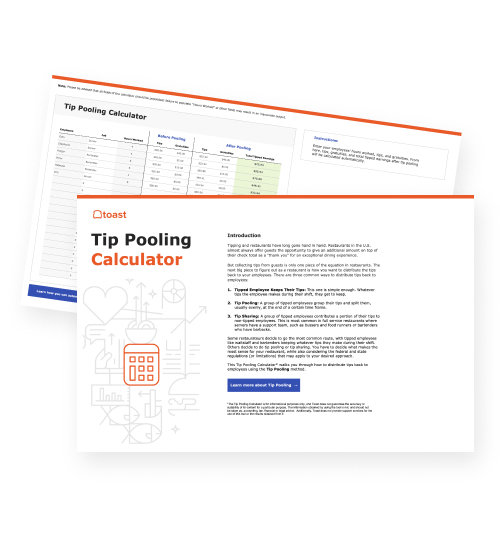
 Tip Pooling Calculator
Use the Tip Pooling Calculator to learn how to distribute tips back to your restaurant’s employees using the tip pooling method.
무료 다운로드 받기To calculate overtime pay, multiply an employee’s regular hourly rate by 1.5, then multiply that amount by their overtime hours. Under federal law, covered, nonexempt employees generally earn overtime after working more than 40 hours in a workweek.
For restaurants, the calculation starts with keeping track of changing shifts, different job rates, and tipped pay. When that information already lives in the POS, moving it into payroll shouldn’t require starting over. Toast Payroll & Team Management connects recorded hours and tips with payroll, helping operators manage those details together.
This guide explains the basic formula, common restaurant scenarios, and how to avoid calculation mistakes.
*This article provides general U.S. information, not legal advice. Confirm applicable requirements with your state labor agency or a qualified employment professional.
Key takeaways
Covered, nonexempt employees generally earn 1.5 times their regular rate after 40 hours in a workweek under federal law.
Multiple pay rates, nondiscretionary bonuses, and shift differentials can change the regular rate used to calculate overtime.
Calculate tipped employees’ overtime from their full regular rate, not their reduced cash wage.
Calculate each workweek separately and check state rules for additional overtime requirements.
Connected timekeeping and payroll tools reduce manual work, but accurate records and payroll review remain essential.
Restaurant Labor Cost Calculator
Unlock the power of data-driven labor management with our free Restaurant Labor Cost Calculator. Stop guessing and start optimizing your staffing decisions today.

How to calculate overtime pay
The standard overtime formula is:
Overtime pay = Regular hourly rate × 1.5 × Overtime hours
Under federal overtime rules, each workweek is calculated separately. A two-week pay period does not let you average a busy week with a slower one. Before calculating pay, work through these steps:
Confirm eligibility: Check whether the employee is covered and nonexempt; receiving a salary does not automatically eliminate overtime eligibility.
Count hours worked: Total actual compensable hours within the employee’s fixed workweek.
Determine the regular rate: Include compensation that belongs in the calculation, not just the base hourly wage.
Calculate overtime: Identify qualifying hours and apply the appropriate rate.
Calculate gross pay: Combine regular-hours pay, overtime pay, and other compensation without counting anything twice.
The regular rate of pay can include shift differentials and certain bonuses. That is why two employees with the same base wage may have different overtime rates.
Example: An employee earning $20 per hour works 45 hours
Assume the employee is covered and nonexempt, earns one hourly rate, receives no additional compensation, and is not subject to additional state overtime requirements.
Calculation | Formula | Amount |
Regular-hours pay | 40 × $20 | $800 |
Overtime hours | 45 − 40 | 5 hours |
Overtime rate | $20 × 1.5 | $30/hour |
Overtime pay | 5 × $30 | $150 |
Total gross weekly pay | $800 + $150 | $950 |
The employee earns $950 before taxes and other deductions. Of that amount, $150 pays for the five overtime hours. Understanding the full amount also helps operators track restaurant payroll costs. The extra overtime premium is $50, but those five hours cost $150 in gross wages.
Overtime calculations for common restaurant situations
The basic formula is straightforward when an employee earns one hourly rate. Tips, multiple roles, and bonuses require a closer look at what belongs in the regular rate. The following weekly examples use federal rules unless otherwise stated.
Tipped employees
Overtime for tipped employees is not calculated by multiplying their reduced cash wage by 1.5. Where permitted, a tip credit allows an employer to count some employee tips toward its wage obligations, but the overtime calculation must account for the full regular rate.
Federal tipped-employee guidance explains how this works. For an employee with a $7.25 regular rate and a valid $5.12 hourly tip credit:
($7.25 × 1.5) − $5.12 = approximately $5.76 in employer-paid cash wages per overtime hour.
The Department of Labor’s calculation examples illustrate this distinction.
What $5.76 represents: The employer-paid cash portion, not the employee’s complete overtime compensation.
What the example assumes: A valid full federal tip credit, sufficient tips, and no higher applicable state or local requirements.
What can change the result: A higher regular rate, different tip-credit rules, or additional compensation.
What happens when tips fall short: The employer must make up any shortfall needed to satisfy applicable wage and overtime obligations.
Employees working at multiple pay rates
An employee might work some shifts as a prep cook and others as a line cook at a higher rate. The usual federal approach is to calculate a weighted average: add straight-time earnings from both jobs, then divide by total hours worked.
For example, an employee works 30 hours at $18 and 15 hours at $24:
First role: 30 × $18 = $540.
Second role: 15 × $24 = $360.
Straight-time earnings: $540 + $360 = $900.
Regular rate: $900 ÷ 45 hours = $20.
Additional overtime premium: 5 overtime hours × $20 × 0.5 = $50.
Total gross weekly pay: $900 + $50 = $950.
Why multiply by 0.5 here instead of 1.5? The $900 already includes straight-time pay for all 45 hours. Only the additional half-time premium remains.
Federal law permits certain alternative arrangements under specific conditions, so weighted averaging is the usual method rather than the only permitted option.
Bonuses and shift differentials
A promised performance bonus can increase an employee’s regular rate—and therefore their overtime pay. Shift differentials, such as extra hourly pay for certain shifts, also generally belong in that calculation.
A January 2026 Department of Labor opinion letter reinforced this distinction: Bonuses earned under the predetermined criteria examined in the letter were not discretionary and had to be included in the regular rate.
Suppose an employee earns $20 per hour, works 45 hours, and earns a $90 nondiscretionary bonus for that week:
Base earnings for all hours: 45 × $20 = $900.
Earnings including the bonus: $900 + $90 = $990.
Regular rate: $990 ÷ 45 = $22.
Additional overtime premium: 5 × $22 × 0.5 = $55.
Total gross weekly pay: $990 + $55 = $1,045.
Simply calculating the original $950 weekly pay and adding $90 would produce $1,040—an underpayment of $5.
As employment attorneys Nicole S. LeFave and Brian Rho explained in their analysis of the opinion letter: “Employers should review their bonus programs to ensure compliance, particularly where bonuses are tied to safety, job duties, or similar metrics.”
When designing employee incentive programs, account for their payroll effects. Genuinely discretionary bonuses may be excluded when they meet the legal requirements; calling a bonus “discretionary” is not enough.
State-specific overtime requirements
Federal requirements are a starting point. Some states require overtime based on daily hours, not only weekly totals.
For example, California’s general overtime rules require time-and-a-half for work beyond eight hours through 12 hours in a workday, and double time beyond 12, subject to exceptions. For an employee with a $20 regular rate working a standard 10-hour day:
First eight hours: 8 × $20 = $160.
Two overtime hours: 2 × $30 = $60.
Total gross daily pay: $220.
Daily overtime can apply even when the employee works fewer than 40 hours that week. Check your state’s rules, including any applicable exceptions, before relying on the federal weekly formula alone.
Restaurant New Hire Onboarding Checklist
Bringing new employees onto your team can be both exciting and challenging. Use this free PDF checklist to set your staff up for success.
Common overtime mistakes to avoid
Small calculation errors can add up across employees and pay periods. In April 2026, the Department of Labor reported recovering $95,095 in back wages for 33 cooks at three IHOP franchise locations in North and South Carolina after finding overtime violations. Use these checks before submitting payroll:
Averaging workweeks: Calculate overtime separately for each workweek, even when payroll runs every two weeks.
Assuming salary means exempt: Salary basis and job duties matter. The DOL’s May 2026 update confirms the standard federal salary threshold of $684 per week for most executive, administrative, and professional exemptions, but meeting it alone does not establish exemption.
Leaving out compensation: Review bonuses, shift differentials, and other payments that may affect the regular rate.
Using the tipped cash wage: Do not multiply a reduced cash wage by 1.5 to determine the employee’s complete overtime entitlement.
Counting pay twice—or missing part of it: Distinguish full overtime pay from the additional half-time premium when straight-time pay already covers every hour.
Using scheduled rather than actual hours: Include all compensable time worked, including overtime that was not approved in advance.
Overlooking state requirements: Daily overtime rules and stricter exemption standards may change the result.
Reviewing time records alongside labor reports helps managers spot unusual hours and investigate discrepancies before they carry into payroll.
How AI and payroll tools can make overtime easier to manage
Technology can help managers spend less time gathering information and more time reviewing what needs attention. Scheduling tools support planning, payroll software handles calculations, and AI can help operators explore their labor data.
Toast IQ lets operators ask plain-language questions about labor, sales, and other restaurant activity. A question such as “How did labor costs change this week?” can give managers a starting point for reviewing staffing decisions.
Plan coverage: Use restaurant employee scheduling software to coordinate expected demand, employee availability, and scheduled hours.
Investigate changes: Review labor trends alongside sales to understand where staffing and demand may have shifted.
Check time entries: Depending on products and permissions, Toast IQ can help operators view and edit shifts or automatic clock-outs, with confirmation before changes.
Connect records: Bring recorded hours, tips, and pay rates into payroll to reduce repeated data entry.
Review before submitting: Confirm actual hours, bonus treatment, employee classifications, and applicable overtime settings.
Any time-entry correction should reflect what the employee actually worked. AI can help surface information, but it does not replace legal guidance or a manager’s responsibility to review payroll.
Make overtime easier from clock-in to payday
Overtime is easier to manage when hours, pay rates, and payroll records stay connected. Once those details are accurate, managers can focus on reviewing exceptions instead of rebuilding the calculation every pay period.
Toast Payroll & Team Management pulls hours and tips from Toast POS and automatically tracks and calculates overtime across locations and multiple job types. With the right setup and a consistent review process, that connection helps reduce manual work and gives your team a clearer path from the hours they work to the pay they receive.
Training Manual Template
Use this restaurant training manual template, a customizable Word Doc, to provide your staff with the rules, guidelines, and clarity they need to do their jobs efficiently.
FAQ
What is the federal overtime rate in 2026?
The federal overtime rate is generally at least 1.5 times an employee’s regular rate for hours worked beyond 40 in a workweek, unless the employee is exempt.
Do salaried restaurant managers qualify for overtime?
Yes, salaried restaurant managers can qualify for overtime if they do not meet the applicable salary and job-duty requirements for exemption.
Does overtime reset every week?
Yes, federal overtime is calculated separately for each fixed, seven-day workweek, so employers cannot average hours across weeks.
How is overtime calculated for tipped employees?
For federal time-and-a-half overtime, multiply the employee’s full regular rate by 1.5, then subtract any valid hourly tip credit to determine the employer-paid cash rate.
Can a restaurant require employees to work overtime?
A restaurant can generally require overtime, subject to applicable laws and employment agreements, but must pay eligible employees for all compensable overtime worked.
What happens if overtime is miscalculated?
Restaurants should correct payroll errors promptly and pay any amount owed, since overtime underpayments can result in back wages, damages, or penalties.


이 문서가 도움이 되었나요?
면책 조항: 이 정보는 일반 정보 제공 목적으로 작성되었으며 당사의 권고를 의미하는 것은 아닙니다. Toast는 본 콘텐츠에 포함된 정보, 텍스트, 그래픽, 링크 및 기타 항목의 정확성이나 완전성을 보장하지 않습니다. Toast는 본 문서의 조언을 따른다고 해서 특정한 결과를 얻을 수 있음을 보장하지 않습니다. 귀하의 상황에 맞는 조언이 필요한 경우 변호사, 회계사 또는 비즈니스 자문가 등 전문가와 상담하시기 바랍니다.
