
Gratuity vs. Tip: What’s the Difference and Why Does It Matter?
Clear tipping rules help guests and staff understand each payment. Learn how gratuities and tips differ on the bill and in payroll.

작성자
 RESOURCE
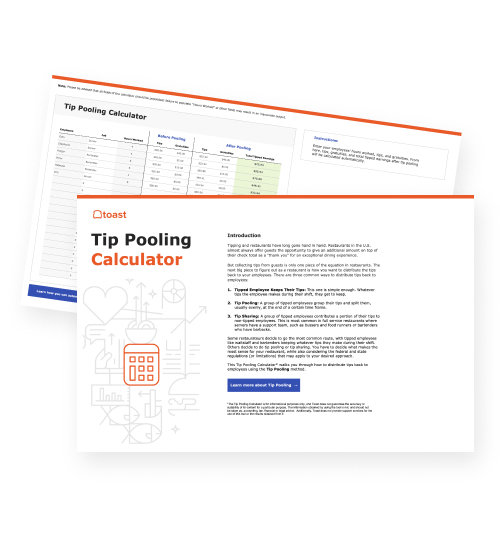
 Tip Pooling Calculator
Use the Tip Pooling Calculator to learn how to distribute tips back to your restaurant’s employees using the tip pooling method.
무료 다운로드 받기A gratuity usually means a voluntary tip, but a mandatory “automatic gratuity” is a service charge under U.S. federal tax and labor rules. The key distinction is whether the customer freely chooses to pay and determines the amount.
For restaurants, that distinction affects how payments are recorded, distributed, and processed through payroll. Once those categories are clear, Toast Tips Manager helps restaurants apply distribution rules and give employees clearer records of their earnings.
Here’s how gratuities and tips differ, what to do when gratuity is included, and how restaurants can keep the process clear for everyone.
Key takeaways
A gratuity usually means a voluntary tip, but mandatory automatic gratuity is a service charge.
An extra tip is optional when gratuity is already included, so check the receipt before adding more.
Service charges distributed to employees are wages, not tips, and affect overtime calculations.
Restaurants should keep payment categories separate and explain how employee earnings are distributed.
Employee Handbook Template
Outline your restaurant’s staff policies in this customizable Word doc to help restaurant management and staff get on the same page.

What is the difference between a gratuity and a tip?
In everyday language, “gratuity” and “tip” generally mean the same thing: an optional payment for service. The confusion starts when a restaurant uses “gratuity” to describe a required charge. These four terms help explain what’s on the receipt:
Tip or voluntary gratuity: The customer decides whether to leave something and how much.
Automatic gratuity: A mandatory amount added by the restaurant, often for large parties.
Service charge: A broader category of required charges, including mandatory automatic gratuities.
Suggested gratuity: A recommended amount that remains optional when the customer can freely change it or leave nothing.
The IRS distinguishes tips from service charges based on the circumstances of the payment, not simply its name. Calling a required charge a “tip” does not make it voluntary.
Service charges and tips can appear on the same receipt without being the same kind of payment. An automatic charge and an additional amount freely chosen by the guest should remain distinguishable in the restaurant’s records.
Question | Voluntary tip or gratuity | Mandatory automatic gratuity |
Who chooses the amount? | The customer | The restaurant |
Is payment optional? | Yes | It is a required charge, subject to applicable rules |
How is it classified federally? | A tip | A service charge |
Who receives it? | Employees, directly or through a lawful tip pool | Distribution depends on applicable law and restaurant policy |
How is money paid to employees treated? | Tip income | Wages |
Should you tip if gratuity is already included?
An additional tip is optional when an automatic gratuity is already included. Check what the charge covers before deciding whether to leave more.
A blank tip line or a payment screen suggesting another percentage does not necessarily mean an additional payment is expected. Taking a moment to read the receipt can prevent an accidental double tip.
Check for an included charge: Look for an automatic gratuity already added to the total.
Ask what it covers: A charge supporting employee compensation is different from a fee for another purpose; not every service charge goes directly to the server.
Separate suggestions from charges: Printed tipping suggestions are not necessarily amounts already included in the bill.
Choose any extra tip deliberately: You can recognize especially helpful service without assuming you must tip twice.
For example, a $100 meal subtotal with an 18% automatic gratuity already includes an $18 service charge, before any applicable tax. Adding a voluntary $20 tip brings the combined charge and tip to $38.
Restaurants can make this easier by clearly disclosing mandatory charges before guests order, explaining their purpose, and distinguishing included amounts from optional additional tips. Staff should be able to explain the policy without leaving guests to interpret the receipt alone.
How should restaurants handle gratuities and tips?
Restaurants should classify payments correctly, explain how employee earnings are distributed, and carry those distinctions through payroll. Clear procedures help guests understand their bill and employees understand their pay.
1. Record tips and service charges separately
A voluntary tip, a mandatory gratuity paid to employees, and a charge retained by the restaurant can all appear during service. They shouldn’t become one undifferentiated total behind the scenes. Accurate tip reporting starts with identifying what each payment represents.
Identify the payment: Determine whether the customer freely chose to pay it.
Separate additional tips: Record voluntary amounts distinctly from required charges on the same check.
Configure the POS: Match payment settings to the restaurant’s policy and applicable requirements.
Review the records: Check that reported amounts reflect how money was collected and allocated.
Toast’s service-charge settings distinguish mandatory gratuities paid to employees from employer-kept charges. Tips Manager can include selected employee-paid mandatory gratuities in distribution rules, while employer-kept service charges stay outside those distributions.
Restaurant Labor Cost Calculator
Unlock the power of data-driven labor management with our free Restaurant Labor Cost Calculator. Stop guessing and start optimizing your staffing decisions today.
2. Explain how payments are distributed
Employees should understand which earnings enter a pool, who participates, and how their share is calculated. A written policy and understandable records make those conversations easier.
Define eligible roles: Identify which jobs contribute and receive earnings under applicable rules.
Explain the calculation: Document any percentages, points, or hours-based allocation.
Set the pooling period: Clarify whether calculations cover a workday, service period, or individual order.
Provide clear records: Make tip-out information available and explain how employees can raise questions.
A tip-pooling calculator can help illustrate how a proposed distribution works. Toast Tips Manager lets operators configure job-based rules, choose distribution methods, and review calculated results. Once the policy is established, the system applies those rules without requiring managers to rebuild the same calculations in a spreadsheet after every shift.
3. Apply the correct payroll treatment
Mandatory service charges distributed to employees are wages rather than voluntary tips, even when the receipt calls them gratuities. That distinction affects payroll calculations as well as recordkeeping.
Use appropriate earning categories: Keep reported tips and distributed service-charge wages correctly classified.
Account for overtime: Include applicable service-charge payments when calculating the employee’s regular rate.
Maintain supporting records: Preserve the payment and distribution information used for payroll.
Check local requirements: State and local rules may impose additional protections or disclosure obligations.
The Department of Labor explains that distributed service charges form part of employee compensation and must be included in the regular rate used to calculate overtime under the FLSA.
With Toast Payroll, managers can send reviewed Tips Manager results into payroll using configured earning codes.
Make tipping clear for guests and employees
Guests should be able to tell what’s included before deciding whether to leave more, and employees should be able to understand how their earnings were calculated. Clear receipts, consistent policies, and connected records make both easier.
Toast Tips Manager helps restaurants apply distribution rules, review the results, and connect them with payroll. That means less time working through manual tip-outs and a simpler way to explain where the money goes.
Restaurant Operations Manual Template
Use this free template to easily outline all of your operating procedures and make day-to-day operations as consistent as possible.
FAQ
Do you tip when gratuity is already added?
An additional tip is optional when automatic gratuity is already included. Check what the charge covers before deciding whether to leave more; a blank tip line doesn’t mean another payment is required.
Is a 20% service charge the same as gratuity?
A mandatory 20% service charge may be called an automatic gratuity, but it’s not a voluntary tip. The percentage alone doesn’t tell you whether the money goes to employees.
Is gratuity the same as a tip?
Gratuity usually means a voluntary tip, but a mandatory automatic gratuity is classified as a service charge under U.S. federal tax and labor rules.
Can you refuse to pay gratuity?
You can decline a voluntary gratuity, but a disclosed mandatory automatic gratuity is generally part of the bill, subject to applicable law. If the charge was unexpected or unclear, ask a manager to explain it before paying.
How much is standard gratuity?
For full-service dining in the U.S., 15%–20% of the pretax bill is a common voluntary tipping range, not a requirement. Automatic gratuity amounts are set by the restaurant and should be disclosed before ordering.
Is gratuity taxed differently than tips?
A voluntary gratuity receives the same tax treatment as a tip. Mandatory automatic gratuities distributed to employees are treated as wages rather than tip income, so restaurants must classify and report them accordingly.
Do service charges go to servers?
Not necessarily; service-charge distribution depends on applicable law and the restaurant’s policy. Ask how the charge is allocated rather than assuming it goes directly to your server.
Why do some restaurants add automatic gratuity?
Restaurants may add automatic gratuity to establish a predictable service charge for large parties, events, or other service arrangements. Whether and how that money is distributed to employees depends on the restaurant’s policy and applicable rules.


이 문서가 도움이 되었나요?
면책 조항: 이 정보는 일반 정보 제공 목적으로 작성되었으며 당사의 권고를 의미하는 것은 아닙니다. Toast는 본 콘텐츠에 포함된 정보, 텍스트, 그래픽, 링크 및 기타 항목의 정확성이나 완전성을 보장하지 않습니다. Toast는 본 문서의 조언을 따른다고 해서 특정한 결과를 얻을 수 있음을 보장하지 않습니다. 귀하의 상황에 맞는 조언이 필요한 경우 변호사, 회계사 또는 비즈니스 자문가 등 전문가와 상담하시기 바랍니다.
 트렌드
트렌드


