How to Charge for Catering: Pricing Guide + Per-Person Price Chart (2027)
Make larger orders a profitable part of your restaurant. Learn how to charge for catering, account for labor, and calculate per-person prices.
작성자
 RESOURCE
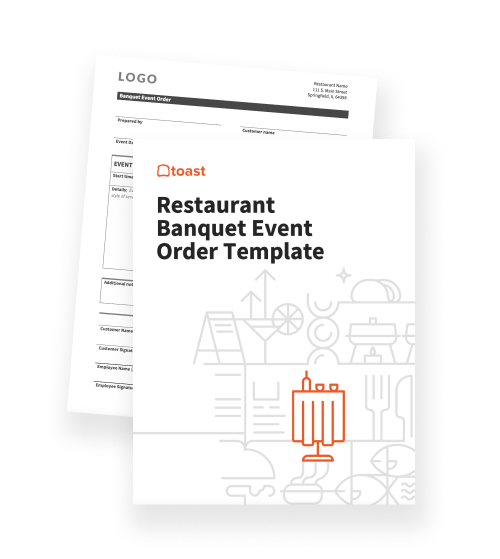
Restaurant Banquet Event Order (BEO) Template
This free BEO template can help your restaurant optimize incoming catering requests and streamline documentation.
무료 다운로드 받기To charge for catering, set a price that covers the full cost of the order and leaves room for profit. You can charge per person, per tray, or as a package. Each option should clearly explain what the customer receives.
Once the customer is ready to book, those details need to carry through to the order and payment. Toast Catering & Events brings catering orders, invoices, and payments together, helping your team manage the process in one place.
Start by choosing how to present your prices, then use the comparison chart and worked example below to build your next quote.
Key takeaways
Restaurants can charge for catering per person, per tray or item, or as a package.
Catering prices should cover food, labor, supplies, delivery, and overhead while leaving room for profit.
Calculate the per-person catering price by dividing the total price by the number of servings.
Profit margin measures profit as a percentage of the selling price, while markup measures it against costs.
A clear catering quote specifies the food, included services, total price, payment terms, and deadlines for changes.
Catering Menu Templates
Use these catering menu templates as a starting point for your menu design or to give your menu a refresh.

Choose how to charge for catering
Your pricing strategy should match how customers order and how your team serves the food. Most catering orders use one of three methods:
Per person: Charge for each guest receiving a defined meal. This works for boxed lunches, buffets, and plated dinners. State what each guest receives and which services are included.
Per tray or item: Charge for quantities such as sandwich platters, pasta trays, or desserts. Explain how many people each item serves and whether the portions are intended as a main, side, or appetizer.
Per package: Charge one price for a complete assortment serving a set number of people. For example, a lunch package might include sandwiches, salad, and cookies for 10 guests.
These methods can overlap. A buffet package might have a per-person price, with delivery or additional staffing charged separately.
For customers choosing between packages, make the differences easy to see. Each level should offer a clear benefit, such as another entrée, dessert, or more service. John Crisafulli of BTS Hospitality recommends offering three price levels to simplify corporate catering decisions:
“People who book corporate events tend to be administrative staff, and the easier you can make it for them, the better.”
Catering prices per person: comparison chart
To convert a catering offer into a per-person price, divide the total price by the number of people it serves.
Price per person = Total price ÷ Number of servings
These hypothetical examples show the calculation:
Catering offer | Example price | People served | Price per person |
Boxed lunch | $18 | 1 | $18 |
Sandwich platter | $120 | 10 | $12 |
Lunch package | $300 | 15 | $20 |
Staffed buffet | $2,000 | 50 | $40 |
These are illustrative examples. Actual prices depend on your menu, costs, location, and service requirements.
When comparing offers, check portion sizes and whether delivery, setup, staff, rentals, and cleanup are included. Add any separate charges before comparing the totals.
How to price a catering order
A consistent pricing process helps your team quote accurately and explain charges to customers. Let’s work through a hypothetical buffet for 50 people.
1. Confirm what the customer needs
Before calculating a price, establish the size and scope of the order. Record the agreed details in a banquet event order, or BEO, so everyone works from the same plan.
Food: Menu, portions, guest count, and dietary requirements.
Timing and location: Event address, venue access, delivery time, and service duration.
Service: Pickup or delivery, setup, serving staff, and cleanup.
Equipment: Plates, utensils, serving equipment, linens, and rentals.
Budget and deadlines: Spending range and the date for confirming the final order.
2. Calculate the full cost
Add up the expenses required to complete the order. Use your plate costs to calculate ingredients and portions, then include preparation, service, transportation, and cleanup. For our example buffet:
Cost | Amount |
Food and ingredients | $650 |
Preparation, service, and cleanup labor | $600 |
Packaging and serving supplies | $100 |
Delivery and transportation | $100 |
Allocated overhead | $150 |
Total estimated cost | $1,600 |
Overhead is the order’s share of expenses such as rent, insurance, utilities, and administration. Count your own working time in labor, and avoid including the same expense twice.
The exact split varies by order, but food is only one part of the calculation. For holiday catering, account for any additional staffing, rental, or delivery expenses. Include them in the package price or show a clearly explained holiday fee.
xtraCHEF supports ingredient tracking and recipe costing as purchasing costs change. xtraCHEF customers save on average 1 to 5 hours per week using xtraCHEF.*
Restaurant Cost Control Guide
Use this guide to learn more about your restaurant costs, how to track them, and steps you can take to help maximize your profitability.
3. Set the selling price
Once you know the estimated cost, choose your target profit margin.
Selling price = Total estimated cost ÷ (1 − Target profit margin)
Using an illustrative 20% margin:
$1,600 ÷ 0.80 = $2,000
For 50 guests, that works out to $40 per person, with $400 in estimated profit before tax. Be careful with markup and margin. Adding 20% to your costs produces a 20% markup. In this example, that would give you a $1,920 selling price and about a 16.7% margin.
Minimum orders: Smaller orders still require preparation, packing, and transportation. Set a minimum that covers the work involved.
Custom requests: Calculate the cost of substitutions, premium ingredients, or additional service.
Guest-count changes: Recalculate the order when numbers change. Staffing, equipment, and delivery costs may stay the same even when you serve fewer guests.
Quote validity: State how long the price remains available, especially for events booked well in advance.
Regular cost reviews help keep quotes accurate. “I literally change prices every week,” Steve Short of Steve Short Culinary Team told CFE News. His team recalculates food costs weekly and gives customers two weeks to accept proposals.
4. Present a clear quote
The customer should be able to see what they’re buying, what it costs, and what happens next. If the total exceeds the customer’s budget, offer specific adjustments. A different protein, fewer menu options, or drop-off service may bring the price closer to their target.
Order details: Menu, quantities, guest count, date, location, and service times.
Included services: Delivery, setup, equipment, staffing, and cleanup.
Total price: Additional charges, applicable taxes and fees, and the final amount.
Payment terms: Deposit, balance, due dates, and quote expiration.
Change terms: Deadlines and pricing rules for guest-count changes, menu revisions, and cancellations.
Toast Catering & Events helps connect the agreed order with invoicing and payment. Adriana Johnson, Director of Catering at Fieldtrip, explained the benefit of Toast’s invoicing process:
“Quicker turnaround time to get the customers locked into their event date and paid upfront.”
Make that next step clear: what the customer needs to approve, what payment is due, and when the booking is confirmed.
Make every catering order worth the work
Start with one menu or package, calculate what it takes to prepare and serve it, and set a price you can confidently explain. After each event, check your actual costs so the next quote builds on what you’ve learned.
Once the price is agreed, keep the booking moving. Toast Catering & Events brings orders, invoices, and payments together, helping your team stay organized while customers take the next step.
Restaurant Metrics Calculator
Use this free calculator to calculate the key restaurant metrics needed to understand the health and success of your business.
*Based on a survey of 79 xtraCHEF Pro and Essentials customers from 11/2/24 to 11/29/24. Individual results may vary.
FAQ
How do you calculate catering prices per person?
Divide the total catering price by the number of people served. A $2,000 order for 50 guests costs $40 per person.
How much should I charge for catering for 50 people?
Our example prices a 50-person buffet at $2,000, or $40 per person. This covers $1,600 in costs and leaves a 20% profit margin. Your actual price depends on the menu and service.
Should caterers charge a holiday surcharge?
A holiday surcharge can cover additional staffing, rental, or delivery costs. You can also include these expenses in the package price. Explain any separate fee upfront.
What is a typical catering service charge?
There’s no single standard catering service charge. Base the fee on the services provided, such as staffing, setup, and cleanup. Clearly state what it covers.
What’s the most common way to charge for catering?
Per-person pricing is common for boxed meals, buffets, and plated dinners. Caterers also charge per tray, per item, or by package, depending on the order.
이 문서가 도움이 되었나요?
면책 조항: 이 정보는 일반 정보 제공 목적으로 작성되었으며 당사의 권고를 의미하는 것은 아닙니다. Toast는 본 콘텐츠에 포함된 정보, 텍스트, 그래픽, 링크 및 기타 항목의 정확성이나 완전성을 보장하지 않습니다. Toast는 본 문서의 조언을 따른다고 해서 특정한 결과를 얻을 수 있음을 보장하지 않습니다. 귀하의 상황에 맞는 조언이 필요한 경우 변호사, 회계사 또는 비즈니스 자문가 등 전문가와 상담하시기 바랍니다.
 트렌드