
Restaurant Inventory Management: The Essential Guide for 2026
See why managing inventory is an integral part of operating a successful restaurant — with helpful tips, terms, and tactics to make managing inventory less complex.

Autor
CEO and Co-Founder, WISK.ai
 RECURSO
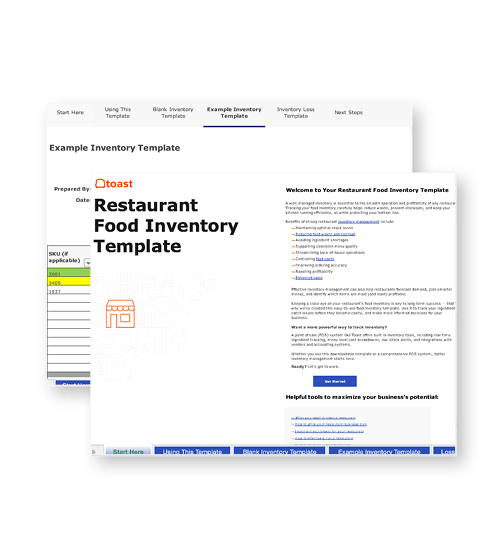
 Plantilla de inventario de alimentos para restaurantes
Utiliza esta plantilla gratuita de inventario de alimentos para ayudar a tu empresa a mantenerse organizada y gestionar el inventario con facilidad.
Obtener descarga gratisRestaurant inventory management is the process of tracking what a restaurant buys, stores, uses, wastes, and sells so operators can control food costs and protect margins.
That visibility matters because food waste and rising costs can quickly cut into profit. ReFED’s 2026 U.S. Food Waste Report found that U.S. surplus food reached 70 million tons in 2024, or about 29% of the food supply, with a total value of $380 billion. ReFED President Dana Gunders also called food waste reduction a business decision with “material impact on the bottom line.”
For restaurants, inventory management connects purchasing, recipe costing, storage, waste tracking, sales data, and reporting into one cost-control process.
Key Takeaways
Restaurant inventory management connects purchasing, stock counts, recipe costing, food waste, and sales data into one cost-control process.
Food costs remain volatile, making ingredient-level tracking important for protecting restaurant margins.
Restaurants can reduce waste by measuring what they buy, prep, sell, spoil, and throw away.
Inventory software is most useful when it connects supplier invoices, POS sales, recipe costs, inventory counts, and actual vs. theoretical usage.
Toast helps restaurants manage inventory with tools for invoice automation, recipe costing, inventory counts, food cost reporting, waste tracking, and analytics.
Plantilla de hoja de inventario de PAR
Realiza fácilmente un seguimiento de tu inventario con la ayuda de esta plantilla de hojas de inventario de PAR personalizable.

What is restaurant inventory management?
Restaurant inventory management involves tracking the ingredients, beverages, and supplies a restaurant buys, stores, uses, wastes, and sells. It helps restaurant operators understand what is on hand, what is being used, what needs to be reordered, what is being wasted, and how inventory affects food cost and profitability.
Why is restaurant inventory management important?
Inventory management matters because ingredients are one of a restaurant’s largest controllable costs. Inaccurate inventory can lead to waste, stockouts, poor menu pricing, and margin pressure.
The National Restaurant Association reported that as of May 2026, the Producer Price Index for All Foods was 35% above its February 2020 reading. Meanwhile, individual commodities moved in very different directions depending on category and menu mix.
That makes ingredient-level visibility important for restaurants that need to price menus, manage purchasing, and protect margins.
Food cost control: Inventory data helps restaurants see what ingredients cost and how those costs change.
Waste reduction: Tracking what gets ordered, prepped, sold, spoiled, or tossed helps operators find preventable waste.
Stockout prevention: Accurate counts and par levels help restaurants reorder before key ingredients run out.
Menu profitability: Recipe costing helps restaurants understand whether menu prices still protect margins.
Cash flow: Smarter ordering keeps less money tied up in unused or excess stock.
Consistency: Inventory systems support standardized recipes, portions, storage routines, and ordering processes.
Bar Inventory Template
Use this free bar inventory template to help your bar stay organized, track your stock accurately, and manage your beverage costs with ease.
How do you calculate restaurant inventory?
Restaurants calculate inventory by comparing what they started with, what they purchased, and what they had left at the end of a period. These formulas help restaurants move from “we think food costs are high” to “we know where cost, waste, or variance is happening.”
AI tools can make that work faster. Toast IQ lets operators ask questions about their business data in plain language, get quick answers, surface trends, and complete tasks directly from chat, which can reduce the time spent digging through reports or calculating insights manually.
Metric | Formula | What it shows |
COGS | Beginning Inventory + Purchases - Ending Inventory | How much inventory was used or sold during a period. |
Food cost percentage | Food Cost / Food Sales x 100 | How much food cost represents as a share of food sales. |
Inventory turnover | COGS / Average Inventory | How quickly inventory moves through the restaurant. |
Variance | Theoretical Usage - Actual Usage | Where expected usage differs from real inventory usage. |
How does inventory management help reduce restaurant food waste?
Smart inventory management reduces waste by showing restaurants where food is being lost, why it is being wasted, and how planning should change.
Food waste can happen at every stage of restaurant operations. ReFED reported that restaurants and foodservice businesses generated 12.5 million tons of surplus food in 2024. More than 85% went to landfill or incineration, and nearly 70% came from plate waste.
Back-of-house waste is also expensive. The National Restaurant Association reported that commercial kitchens typically waste 4% to 10% of the food they purchase before it reaches the guest. That waste can cost more than the food itself because restaurants also pay for the labor to purchase, inventory, prep, and serve it.
Waste logs: Track what gets thrown away and why.
Prep planning: Adjust prep levels based on sales and waste patterns.
Smarter purchasing: Order based on usage, seasonality, and menu mix.
FIFO: Use older inventory first to reduce spoilage.
Portion control: Identify items that create recurring plate waste.
Repurposing: Turn usable excess into specials, sauces, stocks, or staff meals.
How Toast helps restaurants manage inventory
Toast helps restaurants manage inventory by connecting POS sales data with inventory counts, invoice automation, recipe costing, food cost reporting, and inventory analytics.
Sales-connected inventory: Toast POS sales data can support reporting on usage, depletion, and cost trends.
Invoice automation: xtraCHEF helps reduce manual invoice entry and gives operators better visibility into purchasing.
Recipe costing: Restaurants can connect recipes to ingredient costs and understand menu-item profitability.
Inventory counts: Teams can digitize physical inventory counts instead of relying on spreadsheets.
Variance tracking: Actual vs. theoretical reporting helps operators see where expected usage differs from actual counts.
Waste and shrinkage visibility: Reporting can help identify patterns of missing value, waste, shrinkage, or theft.
How xtraCHEF by Toast supports inventory workflows
xtraCHEF by Toast supports restaurant inventory workflows by turning supplier invoice data, recipe data, inventory counts, and POS sales data into food-cost and inventory reporting. Operators can use supplier invoice line items as products for advanced food-cost reporting, recipe creation, and inventory management. A typical workflow looks like this:
Supplier invoices are captured.
Invoice line items become inventory products.
Recipes connect ingredients to menu items.
POS sales data helps calculate expected usage.
Inventory counts show what is actually on hand.
Reports show COGS, variance, waste, and depletion.
Manage restaurant inventory with better data
Restaurant inventory management isn’t just counting what is in the walk-in. It’s a system for protecting margins, reducing waste, and making better menu decisions.
With an integrated POS and inventory system, your restaurant can connect inventory counts, supplier invoices, POS sales, and reporting to manage food costs with better visibility and less manual work.
Plantilla de manual de operaciones para restaurantes
Usa esta plantilla gratuita para describir fácilmente todos tus procedimientos operativos y lograr que las operaciones diarias sean tan uniformes como sea posible.
FAQs
What is the difference between food cost and food cost percentage?
Food cost is the dollar amount a restaurant spends on ingredients, while food cost percentage shows ingredient cost as a share of food sales.
How do I set par levels for my restaurant?
Set par levels by reviewing how much of each item you use between deliveries, then adding a small buffer for demand spikes, delays, or specials.
What causes inventory shrinkage in a restaurant?
Restaurant inventory shrinkage is usually caused by spoilage, waste, over-portioning, incorrect counts, theft, unrecorded comps, vendor errors, or poor receiving practices.
What is FIFO and why does it matter?
FIFO stands for first in, first out, and it matters because using older inventory before newer inventory helps restaurants reduce spoilage, waste, and food safety risk.
Restaurant Invoice Automation Guide
Use this guide to learn more about your restaurant invoices, the value within, and how to consistently and accurately tap into it to make smarter decisions.


¿Es útil este artículo?
AVISO LEGAL: Esta información se proporciona solo con fines informativos generales y su publicación no constituye un aval. Toast no garantiza la precisión ni la integridad de la información, el texto, los gráficos, los enlaces y otros elementos que incluye este contenido. Toast no garantiza que alcanzarás ningún resultado específico si sigues los consejos que aparecen aquí. Te recomendamos consultar con un profesional, como un abogado, contador o asesor comercial, para recibir asesoramiento específico para tu situación.
 Tendencias


Subscribe to On the line
Sign up to get industry intel, advice, tools, and honest takes from real people tackling their restaurants' greatest challenges.
Al enviar, aceptas recibir correos electrónicos de marketing de Toast. Trataremos tu información de acuerdo con nuestra declaración de privacidad. Información adicional disponible para residentes de California aquí.