
Front of House Training: 10 Steps to a Stronger Team
FOH training teaches staff how to manage service and keep operations running smoothly. Learn how to train your front-of-house team effectively.
Autor
 RECURSOS PARA RESTAURANTES
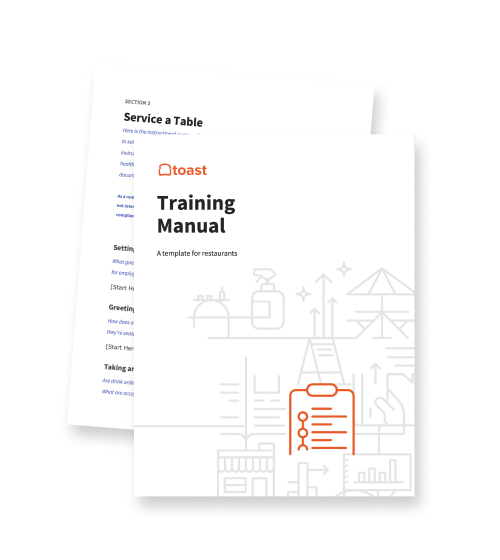
 Plantilla del manual de capacitación
Usa esta plantilla de manual de capacitación para restaurantes, un documento de Word personalizable, para proporcionar a tu personal las reglas, pautas y claridad que necesitan para hacer su trabajo con eficiencia.
Obtener descarga gratisFOH training (front of house training) is the process of teaching staff how to communicate orders and interact with guests in your restaurant. It’s essential for keeping service fast and consistent—especially during busy shifts.
Even so, effective training isn’t just about systems—it’s also about supporting your team. A widely shared parody training video inspired by Waffle House highlights this idea, using humor to show how training can connect with employees in real-world situations. As Suzanne Lucas, a human resources consultant, explains:
“While the fake training video is all about getting laughs, think about how your policies and practices support employees. If there isn’t a benefit to the employee, then maybe you shouldn’t be doing it. Engaged and happy employees perform at a much higher level than unhappy employees.”
In this guide, you’ll learn how to train your front of house staff step by step so your team can operate smoothly and deliver a better guest experience.
Key takeaways
FOH training is about building clear systems and workflows that keep service consistent and efficient.
Training staff on your POS system is essential for accurate orders, smooth communication, and fast service.
Teaching the full service flow helps staff understand timing, coordination, and the guest experience from start to finish.
Practicing real scenarios prepares your team to handle rushes, mistakes, and guest issues with confidence.
Ongoing coaching, checklists, and technology help reinforce training and improve performance over time.
Lista de verificación de la incorporación de nuevos empleados a un restaurante
Incorporar nuevos empleados a tu equipo puede ser emocionante y desafiante a la vez. Usa esta lista de comprobación en PDF gratuita para que tu personal tenga éxito.

1. Define your FOH workflows
Before training your team, you need a clear system for how service runs. FOH workflows outline how orders move from the guest to the kitchen and back to the table, helping your team stay coordinated during every shift.
Map the full service flow: Ensure nothing gets missed by defining each step from order to POS, then to the kitchen, table, and payment.
Clarify roles: Make sure servers, hosts, runners, and bartenders each know their responsibilities during service.
Prioritize consistency: Standardized workflows reduce confusion and help your team deliver the same level of service every time.
2. Train staff on your POS system
Once your workflows are defined, your team needs to execute them through your POS system. Since nearly every step of service runs through the POS, training here is critical to speed, accuracy, and communication.
Entering orders quickly and accurately: Teach staff how to navigate menus and input orders without slowing down service.
Using modifiers and special requests: Ensure customizations are entered clearly so the kitchen receives accurate tickets.
Processing payments: Train staff on splitting checks, applying discounts, and handling different payment types.
Handling common scenarios: Walk through voids, refunds, and order corrections so staff can resolve issues confidently.
3. Teach the full guest experience flow
FOH training should cover the entire guest journey, not just individual tasks. When staff understands how each step connects, service becomes more consistent and coordinated from start to finish.
Greeting and seating: Set expectations for how guests are welcomed and brought into the experience.
Taking orders and confirming accuracy: Train staff to capture orders clearly and repeat them back when needed.
Checking in and delivering food: Reinforce timing for food delivery and follow-up without interrupting the experience.
Closing out and final touchpoints: Ensure guests leave with a smooth payment process and a strong final impression.
4. Train for speed and accuracy during peak hours
Staff need to know how to maintain speed without sacrificing accuracy when volume increases. Consistent training helps your team stay efficient and composed when it matters most.
Handling lunch and dinner rushes: Prepare staff for high-volume periods where orders come in quickly and continuously.
Prioritizing tasks under pressure: Teach what needs to happen first, what can wait, and how to stay organized.
Avoiding bottlenecks and delays: Identify common slow points and train staff on how to keep things moving.
Balancing speed with accuracy: Reinforce that fast service still needs to be correct to avoid rework and guest frustration.
5. Standardize FOH and BOH communication
Strong communication between front and back of house keeps service running smoothly. Without clear systems, small missteps can quickly turn into delays, errors, and frustrated guests.
Clear order entry through POS: Make sure orders are entered accurately so the kitchen receives complete, easy-to-read tickets.
Communicating changes and issues: Train staff on how to handle modifications, delays, and out-of-stock items in real time.
Coordinating timing: Align FOH and BOH on when to fire courses, run food, and manage pacing during service.
Plantilla de manual de empleados
Describe las políticas de personal de tu restaurante en este documento de Word personalizable para ayudar a la gerencia y al personal a estar alineados.
6. Practice real service scenarios
Training shouldn’t stop at explanation—your team needs to practice handling real situations they’ll face during service. This builds confidence and prepares staff to respond quickly under pressure.
Handling mistakes and wrong orders: Teach how to fix issues quickly while keeping guests informed.
Managing guest complaints: Train staff to respond calmly, listen actively, and resolve problems professionally.
Adapting to special requests: Prepare staff to handle customizations without disrupting the flow of service.
7. Use shadowing and hands-on training
FOH training is most effective when staff learn by doing. Shadowing and hands-on experience help new hires understand how service runs in real time.
Observe experienced staff: New hires watch how experienced team members handle service, timing, and communication.
Transition to active service: Gradually move from observation to taking orders and interacting with guests.
Learn through repetition: Repeating tasks during real shifts helps build confidence and consistency.
8. Use checklists and SOPs to reinforce consistency
Clear checklists and standard operating procedures (SOPs) help your team deliver consistent service across every shift and every role.
Opening and closing duties: Define what needs to be completed at the start and end of each shift.
Side work expectations: Outline ongoing tasks like restocking, cleaning, and station setup.
Standard service steps: Document how service should be handled from greeting to payment.
Consistency across staff: Ensure every team member follows the same processes, regardless of experience level.
9. Provide ongoing coaching and feedback
FOH training doesn’t end after onboarding. Continuous coaching helps your team improve over time and maintain consistent service standards.
Reinforce strong performance: Recognize what staff are doing well so those behaviors become consistent.
Correct mistakes early: Address issues as they happen to prevent them from becoming habits.
Keep training continuous: Use pre-shift meetings and regular check-ins to reinforce expectations and refine skills.
10. Use technology to support FOH training
Technology can make FOH training more efficient by simplifying workflows and giving your team better tools to work with.
Reduce errors and simplify workflows: POS systems guide order entry and communication, making it easier for staff to follow the correct process.
Help new hires ramp faster: Intuitive systems reduce the learning curve and build confidence more quickly.
Identify training gaps: Sales data and performance insights highlight where staff may need additional support or coaching.
Good training, good service
Training servers and other FOH staff is about building a system your team can rely on during every shift. When your workflows are clear, your tools are understood, and your expectations are consistent, your team can deliver smooth service.
This matters even more in an industry where restaurant turnover rates hover around 80%, making retention a constant challenge. Strong training can help address that by improving both performance and employee experience. As Tyler Afflixio, a hospitality industry executive, explains:
“When these initial experiences with a company are positive, employees are more likely to feel prepared for the role and stay with the company for a more extended period, which is especially important in high-turnover hospitality environments.”
Remember, investing in FOH training doesn’t just improve service—it helps you build a confident team that’s more likely to stay and grow with your business.
FAQ
What is FOH?
Front of house (FOH) refers to the parts of a restaurant that guests interact with directly — essentially everything the customer sees and experiences.
What is FOH training?
FOH training is the process of teaching restaurant staff how to communicate orders, interact with guests, and manage service workflows to keep operations fast and consistent.
How does Toast help new FOH staff get up to speed faster?
Toast's intuitive interface reduces the learning curve for new hires, guiding order entry and communication so staff can build confidence quickly. Its sales data and performance insights also help managers identify where additional coaching may be needed.
What should FOH training cover beyond individual tasks?
Training should cover the entire guest journey — from greeting and seating through taking orders, delivering food, and closing out — so staff understand how each step connects and can deliver a coordinated experience.
How should staff be prepared for peak service hours?
Staff should be trained to prioritize tasks under pressure, avoid common bottlenecks, and balance speed with accuracy so that high-volume periods don't lead to errors or frustrated guests.
How does FOH training improve communication with the kitchen?
By standardizing order entry through the POS and establishing clear protocols for handling modifications, delays, and out-of-stock items, FOH training keeps both sides of the operation aligned.
What is the most effective method for training new FOH staff?
Hands-on training and shadowing are most effective — new hires observe experienced staff first, then gradually transition to taking orders and handling guests themselves, building confidence through repetition.
Does FOH training end after onboarding?
No. Ongoing coaching, pre-shift meetings, and regular feedback are essential for maintaining service standards, correcting mistakes early, and helping staff continue to improve over time.
¿Es útil este artículo?
AVISO LEGAL: Esta información se proporciona solo con fines informativos generales y su publicación no constituye un aval. Toast no garantiza la precisión ni la integridad de la información, el texto, los gráficos, los enlaces y otros elementos que incluye este contenido. Toast no garantiza que alcanzarás ningún resultado específico si sigues los consejos que aparecen aquí. Te recomendamos consultar con un profesional, como un abogado, contador o asesor comercial, para recibir asesoramiento específico para tu situación.
 Tendencias

Subscribe to On the line
Sign up to get industry intel, advice, tools, and honest takes from real people tackling their restaurants' greatest challenges.
Al enviar, aceptas recibir correos electrónicos de marketing de Toast. Trataremos tu información de acuerdo con nuestra declaración de privacidad. Información adicional disponible para residentes de California aquí.