Introducing a Fully Connected, All-in-One Handheld POS
Explore what a fully connected, all-in-one handheld POS is and why it’s becoming core infrastructure.
Author
For many restaurants, handheld POS has historically been framed as a convenience. A way to take orders tableside, reduce steps, or speed up payment at the end of a meal. But that framing is starting to feel incomplete.
What’s emerging instead is a shift in how operators think about these devices. Not as add-ons to an existing system, but as part of a broader operational infrastructure that connects the entire restaurant in real time.
What “fully connected” actually means in practice
“Fully connected” is often used as a broad phrase, but in a restaurant context, it has a very specific operational meaning.
It refers to the removal of gaps between systems, teams, and moments of service.
In a disconnected environment, orders are taken in one place, entered in another, and interpreted somewhere else. Payments happen at a different point in the journey. Data lives in separate systems that don’t always reflect what’s happening on the floor in real time.
A connected environment changes that flow.
When a server takes an order tableside, it is immediately transmitted to the kitchen exactly as entered. Modifiers, dietary requirements, and pacing instructions are preserved without reinterpretation. The kitchen sees the same information the server entered, at the same moment.
At the same time, menu availability updates across every device. If an item is sold out, it is reflected instantly, reducing the need for mid-service corrections.
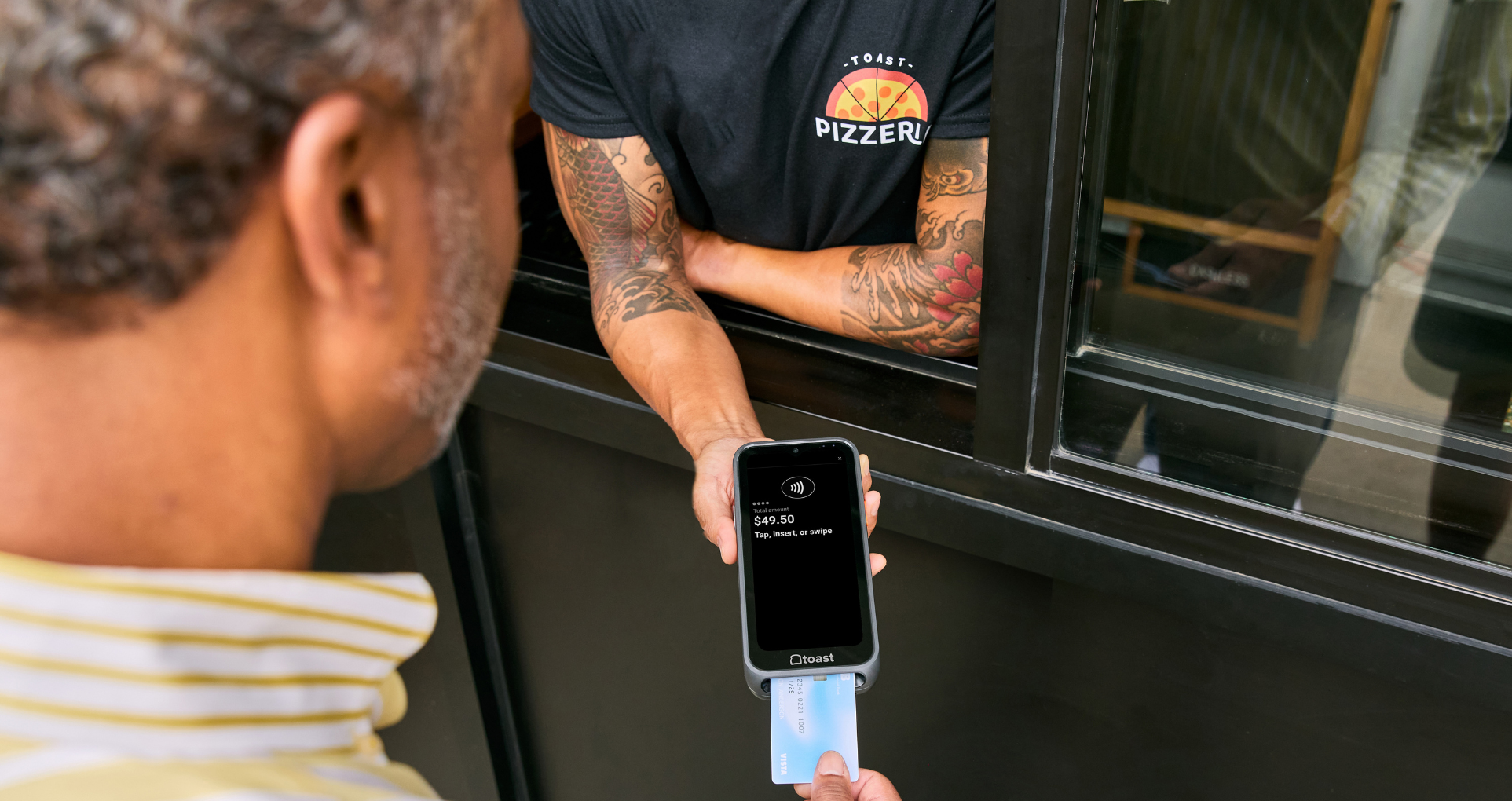
Payments are no longer a separate stage of service. They are integrated into the same flow, happening at the table, without requiring additional trips or handoffs.
This is what connectivity looks like operationally. Not a single feature, but a continuous flow of information across front-of-house and back-of-house.
Why this shift is happening now
Several structural changes in the Canadian restaurant industry are accelerating this move toward connected systems.
One is the increasing complexity of service. Many restaurants are now managing dine-in, takeout, delivery, and digital ordering simultaneously. Each channel introduces its own demands, and without integration, those demands can overwhelm the kitchen and the floor.
Another is labour pressure. According to our Canadian Restaurant Industry Predictions report, staffing challenges remain a concern for a majority of operators heading into 2026. When teams are lean, every inefficiency becomes more visible. Staff spend more time moving between systems, clarifying orders, or resolving issues that could have been prevented upstream.
Reliability is becoming a core operational priority. Connectivity issues, whether from unstable Wi-Fi or disconnected systems, can disrupt service at critical moments. In response, operators are placing greater emphasis on technology that maintains continuity under pressure.
As a result, the industry is shifting toward systems that reduce operational friction, rather than introduce additional complexity.
The role of handheld POS in a connected ecosystem
Within this broader shift, handheld POS devices are becoming the interface through which much of the operation flows.
They sit at the point where guest interaction meets system execution.
When used within a connected ecosystem, handhelds are no longer just input devices. They become the way orders are captured, transmitted, adjusted, and completed in real time.
This changes the role of the server as well. Instead of acting as a go-between, carrying information from table to terminal to kitchen, they become a direct link in the system. Orders are entered once, at the source, and flow through without duplication.
This has implications beyond speed. It affects accuracy, consistency, and the ability to maintain service standards under pressure.
It also changes how operators think about the floor itself. The dining room becomes less dependent on fixed points, such as terminals or printers, and more fluid in how service is delivered.
Case study: how connectivity reshapes service flow
This shift becomes clearer when you look at how restaurants are actually operating day to day.
At Befikre in Toronto, the team once depended on paper tickets and constant back-and-forth between the floor and the kitchen. When service got busy, service would start to break down, and chefs ended up spending more time organising orders than preparing food.
Once they switched to a connected system, everything started to run more smoothly. Orders went straight from the table to the kitchen, communication improved, and servers could handle more tables without feeling stretched. It led to a more stable service overall, with fewer mistakes and more time to focus on guests.
A similar pattern emerged at Gusto in Atlantic Canada. High volumes and limited capacity were putting pressure on service, with delays in ticket times slowing everything down. Once they moved to a more connected setup with handhelds and kitchen displays, things started to move faster, with quicker table turns and shorter ticket times.
Importantly, the technology didn’t take away from the experience. It just made it easier for the team to deliver great service, every time.
From connectivity to resilience
One of the less visible, but increasingly important, aspects of a fully connected handheld POS is resilience.
In a restaurant environment, disruptions are inevitable. Internet outages, peak service pressure, or unexpected demand can all challenge the system.
A connected handheld that can operate across Wi-Fi and cellular networks, or continue functioning in offline mode, changes how those disruptions are managed. Instead of service stopping, it adapts.
This matters more than it might appear at first glance. According to industry insights, operators are increasingly concerned about avoiding service interruptions, particularly during peak periods where the financial impact is highest.
Resilience, in this context, becomes part of the value proposition. Not just what the system can do when everything is working, but how it performs when it isn’t.
The emergence of real-time intelligence on the floor
Another defining feature of this new generation of handheld POS systems is the introduction of real-time intelligence.
Traditionally, data has been something operators review after service. Reports are analysed at the end of the day, week, or month.
What is changing is the timing of that insight.
With connected handheld systems, information can be surfaced during service itself. Servers can receive prompts for upselling, pairing suggestions, or reminders based on the context of the order. Managers can monitor performance without being physically present at every moment.
This shifts data from a retrospective tool to an active part of the service.
It also introduces another tension. The balance between automation and human interaction. The goal is not to script service, but to support it in ways that feel natural and unobtrusive.
Introducing a benchmark for connected handheld POS
Within this evolving landscape, devices like the Toast Go® 3 are designed to reflect what a fully connected handheld POS can look like in practice.
Rather than relying on a single network, it works across both Wi-Fi and cellular, so service can continue even when conditions change. Orders, payments, and printing move seamlessly across these networks, reducing one of the most common points of failure during busy shifts.
The hardware is built for hospitality environments, with durability, portability, and battery life designed to support full shifts without disruption.
More significantly, it is embedded within a connected system. Orders move directly to the kitchen, menu changes sync instantly, and payments happen at the table, removing delays from the service flow.
Real-time prompts and contextual insights enable staff to act in the moment, rather than relying on post-service reporting. The focus is on responsiveness, not added complexity.
In that sense, it functions less as a standalone device and more as part of a connected operational network.
What this means for Canadian operators
For restaurant owners, operations managers, and financial leaders, the shift toward fully connected handheld POS systems raises a broader strategic question.
What role should technology play in the operation?
If it is treated as an add-on, its impact will be incremental. It may improve certain workflows, but it will not fundamentally change how the restaurant runs.
If it is treated as infrastructure, it becomes part of how the operation is designed. It influences how teams communicate, how service flows, and how decisions are made in real time.
Data suggests that many Canadian operators are already moving in this direction. With 69% expecting to increase technology spend and a growing focus on integrated systems, the emphasis is shifting toward solutions that bring multiple functions into a single ecosystem.
This is not about adopting more technology. It is about adopting technology that reduces the need for multiple, disconnected tools.
Looking ahead
It would be easy to frame fully connected handheld POS as the inevitable future of the industry. But the reality is more nuanced.
Adoption will vary by concept, by market, and by operational priorities. Some restaurants will prioritise simplicity over integration. Others will move more quickly toward connected systems as they look to scale or stabilise their operations.
If you’re exploring handheld POS, it is worth looking more closely at how connected handheld systems perform in real environments. Reviewing ROI benchmarks, seeing how devices operate during peak service, and understanding how they integrate with the wider POS ecosystem can provide a clearer picture of what impact to expect.
Because at this stage, the decision is not just about adopting a device. It is about choosing the kind of system your restaurant is built around.

Bring service closer to your guests
Toast Handheld POS helps your team take orders and payments right at the table, keeping service fast, accurate, and personal across every shift.

Is this article helpful?
DISCLAIMER: This information is provided for general informational purposes only, and publication does not constitute an endorsement. Toast does not warrant the accuracy or completeness of any information, text, graphics, links, or other items contained within this content. Toast does not guarantee you will achieve any specific results if you follow any advice herein. It may be advisable for you to consult with a professional such as a lawyer, accountant, or business advisor for advice specific to your situation.
Subscribe to On the line
Sign up to get industry intel, advice, tools, and honest takes from real people tackling their restaurants' greatest challenges.
By submitting, you agree to receive marketing emails from Toast. We’ll handle your info according to our privacy statement. Additional information for California residents available here.