
How to Do Shelf-to-Sheet Inventory Counts: Guide to Shelf Inventory Management
Restaurant operators can streamline inventory practices and increase count accuracy with shelf-to-sheet inventory processes.

作者
 资源
资源 What is shelf to sheet inventory?
Shelf-to-sheet inventory is a method of inventory management that involves counting items directly on the shelf, recording the number on a sheet of paper or a digital device, and comparing that count to what was expected based on prior counts, new inventory additions, and recent usage.
How to Do Shelf-to-Sheet Inventory Counts: Guide to Shelf Inventory Management
Maintaining proper inventory management can be critical for restaurant operators and kitchen managers to streamline operations, minimize food costs, reduce food waste, and optimize profitability.
Traditional manual inventory counting can be time-consuming and prone to errors, resulting in inaccurate records and inefficient processes. On the other hand, shelf-to-sheet inventory can offer a practical solution to improve inventory management and streamline on-hand counts.
In this article, we'll explore why counting inventory is important, define shelf-to-sheet inventory practices, how to successfully implement shelf-to-sheet in your restaurant, and the benefits and challenges with implementing it.
餐厅成本控制指南
使用本指南,您可以了解更多有关餐厅成本、如何跟踪成本以及如何最大限度地提高盈利能力的信息。


Consistently counting inventory is the foundation of restaurant inventory control
Inventory control is an essential restaurant management practice. It enables operators and managers to define par levels for particular ingredients and ensure that there’s enough on hand or that it’s included on upcoming supplier order guides.
All team members in the back of house can be trained to count inventory — tracking total quantities, understanding different units of measure across products, and updating order guides.
What is shelf-to-sheet inventory?
Shelf-to-sheet inventory is a method of inventory management that involves counting items directly on the shelf, recording the number on a sheet of paper or a digital device, and comparing that count to what was expected based on prior counts, new inventory additions, and recent usage.
Every shelf from the walk-in to dry storage gets hands-on counts for everything that’s in stock.
This process eliminates the need for physically moving items to a separate location for counting, thus helping save time and reducing inaccuracies in inventory records. It’s a common practice for the back of house at restaurants, given few have the space or time to manually move all their products to another space for counts.
Potential benefits shelf-to-sheet inventory counts
Shelf-to-sheet inventory can enable restaurant owners and kitchen managers to streamline the inventory management process.
There can be several benefits for restaurants to implement shelf to sheet:
Streamlined operations: By counting items directly on the shelf, you can streamline the inventory management process, saving time and reducing labor costs associated with manual inventory counting.
Improved accuracy: Shelf-to-sheet inventory reduces the likelihood of recording errors associated with traditional manual counting, improving inventory accuracy.
Cost savings: Accurate inventory management and reduced waste can result in reductions to cost of goods sold (COGS) — savings for the restaurant.
Challenges of manual inventory counting
Manual inventory counting involves several challenges that can negatively impact accuracy and overall efficiency:
Time-consuming: Manual counting can be time-consuming, reducing overall productivity and labor efficiency.
Inaccuracies: The manual counting process increases the likelihood of recording errors, resulting in inconsistencies in inventory records.
Inefficiencies: Traditional manual counting methods require moving items to a separate location, slowing down the counting process and creating inefficiencies.
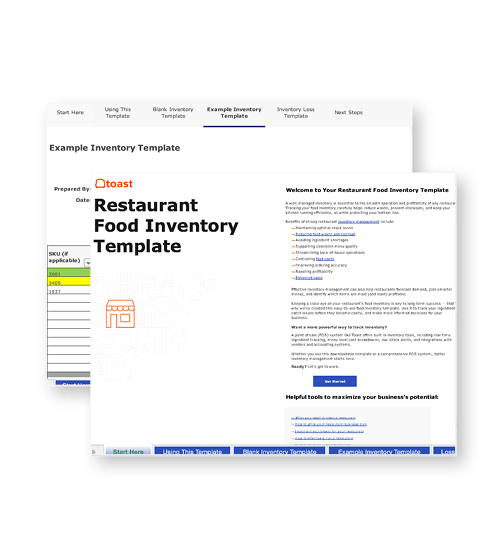
定期自动补货库存表模板
借助这份可定制的定期自动补货库存表模板,无缝跟踪库存。
Implementing shelf-to-sheet restaurant inventory management tactics
Properly implementing shelf-to-sheet inventory can require careful planning, systematic execution, and diligent follow-up.
Performing regular inventory audits, utilizing technology, and training staff can all help restaurant businesses efficiently and effectively implement shelf-to-sheet inventory — achieving newfound operational optimizations and increasing profitability.
The following steps can help ensure efficient and effective implementation from the first-time to tomorrow.
Prepare for the inventory count: Before conducting the inventory count, organize the shelves, familiarize yourself and your team with inventory count sheets, Excel files, or formal inventory management systems to ensure an efficient and systematic approach. Allocate necessary resources, including additional staff and materials, to complete the count accurately and swiftly.
Execute the shelf-to-sheet inventory process: Count items directly on the shelf, recording the number on a sheet of paper or a device. Use templates and worksheets to help boost adoption for shelf-to-sheet food inventory. Ensure a systematic counting approach by organizing the shelves based on item type, category, or location. Track and document inventory levels diligently, ensuring there are no unaccounted-for items.
Deal with discrepancies: Upon completing the inventory count, reconcile inventory records with the actual inventory levels. Investigate and resolve discrepancies, documenting the corrective actions taken. This step is critical for maintaining accurate inventory records.
Regular inventory audits: Perform regular inventory audits to recheck inventory levels and maintain accuracy. Schedule audits at least once a month, or more frequently, if necessary.
Train staff for efficient inventory tracking: Train staff on the importance of efficient inventory management, proper handling, and storage of inventory items, and standardized counting practices.
Utilize technology for improved accuracy
While there may always be a manual, hands-on component to inventory counts, technology can help improve the accuracy and efficiency of shelf-to-sheet practices and all inventory management processes.
Achieving consistently accurate and efficient inventory counts can require scheduling and organization — and it can help if the counts consider information from recent invoices.
In a lot of ways, invoice automation processes make a strong foundation for restaurant inventory management practices. Such tools can streamline counts by helping provide a baseline for what products should be on-hand and where they may be.
Furthermore, the software can also simplify your entire inventory management process by:
Prompting inventory counts. Just set the frequency, time of day, and assign a staff member to take inventory.
Letting you manage inventory via mobile apps, even if you have no Wi-Fi deep inside the walk-in. Simply sync up to the Wi-Fi when you have internet access again, and counts will update automatically.
Making it easy to build count sheets by creating a product catalog from digitized invoices. Historical prices update automatically, so you don’t have to dig through old invoices to find previous pricing, and you can drag and drop new products into existing count sheets when needed.
Ensuring your inventory levels are up to par. Simply select your par levels when using the system for the first time. Then, after you’ve taken inventory, watch how the software automatically generates order guides based on what you have available and what you need to maintain par. It’s that simple.
The benefits of invoice automation tools can extend far beyond inventory. Some restaurant invoice processing software can automatically apply General Ledger (GL) codes to the products on your invoices, rather than having to manually determine which bucket product costs fall into. These codes are part of your restaurant accounting best practices and are vital if you want to improve efficiency and reduce food costs.
Restaurant Invoice Automation Guide
Use this guide to learn more about your restaurant invoices, the value within, and how to consistently and accurately tap into it to make smarter decisions.
Investing in restaurant inventory management software
Whether it’s shelf-to-sheet, Excel spreadsheets, or any other combination of processes, inventory management is meant to help keep food costs down and can track your profitability.
That’s why Toast and xtraCHEF by Toast combine to offer an automated inventory management solution that’s based on a strong data foundation via invoice automation.
xtraCHEF combines invoice processing automation and inventory management in a single platform to help you spend less time flipping between platforms and more time running your restaurant and growing your business.
Learn more about the power of Toast and xtraCHEF by Toast today.
 TOAST TECH
 Built for restaurants just like yours.
Toast’s restaurant technology includes point of sale, kitchen display screens, online ordering, loyalty, analytics, payroll, and more.
FAQs
How often do restaurants do inventory?
This depends on how often you have deliveries in your restaurant. Most restaurants do inventory check-ins 1 - 2 times per week, but it makes sense to take count of your inventory every time you’re restocking, to make sure that everything is fresh and within its expiration dates.
How is food cost calculated?
Food cost percentage is calculated by taking the cost of goods sold and dividing that by the revenue or sales generated from that finished dish. Learn more about calculating food cost percentages here.
How much food inventory should a restaurant carry?
Food inventory management is essential for keeping critical ingredients in stock. You only need to have enough inventory to cover your sales, plus a little bit extra in case of an emergency. For most restaurants, this usually means about 5 - 7 days worth of inventory, if you’re getting 1 - 2 deliveries per week.
What is a good inventory to sales ratio?
A good inventory to sales ratio is between 4 and 8, which means selling your entire food inventory between four and eight times each month.
What is the average inventory turnover ratio for restaurant food?
The inventory turnover ratio indicates the number of times the store sold out its inventory in a given time period. A low inventory turnover ratio indicates either low sales or too much inventory in stock, while a high inventory turnover ratio indicates either strong sales or a poor inventory purchasing plan. The restaurant industry average is about five.
这篇文章有帮助吗?
免责声明:此信息仅作为一般性参考,发布并不构成认可。Toast 不保证本内容中包含的任何信息、文本、图形、链接或其他项目的准确性或完整性。Toast 不保证如果您遵循本文的任何建议,就能取得任何特定结果。您可能需要咨询专业人士,如律师、会计师或商业顾问,以获取针对您情况的具体建议。
 趋势
趋势
