Restaurant Inventory Sheet Template: Complete Guide To Daily Food Inventory Management (2025)
A complete guide to restaurant inventory sheets, from FIFO to software solutions, to control costs and streamline operations.

作者
 资源
资源 Effective restaurant inventory management has never been more critical for profitability and sustainability. With the top features restaurateurs are looking for in a restaurant POS upgrade being ease of use, depth of reporting, and inventory reporting, and the industry facing food costs estimated at 28% to 35% of restaurant sales, implementing proper inventory tracking systems is essential for success.
Restaurant inventory sheets serve as the foundation for controlling costs, reducing waste, and maximizing profitability. With restaurants leaving approximately $2 billion in profits on the table as a result of food waste, systematic inventory tracking has become a crucial competitive advantage.
Key takeaways
Understand what restaurant inventory sheets are and why they’re essential for cost control and profitability.
Learn the different types of inventory sheets and how to use them effectively.
Apply best practices like FIFO, accurate counts, and regular reviews to reduce waste and improve efficiency.
Explore how inventory management software can streamline tracking, automate processes, and boost your bottom line.
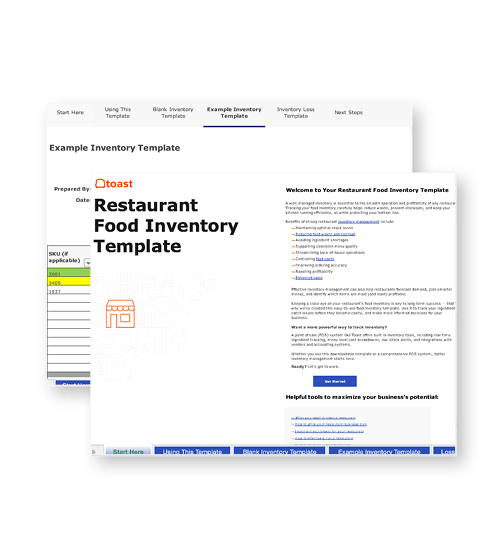
餐厅食品库存模板
使用这个免费的食品库存模板,帮助您的企业规范、轻松管理库存。

What are restaurant inventory sheets?
Restaurant inventory sheets are structured tools that help operators record, track, and analyze food and beverage stock across all storage areas. By keeping an accurate record of what’s on hand, restaurants can monitor stock levels in real time, identify usage patterns and trends, and make informed purchasing decisions that protect profitability.
Modern inventory sheets have evolved beyond simple spreadsheets to include digital templates that integrate with POS systems and supplier networks. This shift is paying off — 42% of restaurants now use software solutions to track and reduce waste, reflecting the industry’s move toward technology-driven inventory management.
Why restaurant inventory management matters in 2025
The stakes for effective inventory control have never been higher. In 2025, restaurants are navigating a perfect storm of rising costs, waste concerns, and market pressure:
Food waste crisis: The U.S. restaurant industry loses $162 billion annually to food waste, generating more than 11 million tons of discarded food each year.
Profit margin pressure: With food costs eating up 25% to 35% of every sales dollar, even small improvements in inventory efficiency can make a significant difference to the bottom line.
Inflation impact: 52% of restaurant professionals named high operating and food costs as a top priority, and 42% of operators raised menu prices as a reaction to inflation in the past 12 months.
Toby Malbec, Managing Director at ConStrata Technology Consulting, emphasizes that the challenge is striking the right balance. Malbec explains, “Supply chain interruptions and increasing costs remind us that staying in business requires more than boosting guest counts and increasing prices. More than ever, there is little margin for error for inventory overstocking and waste. On the other hand, you want to ensure you have sufficient inventory to meet guest demand. Getting it ‘just right’ is a Goldilocks dilemma that requires planning, attention to detail, and — very likely — an inventory management system.”
Bottom line: Tight inventory management is no longer optional — it’s a competitive necessity for survival and profitability.
How to use inventory sheets for better stock control
To get the most out of your food inventory sheets, focus on consistent tracking and clear processes:
Set a schedule: Count high-value perishables daily, long-shelf-life items weekly, and conduct a full inventory monthly.
Assign responsibility: Designate specific staff to handle inventory so counts are consistent and accurate.
Standardize units: Use the same unit of measure for each item (cases, pounds, bottles) to avoid confusion.
Leverage templates or software: Whether using Excel or an integrated POS tool, ensure your sheet calculates totals automatically and flags variances.
Review and act: Compare inventory data to sales reports, adjust orders based on trends, and investigate discrepancies promptly.
By treating your inventory sheet as a decision-making tool rather than just a record-keeping form, you can reduce waste, improve cost control, and ensure you always have the right products on hand.
Types of food inventory sheets
Daily food inventory sheets
Track perishable items with short shelf lives, including fresh produce, dairy, and proteins. Daily tracking helps prevent spoilage and ensures FIFO (first-in, first-out) compliance.
Weekly inventory sheets
Used for items with longer shelf lives, such as dry goods, canned products, and frozen items. These sheets track broader consumption patterns and support weekly ordering cycles.
Beverage inventory sheets
Specialized tracking for alcoholic and non-alcoholic beverages, including beer kegs, wine bottles, and spirits. Toast's xtraCHEF platform helps restaurants track yield on all kegs and bottles based on serving sizes, a task that's particularly complex without proper systems.
Par inventory sheets
Track minimum stock levels for each item to prevent stockouts while avoiding overordering. According to Foodprint, up to 10% of food purchased by restaurants is wasted before reaching the customer, making par level management crucial for profitability.
Key components of effective inventory sheets
An effective inventory sheet captures all the details you need to track stock accurately, control costs, and prevent waste. The most useful sheets include:
1. Item Identification
Product name and description: Full name plus any key details (e.g., “Organic Roma Tomatoes”).
SKU or product codes: Unique identifiers for faster tracking and ordering.
Unit of measure: Cases, pounds, bottles, or other consistent units.
Storage location: Walk-in cooler, dry storage, freezer, or bar area.
For example, imagine logging tomatoes on your inventory sheet. Instead of just writing “tomatoes,” you note “Organic Roma Tomatoes, 20 lb case, Walk-in Cooler, SKU #12345.” That level of detail makes it clear where the product is stored, how it’s measured, and what’s actually on hand — reducing confusion, preventing double orders, and making it easier for staff to track usage.
2. Quantity Tracking
Beginning inventory count: Stock on hand at the start of the period.
Deliveries received: Items added during the period.
Usage/consumption: Amount used during the period.
Ending inventory count: Remaining stock at the end of the period.
Variance analysis: Compare expected vs. actual usage to spot shrinkage, theft, or waste.
For example, if you start the week with 10 cases of chicken, receive 5 more, and sell enough dishes to account for 12 cases, your ending count should be 3. If only 2 remain, the variance signals possible waste, portioning errors, or theft — issues you can investigate and correct.
3. Cost Information
Unit cost per item: Price per case, pound, or bottle.
Total value per item: Unit cost × quantity on hand.
Extended cost calculations: Total value of all items combined.
Cost per serving or portion: Helps with menu pricing and profitability analysis.
For example, if a 20-pound case of rice costs $25, the unit cost is $1.25 per pound. With 40 pounds on hand, the total value is $50. If each portion uses half a pound, the cost per serving is about $0.63 — numbers that help you price dishes correctly and calculate overall food costs.
4. Date and Rotation Tracking
Delivery dates: When the stock was received.
Expiration dates: Critical for food safety.
FIFO rotation notes: Reminders to use older stock first.
Quality indicators: Notes on freshness, damage, or product condition.
For example, if a shipment of dairy arrives on Monday with a two-week shelf life, staff label it with the delivery and expiration dates, place it in front of last week’s stock, and note any damaged cartons. This ensures the oldest products are used first, expired items don’t slip through, and quality issues are caught before service.
What is shelf-to-sheet inventory?
Shelf-to-sheet inventory is a real-time tracking method that records items on your inventory sheet as soon as they’re placed on shelves — and updates counts immediately when items are used or moved. This approach minimizes discrepancies and keeps inventory data accurate at all times.
It’s especially valuable for large or high-volume operations, where turnover is fast and stock levels can change rapidly. By updating counts continuously, operators can:
Prevent stock issues: Continuous updates reduce the risk of overstocking or running out of key ingredients.
Simplify workflows: Streamlined processes make inventory faster and easier for staff.
Improve ordering: Accurate, real-time data supports smarter purchasing decisions.
Using technology can make shelf-to-sheet even more efficient. For example, Toast's inventory management system provides real-time tracking and automates much of the process, cutting down on manual errors and saving valuable time.
What is first-in, first-out (FIFO)?
First-in, first-out (FIFO) is an inventory management method designed to minimize spoilage and maximize turnover by using the oldest products first. This ensures perishable items are consumed before their expiration dates, reducing the risk of waste from sitting inventory.
FIFO is especially important for ingredients with short shelf lives — such as fresh produce, dairy, or baked goods. By following FIFO, restaurants can:
Optimize inventory turnover: Keep stock moving so products are used promptly, reducing the risk of spoilage.
Reduce food waste: Ensure older items are used first, minimizing losses from expired products.
Maintain high-quality standards: Serve dishes with the freshest possible ingredients to meet customer expectations.
Improve customer satisfaction: Consistently fresh food leads to better dining experiences and repeat visits.
For example, if a delivery of lettuce arrives on Monday and another comes in on Wednesday, the Monday shipment is placed at the front of the cooler and used first. This simple practice keeps inventory fresh, prevents unnecessary waste, and ensures customers always receive the best quality product.
How to implement FIFO effectively
Consistent application of FIFO requires clear systems, staff training, and regular quality control to keep inventory fresh and waste to a minimum. Include:
Date labeling: Clearly mark all incoming inventory with delivery and/or expiration dates.
Rotation procedures: Always place newer stock behind older stock so older items are used first.
Staff training: Teach and reinforce FIFO practices with all back-of-house team members.
Quality checks: Inspect dated items regularly to identify and address potential waste early.
Did you know? In a typical American restaurant, 85% of unused food is thrown away, with only a small percentage recycled or donated — making proper FIFO practices a critical step toward waste reduction.
Control food costs with accurate inventory counts and practices
Cost of goods sold (COGS) is one of the most important metrics for restaurant profitability. Accurate inventory counts paired with disciplined management practices give operators the insight needed to control food costs and protect margins.
All back-of-house team members should be trained to:
Count inventory accurately and consistently
Understand and apply the correct units of measure across products
Update order guides promptly to reflect current stock levels
For instance, if a kitchen team consistently counts a 24-bottle case of olive oil as 12 units instead of 24, order guides will show inaccurate usage, leading to over-purchasing. Training staff to count correctly and update guides ensures ordering matches true demand, preventing waste and keeping food costs under control.
Forecasting customer demand and tracking menu items
Strong forecasting prevents both overstocking and costly shortages. By reviewing historical sales data and factoring in seasonality, customer preferences, and upcoming events, operators can plan purchases more precisely.
By using restaurant analytics collected from your POS system, you can review detailed sales reports to make forecasting easier and predict sales for certain scenarios like holidays, seasons, events, and weather conditions.
Managing food cost fluctuations
Fluctuations in food cost percentages can significantly impact a restaurant's bottom line. By regularly monitoring and analyzing these fluctuations, operators can identify areas for restaurant cost control. Food cost percentages have been hard to tame for many restaurants as food inflation has raged, with adjusting portion sizes, negotiating prices with suppliers, and finding alternative ingredients helping to mitigate cost fluctuations and improve profit margins.
Reducing food waste with an efficient inventory tracking template
Food waste is one of the restaurant industry’s biggest profit drains—and a major sustainability challenge. An efficient inventory tracking template provides a clear, structured way to record stock levels, usage, and expiration dates, allowing operators to spot waste before it happens. By keeping the template updated consistently, restaurants can identify issues such as spoilage from expired products, spillage during prep or service, and overstocking that leads to sitting inventory.
Pairing the template with inventory turnover analysis helps refine ordering practices and keep stock moving. Incorporating a first-in, first-out (FIFO) approach further reduces waste by ensuring the oldest ingredients are used first. When combined with stock adjustments based on shelf life and usage frequency, this process keeps ingredients fresh, minimizes spoilage, and strengthens overall sustainability.
Implementation best practices
Staff training
Successful inventory management requires comprehensive staff training on:
Proper counting techniques and procedures: Ensure accuracy by following consistent counting methods during every inventory cycle.
Understanding units of measure and conversion: Use standardized measurements and know how to convert between them to prevent ordering or portioning errors.
Using inventory software and mobile devices: Leverage digital tools for faster, more accurate tracking and reduced manual entry errors.
Recognizing quality issues and proper rotation: Identify spoilage or damage early and follow FIFO rotation to maintain freshness.
Scheduling and accountability
Establish clear procedures for inventory management:
Assign specific team members to inventory responsibilities: Designate consistent staff to handle counts for accuracy and familiarity with products.
Create regular counting schedules (daily, weekly, monthly): Set a routine cadence for different inventory categories to keep data up to date.
Implement check and verification procedures: Use double-checks or manager sign-offs to ensure counts are correct.
Establish accountability measures for accuracy: Track performance and address recurring errors to maintain reliable inventory data.
Continuous improvement
Regular review and optimization of inventory processes:
Monthly analysis of inventory accuracy and variance: Identify discrepancies early to prevent ongoing losses and improve tracking methods.
Quarterly review of par levels and reorder points: Adjust stock minimums based on seasonal demand, sales trends, and menu changes.
Annual assessment of supplier performance and costs: Evaluate pricing, quality, and reliability to ensure you’re getting the best value.
Ongoing staff feedback and procedure refinement: Encourage input from the team to spot inefficiencies and improve processes over time.
Measuring inventory management success
Key performance indicators for inventory management include:
Food cost percentage: Aim for 28% to 35% depending on restaurant type. to maintain healthy margins.
Inventory turnover: Measures how quickly inventory is used over a set period, with a higher turnover rate indicating fresher stock and better efficiency.
Waste percentage: Keep waste below 2% to 4% of total food purchases to control costs and improve sustainability.
Variance accuracy: Maintain inventory accuracy above 95% to minimize losses from theft, spoilage, or counting errors.
Regular monitoring of these metrics helps identify improvement opportunities and demonstrates the value of effective inventory management practices.
Investing in restaurant inventory management software
Whether you’re using shelf-to-sheet methods, Excel spreadsheets, or a hybrid approach, the goal of inventory management is the same: keep food costs down and protect profitability. Consistently counting inventory is the foundation of strong restaurant cost control. When the process is optimized, operators can improve their bottom line while meeting customer demand more efficiently.
Modern restaurant inventory management software takes this a step further with:
Real-time tracking: Monitor inventory levels instantly for up-to-date accuracy.
POS integration: Connect sales and stock data for seamless, automated updates.
Comprehensive reporting: Use detailed insights to guide smarter purchasing and menu decisions.
These tools empower operators to make data-driven decisions, automate reordering, and negotiate better supplier contracts. Beyond inventory control, they streamline operations, centralize data storage, and give a complete picture of inventory, sales, and costs — all of which contribute to higher profitability.
Toast and xtraCHEF by Toast deliver an automated inventory solution built on a strong data foundation through invoice automation. By combining invoice processing automation and inventory management in a single platform, xtraCHEF helps you spend less time switching between systems and more time running and growing your restaurant.
Learn more about the power of Toast and xtraCHEF by Toast today.
Final thoughts
Mastering inventory management isn’t just about keeping shelves stocked — it’s about protecting your margins, reducing waste, and creating a more sustainable operation. The most successful restaurants pair disciplined counting and rotation practices with the right technology to gain real-time visibility into their stock and costs. Start small by tightening your processes, then build on that foundation with tools that make tracking faster, smarter, and more accurate. Every improvement you make in inventory control is an investment in your restaurant’s long-term profitability.
Frequently asked questions
How often should restaurants conduct inventory counts?
Most restaurants benefit from daily counts for high-value perishables, weekly counts for dry goods and frozen items, and monthly full inventory counts for comprehensive analysis.
What's the difference between perpetual and periodic inventory systems?
Perpetual systems track inventory continuously in real-time, while periodic systems conduct counts at regular intervals. Most modern restaurants use perpetual systems integrated with POS data.
What are the most common inventory management mistakes?
Common errors include inconsistent counting procedures, poor FIFO rotation, inadequate staff training, and failure to integrate inventory data with sales and purchasing decisions.
How does inventory management help with food safety compliance?
Proper inventory tracking includes expiration date monitoring, temperature logging, and supplier verification, all crucial components of food safety compliance and HACCP protocols.
这篇文章有帮助吗?
免责声明:此信息仅作为一般性参考,发布并不构成认可。Toast 不保证本内容中包含的任何信息、文本、图形、链接或其他项目的准确性或完整性。Toast 不保证如果您遵循本文的任何建议,就能取得任何特定结果。您可能需要咨询专业人士,如律师、会计师或商业顾问,以获取针对您情况的具体建议。
 趋势
趋势