Menu Engineering Matrix: Your Guide to Stars, Puzzles, & More
Discover how the menu engineering matrix can transform your restaurant’s menu. Learn why it’s key to identify your Stars, Puzzles, Plowhorses, and Dog

作者
 资源
资源 Your restaurant’s menu is more than just a list of dishes—it’s the cornerstone of your success. As Dr. Sybil Yang, a professor and menu design researcher at San Francisco State, explains in a study:
“The good news for restaurants is that people are reading the menus carefully, and that they seem to be choosing an entrée and then building a meal around it.”
In other words, your menu isn’t just being read—it’s shaping your guests’ dining experiences. By strategically engineering your menu, you can showcase your best dishes, maximize profitability, and streamline kitchen operations.
At the heart of this process is the menu engineering matrix. This essential tool evaluates menu items based on both popularity and profitability, giving you a clear path to decide which dishes to elevate, adjust, or phase out. With that in mind, let’s explore how the menu engineering matrix works, how to build one, and how it can help your restaurant thrive.
Key takeaways
The menu engineering matrix categorizes dishes into Stars, Puzzles, Plowhorses, and Dogs based on popularity and profitability, helping you make informed menu decisions.
Stars—highly profitable and popular items—should be featured prominently on your menu and in marketing campaigns to boost visibility and sales.
Plowhorses are crowd-pleasers with low profitability. Strategies like portion adjustments, price tweaks, and pairing them with high-margin items can boost their profitability without losing their appeal.
Puzzles represent untapped opportunities; by adjusting their presentation or promotion, you can transform them into guest favorites.
Removing underperforming items (Dogs) can simplify operations, reduce waste, and create space for more successful dishes.
 Start optimizing your menu
 Toast Menu Checker
Fresh ideas for your restaurant menu in 3 quick steps.

What is a menu engineering matrix?
A menu engineering matrix is a strategic tool that categorizes every item on your menu into four quadrants—Stars, Puzzles, Plowhorses, and Dogs—based on two variables: profitability and popularity. Plot your items on a grid (x-axis: popularity, y-axis: profitability) and you get a clear, visual picture of what's working, what's not, and where to act.
Each category serves a distinct purpose, offering insights into what’s working, what’s not, and what adjustments could boost overall profitability. Understanding which items are bringing in the most revenue and why helps you:
Maximize profitability by promoting high-margin items.
Streamline operations by focusing on dishes that align with your kitchen’s strengths.
Enhance the guest experience by curating a menu that resonates with customer preferences.
Reduce waste by minimizing low-performing items that don’t justify their cost.
餐厅成本控制指南
使用本指南,您可以了解更多有关餐厅成本、如何跟踪成本以及如何最大限度地提高盈利能力的信息。
What are Stars, Puzzles, Plowhorses, and Dogs?
Stars (high profitability, high popularity): Your best performers. High margin, high demand. Protect them.
Puzzles (high profitability, low popularity): High margin, but guests aren't ordering them. Untapped revenue sitting on your menu.
Plowhorses (low profitability, high popularity): Guests love them. Your margins don't. The goal is to close that gap without killing the appeal.
Dogs (low profitability, low popularity): Low margin, low demand. Every menu has them. Most menus keep them too long.
Category | Profitability | Popularity | What to Do |
Stars | High | High | Protect, promote, and feature prominently |
Puzzles | High | Low | Improve visibility, descriptions, and staff recommendations |
Plowhorses | Low | High | Adjust pricing, portions, or bundle with high-margin items |
Dogs | Low | Low | Evaluate, test one adjustment, then remove if no improvement |
Stars (high profitability, high popularity)
Stars are your highest-margin, highest-demand items. They're already doing the work. Your job is to make sure every guest sees them. To maximize the impact of your Stars:
Feature them prominently: Place Stars in high-visibility areas of your menu, like the top right corner or a dedicated "house specialties" section.
Ensure consistent quality: Keep these dishes consistently excellent, as any dip in quality could damage their popularity.
Train your staff to recommend them: Empower servers to highlight Stars during guest interactions to boost sales further.
Use them in marketing campaigns: Showcase Stars on social media, in promotions, or as part of special events to draw attention to your best offerings.
Puzzles (high profitability, low popularity)
Puzzles have the margins. They don't have the orders. Something is getting in the way—visibility, description, placement, or all three. That's fixable.
While Puzzles aren't performing as well as they could, they represent untapped potential. By making small, targeted changes, you can transform these items into menu favorites:
Improve their visibility: Highlight Puzzles on your menu with eye-catching design elements, such as bold font, placement in a featured section, or a chef's recommendation badge.
Revisit the description: Rewrite menu descriptions to make these items more appealing. Use mouthwatering language or emphasize unique ingredients.
Incorporate staff recommendations: Train servers to suggest Puzzles to guests by explaining their value, flavor, or exclusivity.
Offer limited-time promotions: Create specials or discounts around Puzzles to entice customers to try them.
Gather customer feedback: Conduct surveys or analyze sales data to understand why Puzzles aren't as popular and adjust accordingly.
Plowhorses (low profitability, high popularity)
Plowhorses are your most-ordered items with your slimmest margins. Guests keep coming back for them. Your bottom line keeps taking the hit. The fix isn't to cut them—it's to make them work harder.
Removing them from your menu could alienate loyal customers, but leaving them as-is may leave money on the table. The key is to manage them carefully, ensuring they remain profitable while maintaining their strong appeal. With a few tweaks, you can improve the profitability of Plowhorses without sacrificing their popularity:
Adjust portion sizes: Reduce waste and control costs by slightly decreasing portion sizes while maintaining customer satisfaction.
Increase prices strategically: Test small price increases to gauge whether customers are willing to pay more for these beloved items.
Enhance perceived value: Add premium touches like garnishes, unique plating, or ingredient upgrades to justify higher prices.
Optimize ingredient sourcing: Negotiate with suppliers to lower costs or explore alternative ingredients that maintain quality but reduce expenses.
Bundle with high-margin items: Pair Plowhorses with profitable sides, drinks, or desserts to increase the overall check size.
Dogs (low profitability, low popularity)
Dogs are low-margin, low-demand items. They take up menu space, add complexity to your kitchen, and don't earn their keep. Every menu has them. Not every operator acts on them.
While every menu has its weak spots, keeping Dogs around can weigh down your menu's overall effectiveness. They take up valuable menu space, add complexity to kitchen operations, and may even confuse customers with too many choices.
Although Dogs may seem like an obvious cut, it's essential to understand why they're underperforming before making a decision. Are they too niche? Poorly marketed? Priced incorrectly? Or simply not aligned with customer preferences?
In some cases, a small adjustment could transform a Dog into a Puzzle or even a Star. Here's how to handle low-performing menu items effectively:
Evaluate their fit: Consider whether Dogs align with your restaurant's brand, concept, and customer base. If they don't, it might be time to let them go.
Analyze sales data: Use your POS system to identify Dogs definitively. Look at their sales volume, profitability, and customer feedback.
Test adjustments: Try reworking Dogs with improved recipes, better descriptions, or strategic pricing to gauge if they can gain traction.
Phase them out: If adjustments don't work, remove Dogs from your menu to streamline operations and make room for higher-performing items.
Focus on opportunities: Use the space and resources freed up by eliminating Dogs to promote Stars, improve Puzzles, or refine Plowhorses.
菜单工程课程
参加本课程,充分发挥菜单的作用。学习菜单心理学与设计、在线菜单管理,以及如何调整菜单以提升销售额。
How to create your menu engineering matrix
Building a menu engineering matrix might seem complex at first, but breaking it into manageable steps makes it a more straightforward process. By collecting accurate data, analyzing key metrics, and visualizing your menu’s performance, you can unlock powerful insights that drive profitability and efficiency.
Collect your data
Data is the foundation for every decision you’ll make during the menu engineering process. Without accurate data, you’re left relying on guesswork—which can lead to missed opportunities or costly mistakes.
So, start by collecting essential data points for each menu item:
Item sales volume: Understand how often each item is ordered.
Menu price for each item: Track the price you’re charging for every dish or drink.
Food cost percentage: Calculate the cost of ingredients as a percentage of the menu price.
Total cost (including labor and seasonings): Consider all variable costs, including prep labor and minor ingredients like garnishes or spices, to get an accurate cost-per-item.
Analyze your data
Once you have the raw data, calculate these KPIs to gain deeper insights:
Contribution margin per item: Subtract the total cost from the menu price to determine how much each item contributes to your bottom line.
Profit margin percentages: Divide the contribution margin by the menu price to measure the profitability of each item.
Item popularity index: Divide the number of times an item is sold by the total number of menu items sold. This shows how popular the item is relative to others.
Your POS system is one of the most valuable tools for collecting and analyzing this data. It provides real-time insights into sales trends, profitability, and customer preferences, making it easier to categorize your menu items accurately.
Plot your menu engineering matrix
Plotting your menu engineering matrix gives you a clear snapshot of how each item contributes to your restaurant’s success. This visual tool allows you to clearly categorize your menu items into Stars, Plowhorses, Puzzles, and Dogs. Here’s how to plot your matrix:
Set up your axes: The x-axis represents popularity (low to high). The y-axis represents profitability (low to high).
Place your menu items: Use the KPIs you calculated—item popularity index and contribution margin per item—to determine where each item belongs. Items with high popularity and high profitability fall into the top-right quadrant (Stars), while low-profit, low-popularity items land in the bottom-left quadrant (Dogs).
Review the distribution: Assess where most of your menu items fall. If you have too many items in the Puzzles or Dogs quadrants, this indicates areas for improvement. Identify any imbalances—like an over-reliance on Plowhorses—and plan adjustments to diversify your menu’s profitability and appeal.
Improve and adapt your menu
Menu engineering isn’t a one-time effort—it’s an ongoing process of refinement and adaptation. After plotting your menu engineering matrix, use it as a roadmap to implement changes and monitor results:
Test adjustments: Experiment with portion sizes, pricing, or descriptions for Plowhorses and Puzzles to improve their performance. For Dogs, test recipe tweaks or reposition items in your menu design to see if they gain traction.
Monitor performance: Use your POS system to track the impact of your changes. Are previously underperforming items improving? Are Stars maintaining their success?
Gather feedback: Regularly collect input from customers and staff to ensure that changes resonate with diners and align with operational goals.
Update regularly: Revisit your menu engineering matrix every quarter or after significant changes, such as introducing new menu items or adjusting pricing.
Menu engineering matrix examples
McDonald’s is a global fast-food giant with a highly engineered menu. Let’s classify a few key menu items into the menu engineering matrix categories:
Star - Big Mac: The Big Mac has a low cost of production relative to its selling price and is one of McDonald’s most popular items worldwide.
Positioned prominently on menus.
Marketed in combo meals to boost sales.
Used in advertising, such as limited-time promotions like the Mac Jr. or Grand Big Mac.
Plowhorse - French Fries: While French Fries are extremely popular, their profitability per unit is lower due to high ingredient and preparation costs (potatoes, frying oil, labor).
Sold in multiple sizes to encourage upselling.
Paired with drinks and sandwiches in combo meals to increase total profitability.
Puzzle - Premium Salads: These items are priced higher than typical McDonald’s food, yielding good margins, but are less popular due to their perceived mismatch with McDonald’s core brand.
Marketed as part of a health-conscious initiative to attract a niche customer base.
Highlighted in specific campaigns targeting health-conscious diners.
Dog - Artisan Grilled Chicken Sandwich: This item was introduced as a healthier option, but it struggled to find an audience due to its higher price point and competition from more indulgent menu items. It also required more preparation time, impacting operational efficiency.
7 tips for using psychology for menu engineering
Psychology plays a powerful role in how customers perceive and interact with your menu.
By understanding and leveraging these psychological principles, you can guide diners’ choices, encourage higher spending, and enhance the overall dining experience.
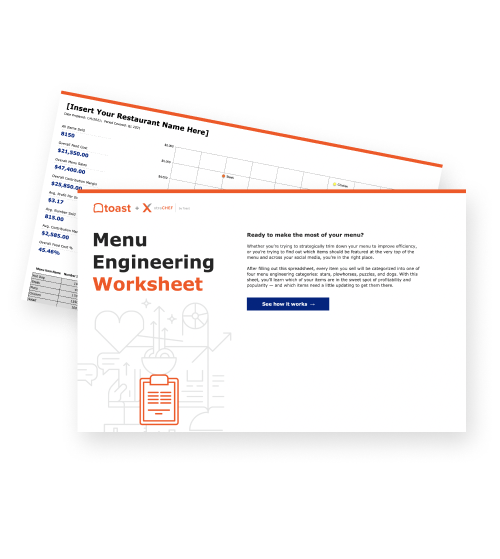
菜单工程工作表
这份菜单工程工作表包含复杂精细的菜单工程公式,您可借此分析餐厅菜单的优势与不足。
1. Use strategic placement
The layout of your menu influences how customers navigate it, and diners tend to focus on certain areas first:
The Golden Triangle: Customers’ eyes naturally go to the center, top right, and top left of a menu. Place your high-margin items (Stars) in these prime spots to maximize their visibility.
Highlight sections: Use boxes, borders, or subtle shading to draw attention to key areas, like specials or high-profit items.
2. Write enticing descriptions
How you describe menu items can significantly impact a customer’s perception of value and taste. Descriptions that evoke emotion or excitement make items feel more valuable and worth the price. To write one that’s effective, keep these tips in mind:
Use vivid, sensory language (e.g., “rich, velvety chocolate mousse”).
Highlight premium or unique ingredients (e.g., “locally sourced, grass-fed beef”).
Mention emotional or cultural connections (e.g., “grandma’s recipe” or “authentic Italian tradition”).
3. Use decoy pricing
Introduce a higher-priced item near your target item to make the latter seem more reasonably priced. For example, if you want to sell a $20 steak, include a $30 premium steak on the menu. The $20 option will look like a better deal by comparison, even if it’s priced higher than usual.
4. Leverage visual cues
Visual elements guide customers’ attention and create a sense of value. For example, use bold fonts or colors sparingly to emphasize high-margin items. Likewise, high-quality images can boost sales, but you should use them selectively to maintain a sophisticated look.
5. Limit choices
Too many options can overwhelm diners and lead to decision fatigue. Streamline your menu to a manageable number of items, ideally between seven and ten per category. This makes decision-making easier and helps focus customers on your best offerings.
6. Use anchoring
Anchoring is a psychological principle where the first price a customer sees influences their perception of value. Place a higher-priced item at the top of a category to make other items appear more affordable by comparison.
7. Encourage impulse orders
Include smaller, high-margin items that encourage add-ons, such as appetizers, sides, or desserts. Phrases like “perfect to share” or “complete your meal” can nudge diners toward ordering more.
Frequently asked questions
What is a menu engineering matrix? A menu engineering matrix is a four-quadrant tool that categorizes restaurant menu items by profitability and popularity. Items fall into one of four groups—Stars, Puzzles, Plowhorses, or Dogs—giving operators a clear framework for which items to promote, adjust, or remove.
How do you calculate menu item profitability? Subtract the total cost of an item (ingredients, labor, garnishes) from its menu price to get the Contribution Margin. Divide that by the menu price to get the Profit Margin %. Items with a Contribution Margin above your menu average are considered high-profitability.
How do you measure menu item popularity? Divide the number of times an item is sold by the total number of items sold across your menu. Items with a Popularity Index above your menu average are considered high-popularity.
What should you do with Dog menu items? Don't cut them immediately. First, understand why they're underperforming—pricing, placement, description, or concept mismatch. Test one adjustment. If sales don't move, remove them. The space and kitchen bandwidth are better spent on your Stars and Puzzles.
Turn your restaurant into a Star with your own menu engineering matrix
A menu engineering matrix tells you the truth about your menu—which items are earning, which are coasting, and which are quietly dragging down your margins. That's information worth acting on. By categorizing your menu items as Stars, Plowhorses, Puzzles, or Dogs, you gain actionable insights into which items to promote, tweak, or retire.
Ready to put it to work? Download Toast's free menu engineering course to learn more.
餐厅菜单模板
将这些菜单模板用作您菜单设计的起点,或借助这些模板为您的菜单增添新意。
For additional information and disclosures, check out how Toast's Menu Checker works.
这篇文章有帮助吗?
免责声明:此信息仅作为一般性参考,发布并不构成认可。Toast 不保证本内容中包含的任何信息、文本、图形、链接或其他项目的准确性或完整性。Toast 不保证如果您遵循本文的任何建议,就能取得任何特定结果。您可能需要咨询专业人士,如律师、会计师或商业顾问,以获取针对您情况的具体建议。
 趋势
趋势