How Long to Let Steak Rest (& Why It's Worth the Wait)
Resting steak keeps juices locked in for tender, flavorful bites. Learn how long to let steak rest and why having a little patience can pay off.

作者
 RESOURCE
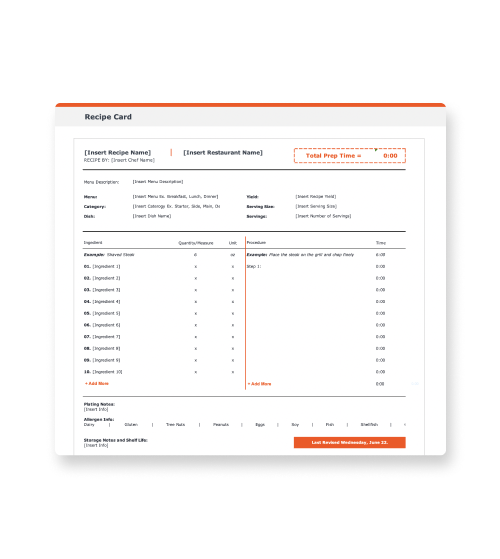
 Recipe Card Template
Train your team with this recipe card template, a customizable Excel sheet that outlines recipe requirements for chefs and back of house staff.
免费下载For most cuts of steak, the sweet spot for resting time is about 5–10 minutes. However, thinner steaks need less time, and larger roasts can benefit from 15–20 minutes or more.
That brief pause might feel like torture when the kitchen smells amazing, but it makes all the difference. Resting allows the juices that were pushed to the center during cooking to redistribute evenly, keeping each bite tender, moist, and flavorful.
In this guide, we’ll break down why steaks need to rest, how long different cuts should sit, and a few tips to get it just right.
Key takeaways
Resting steak is essential for keeping juices locked in, so each bite stays tender, moist, and flavorful.
Thinner cuts only need a couple of minutes, while thick or bone-in steaks benefit from up to 20 minutes.
Factors like thickness, cooking method, and doneness all affect how long a steak should rest.
Simple techniques — like tenting with foil, using a warm surface, and accounting for carryover cooking — make a big difference.
Recipe Card Template
Train your team with this recipe card template, a customizable Excel sheet that outlines recipe requirements for chefs and back of house staff.

Why do steaks need to rest?
When you cook a steak, the heat forces its juices toward the center of the meat. If you slice into it right away, all that liquid spills out onto the plate instead of staying in each bite. That’s why a steak can look juicy on the cutting board but end up tasting dry on the fork.
Resting gives the muscle fibers time to relax and reabsorb those juices, so they’re evenly distributed throughout the steak. The result: every slice stays tender, flavorful, and moist — the way steak is meant to be enjoyed. As Chef Angie Mar, co-owner and executive chef of Les Trois Chevaux in New York, explains:
“When meat is hot, the juices are more liquid. When you cut into a very hot piece of meat, all of the liquid is going to come out. If you rest it, it allows everything to relax and redistribute the juices, which creates a more tender, juicier cut.”
Do all steaks need to rest?
Not every cut of steak needs the same amount of downtime. Thinner steaks — like flank, skirt, or hanger — don’t hold onto as much heat and cook quickly, so they only need a couple of minutes to rest. Any longer and they risk cooling off too much.
How long to rest steak
So, how long should you actually wait before digging in? The answer depends on the cut and thickness of the steak, but a general rule of thumb is to let most steaks rest for about 5–10 minutes before slicing. This window is usually enough time for the juices to redistribute without the steak cooling down too much. A few key factors influence resting time:
Thickness of the cut: Thicker steaks hold more heat and need longer rest — closer to 10 minutes. Thinner cuts can be ready after just a few minutes.
Cooking method: Grilled steaks tend to retain more heat, while pan-seared cuts may cool more quickly, so adjust accordingly.
Desired doneness: If you prefer rare or medium-rare, rest on the shorter side to keep the steak warm and pink inside. More well-done steaks can handle a longer rest without losing heat.
Steak resting times by cut
Generally, the bigger and thicker the steak, the longer the rest. While thickness is the biggest factor, here are some general resting guidelines based on common steak cuts:
Thin cuts (flank, skirt, hanger, flat iron): 2–5 minutes is enough — they cool down fast.
Medium cuts (sirloin, strip, ribeye): 5–10 minutes gives them time to reabsorb juices without losing heat.
Large or bone-in cuts (porterhouse, T-bone, tomahawk, prime rib): 10–20 minutes, depending on size. These steaks hold heat well and need more time for juices to settle.
Tips for resting steak properly
Resting steak doesn’t require much effort, but a few small tweaks can make a big difference in the final result:
Loosely tent with foil: Place a piece of foil over the steak to keep it warm, but don’t wrap it tightly — that will trap steam and soften the crust.
Use a warm plate or cutting board: Resting on a cold surface can make the steak lose heat too quickly. A pre-warmed plate or wooden board helps maintain temperature.
Remember carryover cooking: While resting, the internal temperature of the steak can rise by 3–5°F. This means you can pull the steak from heat slightly before your target doneness, knowing it will finish cooking as it rests.
Cordon Bleu–trained chef Matthew Kreider, executive chef at Miami’s Steak 954, emphasizes the importance of heat management:
“I believe high heat is typically the ideal for a great steak. If you rest the steak in a warm environment it will carry the internal temperature further than you think. I am not a fan of low and slow for most cuts of beef.”
Patience makes perfect
Resting may feel like the hardest part of cooking a steak — after all, you’ve waited this long and it smells incredible — but it’s also a pro chef tip that makes all the difference. Those extra minutes off the heat ensure the juices stay where they belong: in every tender, flavorful bite.
这篇文章有帮助吗?
免责声明:此信息仅作为一般性参考,发布并不构成认可。Toast 不保证本内容中包含的任何信息、文本、图形、链接或其他项目的准确性或完整性。Toast 不保证如果您遵循本文的任何建议,就能取得任何特定结果。您可能需要咨询专业人士,如律师、会计师或商业顾问,以获取针对您情况的具体建议。
 趋势
趋势