10 Must-Have Features for a Bar POS in Canada
Canadian bar sales are under pressure while the wider foodservice sector grows. Here are 10 bar POS features that protect margin, speed service and support operations across provinces.
Author
Every part of Canadian food service grew in 2025 except one. Drinking establishments. Bars are the exception in a growing market, which is a strange position to be in and a specific one to buy technology for.
The Statistics Canada numbers tell the story. Annual sales at food services and drinking places hit $101.4 billion, up 5.6% from 2024. Full-service restaurants, limited-service spots and special food services all grew. Sales at drinking places, including bars, pubs and taverns, fell 2.3%.
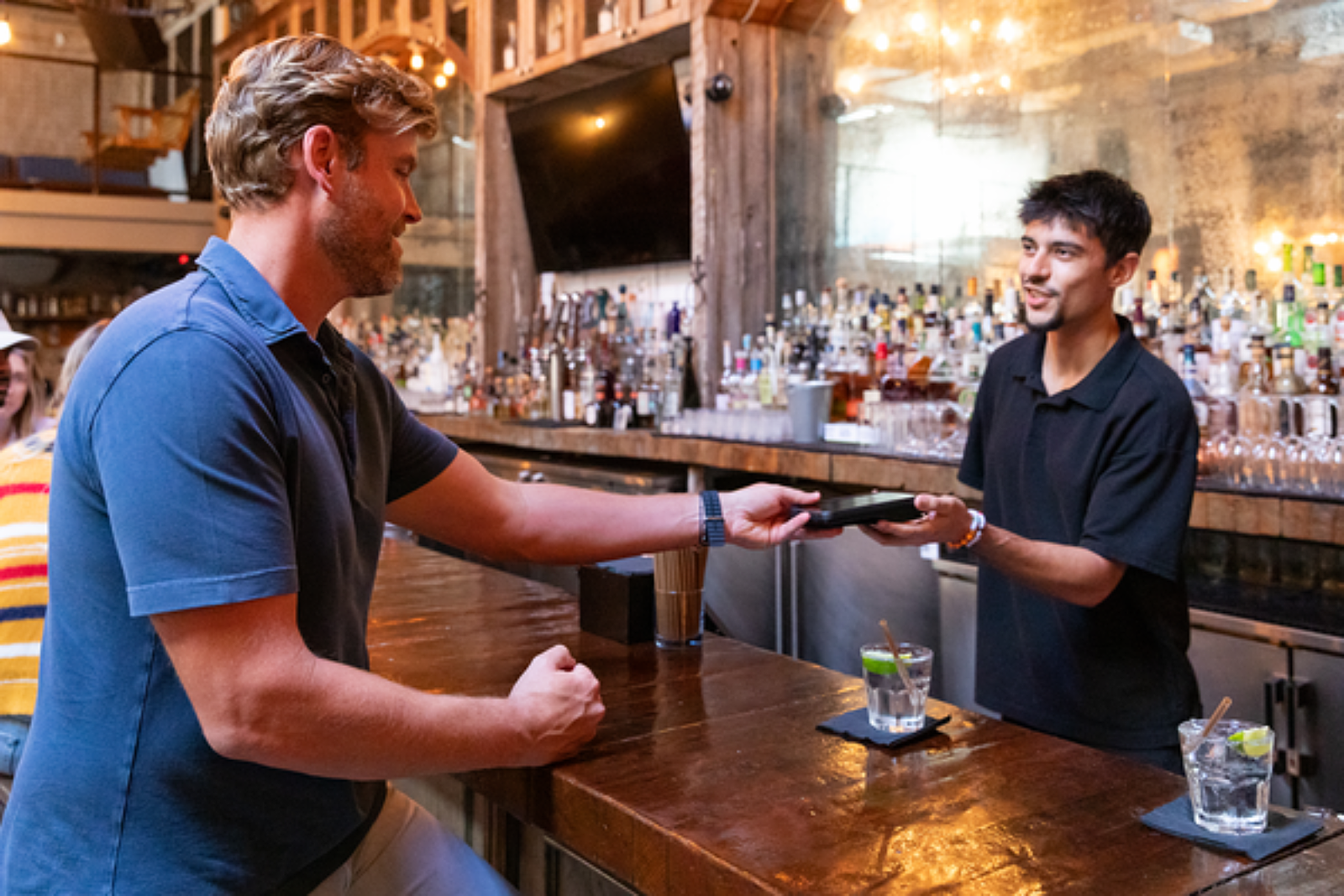
Most bar POS pitches still lead with speed, based on the idea that the goal is to move more rounds per hour. In Toast’s 2025 survey of 200 Canadian hospitality workers, respondents ranked mixology knowledge and responsible alcohol service as the top two bartender-training priorities. Speed and accuracy sat further down the list. For operators, that makes knowledge and responsible service at least as important as raw speed.
Moving towards quality over quantity
In a March 2026 interview with BNN Bloomberg, Restaurants Canada president Kelly Higginson explained what sits behind the sales figures. After adjusting for population growth and inflation, spending at table-service restaurants fell from roughly $1,170 per person in 2019 to about $1,050 in 2025. Guests are buying fewer drinks and choosing better ones, such as one good cocktail instead of several ordinary ones. Higher-end venues have held up reasonably well. Bars and nightclubs have seen the steepest declines because their model depended on people drinking more, with less food revenue to soften the loss.
A bar POS in 2026 needs the speed to handle a rush and the precision to protect margin on fewer, higher-value transactions. Speed does not help if it creates sloppy tabs, untracked pours and variance you cannot see.
The ten features below run from the first tap on the screen to the last count at close. Some are obvious enough that every vendor will demo them unprompted. The ones that matter most in a tighter market are the ones near the end.
1. Menu customisation that keeps up with your guests
Bar orders are rarely tidy. One guest wants a mojito with vodka, no mint and extra lime. If your bartender has to back through three screens to enter it, you have lost the time saved elsewhere. Look for flexible modifiers that let staff build off-menu drinks in a few taps. The system should also store recipes, so a newer bartender can check the specs without leaving the rail.
Toast consumer research found Canadian guests expect restraint in how many options they see. Most respondents, 59.5%, said they expect between 10 and 20 drinks on a bar menu, with 23.5% preferring fewer than ten. Only 3.5% wanted more than 30.
Guests want a focused list. Your staff still need the flexibility to go off it. Those two things are only compatible if the system handles customisation well.
2. Tab management, check moves and splits
A guest starts a tab at the bar, gets seated and orders food. Later, they want the bill split four ways, with one card paying for the shared plates. This happens every night in bars across Canada. When the POS forces bartenders to close and reopen checks, it adds minutes to the process and gives tabs more chances to walk.
Evaluate this by watching someone do it. Move a check from bar to table. Split by item and by seat. Merge two tabs. If it takes more than a few seconds, it will take longer under pressure.
3. Offline order and payment continuity
Internet problems should not stop a busy service. George Davis, owner of 2 Doors Down in Halifax, named this in the Voice of the Canadian Restaurant Industry report, describing a power or internet failure as the worst thing that can happen to a hospitality business mid-service. Avoiding outages ranked among the top technology priorities for the Canadian restaurant operators surveyed.
Every vendor will say they handle it. What matters is the detail. Can staff keep sending orders to the bar and kitchen with the connection down. Can cards still be accepted and queued for processing once it returns, or does the venue drop to cash. Offline transactions are not verified with the issuer at the moment of sale, so ask who carries the risk if one fails on submission, and how the next morning's reconciliation shows you which ones did.
Then test it. Pull the connection during a quiet shift, run a few transactions, and watch what reconciles the following day. That hour tells you more than any demo. Coverage is worth checking room by room too, since basements, rooftops and patios are where venue Wi-Fi thins out.
4. Cloud-based menu management
A bar menu can change in minutes. Happy hour starts, a keg runs dry or the feature cocktail sells out. You should not have to be on site or restart a terminal to keep up. With cloud-based menu management, you can update a price or 86 an item from your phone. The change reaches every terminal and handheld at once, so staff stop selling it right away.
For operators running more than one room or more than one site, this is also the difference between consistent pricing and a slow drift between locations.
5. Payment flexibility that matches Canadian habits
Canadian guests have settled into contactless. Toast consumer research found that 45.5% prefer contactless cards and 19.5% prefer mobile wallets such as Apple Pay or Google Pay. Together, 65% prefer to tap, while 16.5% prefer cash.
Cash has not disappeared, and in some neighbourhood bars it holds a meaningful share, so a system that treats cash handling as an afterthought will create problems at close. What the data points toward is that tap has to be effortless everywhere in the venue, including the patio, and that payment processing should support Interac, credit, debit and mobile wallets without a separate workflow for each.
6. Tipping controls that are transparent
Suggested tips, often set at 15%, 18% and 20%, save guests from doing mental maths at payment. But the prompts are also a common source of frustration. In open-text responses to Toast’s 2026 menu trends survey, guests objected to pre-added amounts and tip requests on small purchases.
A fair prompt is still useful. For bills below a set amount, offer dollar-value suggestions instead of percentages so a $4.50 beer does not come with a tip request that feels excessive. Your system should let you choose that threshold rather than forcing a default.
7. Handheld hardware built for hospitality
A handheld that lets a bartender take an order on the patio and close it there is worth more than one extra terminal, provided it survives the room. The checks are unglamorous. Check spill and dust resistance, drop rating, full-shift battery life and how the device feels after four hours in hand. Staff will stop carrying hardware that runs out of power mid-service or cracks when it hits tile.
8. Reporting that shows you where margin is going
Real-time reporting across sales, labour and product mix is what turns a POS from a cash register into a management tool. At a bar, the reports that matter most are the ones that show product mix by daypart, labour cost against sales hour by hour, and performance by bartender.
Consumer expectations add a concern worth planning around. When Canadian consumers ranked what matters in bartender training, mixology knowledge and responsible alcohol service drew far more first-place rankings than speed and accuracy, which most respondents placed in the middle of the list.
Use these reports to spot shifts where service standards or responsible-service practices slip, then adjust staffing or coaching instead of cutting labour across the board.
9. User permissions, cash controls and compliance
Granular permissions let you decide who can void, comp, discount or open a drawer, and individual overrides let you extend access to a bartender moving into a management role without loosening controls for everyone. Blind closeouts, where staff reconcile without being told the expected figure, add accountability at close.
Permissions also intersect with regulation, and this is where treating Canada as one market causes problems. Responsible-service requirements vary by province, and recognition of out-of-province certificates is not uniform. Ontario uses Smart Serve, Alberta uses ProServe, and British Columbia generally requires Serving It Right, although some valid provincial certificates are recognized for servers and bartenders. An operator with sites in Toronto and Vancouver is managing two separate certification regimes, and a system that lets you attach role permissions and certification records to individual employee profiles turns a compliance headache into a routine check. Provincial bar licences and permits vary in the same way.
10. Liquor inventory and variance reporting
This is where the margin conversation lands, and it is the feature most often bought last. Toast surveyed Canadian owners on inventory practice and found 42.5% count bar inventory weekly and 26% count biweekly, so the discipline exists. The tooling often does not match it. Only 15.5% track inventory through a POS integration. 30% still work from manual spreadsheets and 11.5% use paper logs.
That gap leaves a clear opportunity to tighten inventory control. When asked to name their largest inventory challenge, 30.5% of owners cited shrinkage through theft or waste and 30% cited the time the process consumes. Counting weekly on a spreadsheet catches the discrepancy after the money is gone. Variance reporting compares theoretical usage from POS sales with counted inventory, showing which products are running short. Identifying the responsible shift or station requires more frequent counts or connected measurement tools. If you are building this discipline from scratch, bar inventory basics is a reasonable place to start.
Choosing your next POS
Higginson's point about guests buying one good cocktail instead of three ordinary ones is really a point about your P&L. Fewer transactions, each carrying more weight, and less margin for error on any of them.
A feature list is only useful if you read it through that lens. Ask what variance reporting recovers in over-pour, what permissions prevent at close, what happens to a full room when the internet goes down, and what handhelds return in covers per bartender. Those four answers tell you more than any demo.
The free POS comparison tool is a practical way to hold several systems against the same criteria rather than evaluating each one on its own marketing.
Is this article helpful?
DISCLAIMER: This information is provided for general informational purposes only, and publication does not constitute an endorsement. Toast does not warrant the accuracy or completeness of any information, text, graphics, links, or other items contained within this content. Toast does not guarantee you will achieve any specific results if you follow any advice herein. It may be advisable for you to consult with a professional such as a lawyer, accountant, or business advisor for advice specific to your situation.
Subscribe to On the line
Sign up to get industry intel, advice, tools, and honest takes from real people tackling their restaurants' greatest challenges.
By submitting, you agree to receive marketing emails from Toast. We’ll handle your info according to our privacy statement. Additional information for California residents available here.