How to Optimize Your Restaurant Waitlist in 2026
The ultimate guide on what restaurant waitlists are, what they should be, and how to best use them in your restaurant business.

作者
 RESOURCE
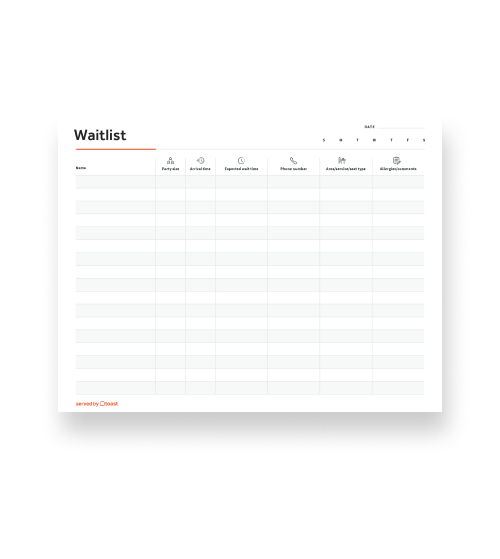
 Restaurant Waitlist Template
A template to help your host keep track of walk-ins and provide estimated wait times, keeping guests happy and staff organized.
免费下载What does waiting list mean in restaurant?
A restaurant waitlist is a physical or digital waitlist that tracks walk-ins with party sizes in order so the host can quote accurate wait times.
What does a waiting list mean in a restaurant? A restaurant waitlist is a physical or digital waitlist that tracks walk-ins with party sizes in order so the host can quote accurate wait times.
Managing waitlists has become an increasingly important aspect of operations for restaurants in recent years. Despite economic concerns, Toast’s Q4 Trends Report shows that guests are continuing to enjoy their favorite restaurants. The New York City metropolitan area, for example, saw an approximate 10% increase in average transactions per restaurant location on the Toast platform in Q4 2022. As diners continue to be eager to support restaurants, optimizing your restaurant's waitlist system can help increase revenue and ensure a positive dining experience for guests.
In this article, we'll explore some of the latest strategies and technologies that restaurants can use to streamline their waitlist and maximize their seating capacity in 2026.
Key takeaways
Restaurant waitlists matter: A restaurant waitlist is one of the first touchpoints guests encounter, making it a direct driver of overall satisfaction and table turnover efficiency.
Diners are planning ahead: According to Toast's Q3 2025 Restaurant Trends Report, seated reservations increased 8% year-over-year and solo dining spiked 22%, signaling that guests are showing up more intentionally than ever.
Software options vary: Waitlist platforms range from Toast Tables (zero cover fees, POS-integrated, with a 57% lift in Loyalty signups) to OpenTable, Yelp Guest Manager, TablesReady, and Hostme, each with different strengths depending on your operation.
Reducing wait times is a team effort: Your host, bussers, and servers each play a distinct role in turning tables efficiently without sacrificing the guest experience.
Technology compresses wait times: From QR code menus and reservation management to POS integration, kitchen automation, and AI answering services, the right tools can reduce friction at every stage of the guest journey.
Unavoidable waits can still be wins: Keeping guests informed, comfortable, and appreciated turns a potential pain point into a hospitality moment that keeps them coming back.
What is a restaurant waitlist?
A restaurant waitlist is a physical or digital waitlist that tracks walk-ins with party sizes in order so the host can quote accurate wait times. The restaurant staff may use various methods to manage the waitlist, such as physical buzzers, calling out names, sending text message notifications or phone calls, or using a digital display board to inform guests when their table is ready. This waitlist solution ensures that the process from the initial check-in to the table is seamless.
Why is your restaurant waitlist important?
Waitlists are an essential tool for restaurants to manage seating arrangements, especially during peak hours, to ensure that customers are served efficiently. They allow restaurants to estimate the number of guests and prepare accordingly. Waitlists can also help prevent overcrowding and ensure that guests are seated in an orderly fashion.
In short, a restaurant waitlist is crucial for 2 reasons: to improve your guest experience and increase overall restaurant efficiency.
Improve customer experience
Your guests are what make your restaurant business thrive. Your waitlist system is one of the first operations your guests come into contact with, and it is a primary driver of overall guest satisfaction. According to research published in the Journal of Marketing Research, customers who wait longer than expected see satisfaction drop — and the damage accelerates significantly the further beyond their expectation the wait goes. Accurate wait time estimates aren't just a courtesy; they're a direct driver of overall guest satisfaction.
You can check out other ways to improve customer experience in this article.
Increase restaurant efficiency
A waitlist can help restaurants to optimize table turnover by ensuring that tables are being used as efficiently as possible. This means that when a table is almost finished, the host can send an sms to the next party to streamline the process of seating guests. This way, the table can be quickly filled when it becomes available. This process can help to increase the number of customers served over the course of the day.
Host Training Checklist
Use this checklist to help streamline your host training process and ensure that your new hosts get off to a great start.

Types of waitlist software
Instead of using pen and paper, there’s software that can streamline your waitlist process in order to decrease walkaways. When choosing a waitlist management system, it’s important to consider options that are best for your specific business. Some factors to consider are:
Pricing
Reporting
Functionality
Easy setup
Floor plan import
Waitlist widget for websites
SMS notifications
There are many different types of restaurant waitlist management systems to help your host stand manage the waiting room and table statuses. Here are a few to check out.
Toast Tables
Toast Tables, available as an added feature with POS, brings restaurant waitlist, reservations, and table management together with zero cover fees. This solution enables your restaurant to:
Offer guests the ability to save a spot or track estimated wait times
Anticipate guest needs with notes and preferences
Automate notifications and two-way messaging to help avoid no-shows and cancellations
Reach more guests via Google Search and Maps with easy access to Reserve a Table on your Google Business Profile
Turn tables quickly with real-time updates to estimate availability
Drive loyalty: Toast customers with Toast Tables saw a 57% lift in Toast Loyalty signups.*
Based on Toast internal data comparing loyalty signups in Q2 2025 vs Q2 2024. Individual results will vary.
OpenTable
OpenTable is a widely used reservation and table management platform with robust online waitlist capabilities. It notifies guests via SMS when their table is ready, provides host-side floor management tools, and surfaces restaurants on OpenTable's large diner network.
TablesReady
TablesReady is a virtual waitlist app and online booking website. With TablesReady, customers can add themselves to your waitlist through a variety of ways, like your website, a kiosk, text message, scanning a QR code, your host, or a public digital waitlist.
Hostme
Hostme is an Intuitive and Customizable Restaurant Reservation System with features such as waitlist, reservation, and table management, server rotation, and CRM for restaurants.
Yelp Guest Manager
Yelp Guest Manager is Yelp's full front-of-house solution, combining reservations, waitlist management, table management, and a kiosk product in one platform, with no cover fees. It lets restaurants list tables on Yelp, Google, Apple Maps, TikTok, Instagram, and Facebook.
How your restaurant can decrease wait times
As your guests wait for their turn in your dining room, there are a few ways your restaurant can speed up the process. This can be accomplished by properly training your front-of-house staff and making use of modern restaurant technology.
Training your staff members to use a centralized digital dashboard allows them to provide more accurate wait time estimates based on real-time table statuses.
Training your staff
Properly training your staff may seem like an obvious procedure in your restaurant. However, some restaurant management may not train staff to properly reduce wait times. For most restaurants, service can be looked at like a game. The goal of the game is to see how many guests they can shuffle in and out of the restaurant in one shift. To win this game, you need all players on board, starting with the player who starts: your host.
Hosts
Your restaurant host plays an essential role when it comes to floorplan management, seating rotation, and the waitlist. Think of your host stand like a quarterback; they’re making important game-time decisions that will set the rest of your team up for success. A good host is trained to notify guests on the waitlist before the table is actually ready. This gives guests a few minutes to make their way to the host stand. A good host communicates to the rest of the staff and pre-plots their reservations so they don’t over-seat walk-ins. A good host wants to seat as many people as possible but never seats incomplete parties.
Bussers
Your bussers are like linemen; they’re clearing the way for your team to get the job done. Train them how to bus tables as quickly as possible. Station bus buckets strategically around the floor to increase efficiency, and make the job easier. It’s also important that your entire staff is trained on bussing and how to use the dish pit. It’s a team effort!
Servers
To stick with this metaphor, your servers are your wide receivers – it’s up to them to gain as many yards as possible and score. Once a table has been cleaned and sat they need to be trained to turn it as quickly as possible while still providing stellar customer service. Servers should be trained to consolidate their visits to their sections, politely ask campers to leave, and not be afraid to drop the check.
Restaurant New Hire Onboarding Checklist
Bringing new employees onto your team can be both exciting and challenging. Use this free PDF checklist to set your staff up for success.
Technology can help
Technology can also help reduce wait times at restaurants by streamlining the ordering process, optimizing table seating, and improving kitchen efficiency. By using technology in these ways, restaurants can improve the overall guest experience and increase customer satisfaction.
“Restaurants continue to see a lot of value in technology: Eight out of 10 say it gives them a competitive advantage, according to the National Restaurant Association’s newly published State of the Restaurant Industry report”.
Joe Guszkowski
Senior Editor at RestaurantBusinessOnline.com
Online menus/QR codes
Online menus and QR codes not only keep your guests entertained while waiting but also help your server turn tables faster. If they review your menu before being seated, they most likely will know what they’ll be ordering sooner. This way, table times decrease, resulting in shorter wait times.
Reservation management
By allowing customers to book their tables online, restaurants can better manage their reservations and reduce the number of walk-ins. Then, your waitlist software can track the expected wait time and notify customers when their table is ready.
Point of sale
A good POS system can increase revenue, streamline operations, and delight guests. Your POS should be a useful tool that helps your staff. For example, Toast’s POS manages orders, sales, and payments in one place with powerful cloud-based software, transparent payment processing, and restaurant-grade hardware all built for the restaurant industry by restaurant people.
Kitchen automation
Kitchen automation technology can help restaurants prepare and cook food faster, which can reduce wait times. Automation can include things like digital displays that show order information and order tracking systems that keep the kitchen staff informed of the status of each order.
AI Automation
AI is increasingly woven into front-of-house workflows. From AI answering services that handle reservation calls and waitlist add-ons after hours, to machine-learning models that improve wait time accuracy over time, these tools reduce pressure on your host team.
How to make a positive waiting experience
Waiting can be frustrating for customers. However, there are things that restaurants can do to create a positive waiting experience.
Keep customers informed – This is where your waitlist and waitlist technology come in handy. It's important to keep customers informed about how long the wait will be. Using a waitlist management system with a public digital waitlist is an effective way to achieve this.
Provide comfortable seating – If customers need to wait for a table, consider providing comfortable seating in a waiting area. This could include couches, armchairs, or high-top tables. Make sure there is enough space for customers to sit comfortably and that the area is clean and well-lit.
Offer a drink – Consider adding a water station near your waiting area so your guests can have a glass while they wait. Your host can also recommend that guests wait at the bar so they can enjoy a beverage before sitting down for their meal.
Show appreciation – After the wait, make sure to thank customers for their patience and apologize for any inconvenience. If a guest had a reservation and still had to wait at least 25 minutes, consider offering a small gesture. This can be a complementary dessert or a round of drinks, which can help show customers that their time is valued.
Optimizing your restaurant's waitlist can be a powerful tool for enhancing your customer experience and increasing your revenue in 2026. By leveraging technology, you can provide accurate wait times and offer guests the ability to watch their spot in real time. Implementing these strategies enables your restaurant to enhance its reputation and ensure that your customers keep coming back for more.
So, take the time to analyze your current waitlist system, identify areas for improvement, and make the necessary changes to optimize your waitlist in 2026 and beyond.
Restaurant Waitlist FAQs
What is a restaurant waitlist, and how does it work?
A restaurant waitlist is a physical or digital system that tracks walk-in guests by party size and arrival order, allowing hosts to quote accurate wait times and notify guests — via text, buzzer, or digital display — when their table is ready.
What's the best waitlist software for restaurants in 2026?
The best option depends on your restaurant's size and needs. Toast Tables is a strong choice for restaurants already on Toast POS, offering waitlist, reservations, and table management in one place with no cover fees. Other popular options include OpenTable, Yelp Guest Manager, TablesReady, and Hostme, each with different pricing structures and feature sets.
How can a restaurant reduce wait times for guests?
Restaurants can reduce wait times by training hosts to notify guests before a table is fully ready, using bussers efficiently to speed up table turns, encouraging servers to drop checks promptly, and leveraging technology like QR code menus, POS-integrated waitlists, and AI answering services to streamline every stage of the guest journey.
Does a long wait time affect customer satisfaction?
Yes — research published in the Journal of Marketing Research found that satisfaction drops when guests wait longer than expected, and the damage accelerates the further beyond that expectation the wait goes, making accurate wait time estimates critical.
How does AI help with restaurant waitlist management?
AI tools are increasingly being used in front-of-house operations to handle reservation calls and waitlist additions after hours, improve wait time accuracy through machine learning, and reduce pressure on host staff — freeing your team to focus on in-person hospitality.


这篇文章有帮助吗?
免责声明:此信息仅作为一般性参考,发布并不构成认可。Toast 不保证本内容中包含的任何信息、文本、图形、链接或其他项目的准确性或完整性。Toast 不保证如果您遵循本文的任何建议,就能取得任何特定结果。您可能需要咨询专业人士,如律师、会计师或商业顾问,以获取针对您情况的具体建议。
