How Much Coffee Per Cup: The Ultimate Guide to Perfect Brewing Ratios
Stop guessing and start brewing — this guide makes coffee ratios simple, consistent, and delicious.
作者

 资源
资源 Making a truly great cup of coffee starts with more than just good beans — it depends on the crucial balance between coffee and water. And with 66% of Americans brewing coffee at home daily and 89% doing so at least once a week, learning how to perfect your ratio isn’t just for coffee enthusiasts; it’s essential for anyone who wants a better cup at home.
Whether you're a casual drinker or a dedicated home brewer, understanding your coffee-to-water ratio can elevate your brew from ordinary to exceptional. This guide breaks down the science, ratios, and brewing methods behind better coffee, giving you the tools to make every cup more consistent, flavorful, and tailored to your taste.
Understanding coffee-to-water ratios
If you've ever wondered why your coffee tastes too strong or too weak, the answer might lie in your coffee-to-water ratio. This simple measurement can make or break your brew — and understanding it is the first step to more consistent, better-tasting coffee.
What is a coffee-to-water ratio?
The coffee-to-water ratio refers to how much ground coffee you use compared to the amount of water. It’s typically written as a ratio, such as 1:16, meaning 1 part coffee to 16 parts water by weight — or, put simply, 1 gram of coffee for every 16 grams (or milliliters) of water.
Professional brewers around the world use the metric system (grams and liters) for precision and consistency, which is why many brewing standards are written this way. For U.S. brewers more familiar with imperial measurements:
1 liter of water = 34 ounces
10 grams of coffee ≈ 2 tablespoons (varies slightly by grind and roast)
What is the golden ratio?
Of course, this isn’t a one-size-fits-all number. Your perfect ratio will depend on factors like:
Brewing method (e.g., French press vs. espresso)
Grind size
Bean roast level
Personal taste preferences
Use 1:18 as your starting point, then fine-tune from there to find what tastes best.
Coffee Shop Opening & Closing Checklist
The beginning and end of a shift can be frantic. Use this free PDF checklist to set your coffee shop staff up for success.

The science behind the perfect ratio
To help set a consistent brewing benchmark, the Specialty Coffee Association (SCA) created the Golden Cup Standard, which also lands at a 1:18 coffee-to-water ratio, or about 55 grams of coffee per liter of water.
This recommendation is rooted in science and sensory testing. It’s designed to maximize extraction — pulling just the right amount of soluble compounds from the coffee grounds to create balanced flavor, aroma, and body.
Why the ratio matters
Getting the ratio right helps avoid two common pitfalls:
Too much water (e.g., 1:20) → weak, sour, under-extracted coffee
Too much coffee (e.g., 1:12) → strong, bitter, over-extracted brew
Think of the ratio as the foundation of your brew. From here, you can fine-tune based on your brew method, roast, and personal preference.
Measuring coffee: Weight vs. volume
When it comes to making consistently great coffee, accuracy matters. While many home brewers use tablespoons or scoops, professional baristas agree that using a scale is the best way to achieve precision and consistency.
Why weight is more accurate
Measuring by weight ensures you're using the exact amount of coffee every time — regardless of bean size, grind, or roast level. That's important because coffee density can vary depending on the type and roast, which makes volume-based measurements less consistent.
For example, a dark roast is less dense than a light roast because it loses more moisture during roasting, so a tablespoon of dark roast weighs less than a tablespoon of light roast — and that difference affects taste.
No scale? No problem
If you're brewing without a scale, use these general conversions as a starting point:
1 tablespoon of coffee grounds ≈ 5 to 7 grams
1 standard coffee scoop ≈ 2 tablespoons ≈ 10 to 14 grams
Quick tip: Use 1 tablespoon of coffee for every 4 ounces of water when measuring by volume.
Need help doing the math?
Use this Coffee-to-water ratio calculator from Honest Coffee Guide to easily convert your desired brew strength into grams, tablespoons, or cups — no guesswork required.
Ratio guides by brewing method
Each brewing method extracts coffee differently — which means the ideal coffee-to-water ratio can vary. Use these tailored guidelines to get the best flavor from your preferred style:
Drip coffee (automatic brewers)
A drip coffee maker emphasizes balance and convenience, delivering a clean, approachable cup that’s perfect for everyday brewing.
Standard ratio range: 1:15 to 1:18 (1 gram of coffee per 15 to 18 grams of water)
For a standard 8-cup drip machine, keep in mind that coffee maker “cups” are usually measured as 5 ounces, not 8 oz mugs. So an 8-cup machine typically brews about 40 ounces (1.2 liters) total.
Here’s how the ratio breaks down:
Medium strength (1:16): 45 to 50 grams of coffee
Stronger brew (1:15): 50 to 55 grams of coffee
Milder brew (1:18): 40 to 45 grams of coffee
Grind size: Use a medium grind, similar to the texture of sea salt, for best results in automatic brewers.
Pour-over (manual drip)
Using a pour-over method emphasizes clarity, precision, and flavor nuance, allowing the unique characteristics of the coffee to shine through. This hands-on approach gives you control over every variable — from grind size to water flow — making it a favorite for those who want to fine-tune their brew.
As Elika Liftee, 2020 U.S. Brewers Cup champion and director of education at Onyx Coffee Lab, explained, “The advantage of pour-over coffee versus machine-brewed coffee is the amount of control that you have. You’re adjusting the grind size, you can adjust your water temperature. And one of the biggest things is you control where the water touches. So, as long as you are pouring really evenly, you’re going to brew really evenly.”
Common methods: V60, Chemex, Kalita Wave
Standard ratio range: 1:16 to 1:17
For one 8 oz cup: Use 15 to 16 grams of coffee.
Grind size: A medium-fine grind, similar to granulated sugar, helps ensure even extraction and clean flavor.
Chemex recommends a 1:16 ratio using a medium-coarse grind, paired with their signature thick paper filters. Pre-wetting the filter helps eliminate any papery taste and improves flow rate, contributing to the clean, crisp taste Chemex is known for.
French press
The French press delivers a bold, full-bodied cup with a heavier mouthfeel and rich texture. As a full immersion brewing method, it allows coffee grounds to steep directly in water, which often benefits from a slightly stronger ratio.
Standard ratio range: 1:12 to 1:18
Common ratio: 1:15
Strong brew: 1:12
Milder brew: 1:16 to 1:18
For one 8 oz cup:
Use 1.3 tablespoons of coarsely ground coffee
Steep for 4 minutes, then plunge and serve
Grind size: Use a coarse grind, similar in texture to sea salt or coarsely ground pepper, to prevent over-extraction and clogging the filter.
Espresso
Espresso delivers a rich, intense shot of flavor with concentrated body, deep aroma, and a creamy layer of crema on top. It’s a pressure-based brewing method that uses a much stronger ratio than most other styles.
Standard ratio range: 1:2 to 1:3
For a standard double shot:
Use 18 to 20 grams of finely ground coffee
Extract 36 to 60 grams of espresso in 25 to 30 seconds
Grind size: Use a fine grind, similar to table salt, to achieve the correct resistance and flow during extraction.
Starbucks typically pulls a 1:2 ratio double shot — using 18 to 20 grams of coffee to yield about 36 grams of liquid espresso. This ratio has become a modern standard among specialty coffee shops because it provides a balanced extraction that highlights sweetness, acidity, and body. The 1:2 ratio evolved from experimentation in the third wave coffee movement, offering more complexity and clarity than the traditional Italian ristretto (1:1) or lungo (1:3) styles.
Cold brew
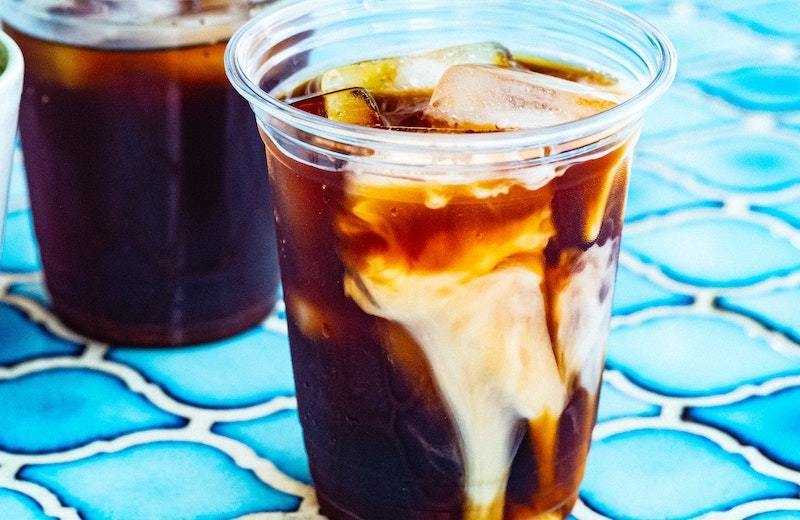
Cold brew offers a smooth, mellow flavor with low acidity and natural sweetness — making it a popular choice for iced coffee drinkers. Because it steeps over many hours without heat, it requires a much more concentrated ratio than other brewing methods.
Standard ratio range: 1:5 to 1:8
For cold brew concentrate: Use a stronger 1:4 ratio
Example: 100 g coffee to 400 g water
Steep for 12 to 24 hours, then strain
Dilute to taste, typically 1:1 with water or milk before serving
Grind size: Use a coarse grind (like raw sugar) to prevent over-extraction and make straining easier.
Many cafés use a 1:4 brew ratio to create a strong cold brew concentrate that can be customized by dilution. This method gives customers flexibility — whether they want a bold iced coffee, a smoother 1:1 dilution, or a milk-heavy cold brew latte. At home, this approach lets you brew once and adjust strength throughout the week based on taste or how you're serving it.
咖啡店菜单模板
将这些咖啡店菜单模板用作您菜单设计的起点,或借助这些模板为您的菜单增添新意。
Conversion chart for common brewing scenarios
If you prefer easy guidelines without a scale, use this practical reference chart based on volume measurements:
Standard 8 oz cup of coffee:
Medium strength: 2 tablespoons (10g) coffee
Strong: 2.5 tablespoons (13g) coffee
Mild: 1.5 tablespoons (8g) coffee
12-cup automatic drip coffeemaker: (Makes about 60 oz of coffee)
Medium strength: 24 tablespoons (125g) coffee
Strong: 30 tablespoons (150g) coffee
Mild: 18 tablespoons (100g) coffee
Factors that influence your ideal ratio
Standard brew ratios provide a reliable starting point — but your ideal cup depends on a few key variables. Fine-tuning based on these factors can take your coffee from good to perfect.
Roast level
Darker roasts extract more easily and may taste better with slightly less coffee (i.e., a higher ratio like 1:17 or 1:18).
Lighter roasts are denser and more complex, often benefitting from more coffee (i.e., a lower ratio like 1:15 or 1:16) to highlight subtle flavors.
Grind size
Finer grinds extract quickly and more efficiently, which can make your coffee taste stronger or even bitter if overdone.
Coarser grinds extract more slowly and often require more coffee or a longer brew time to achieve balance.
Personal taste preferences
Prefer a stronger cup? Start with a 1:15 ratio.
Want something milder? Try 1:18 or even 1:20.
For milk-based drinks (like lattes or flat whites), a 1:15 ratio helps the coffee flavor shine through.
Water quality and temperature
The coffee-to-water ratio plays a big role, but it’s not the only factor that impacts the final taste of your brew. Water temperature and quality can make or break your cup — no matter how perfect your ratio is.
Ideal water temperature
Optimal range: 195°F to 205°F (91°C to 96°C)
Too cold → under-extracted, sour, or weak coffee
Too hot → over-extracted, bitter, or harsh flavors
Pro tip: Let boiling water sit for 30 to 60 seconds before pouring to hit the sweet spot.
Water quality matters
Since water makes up 98% to 99% of your coffee, its quality directly affects flavor.
Hard water (high in minerals like calcium and magnesium) can interfere with extraction and mute nuanced flavors
Chlorinated tap water can give your coffee a flat or chemical aftertaste
In areas with hard water, such as parts of Texas, Arizona, and Southern California, high mineral content can lead to slower extraction and dull, muted flavor profiles — even with the right coffee-to-water ratio. If you notice your coffee tastes off despite using great beans and solid technique, your water may be to blame.
Pro tip: Use filtered or bottled water with balanced mineral content for a cleaner, more flavorful brew. Avoid distilled water, which lacks the minerals needed to properly extract coffee compounds.
Tips for consistent brewing
Consistency is the key to a great cup every time. These simple habits can help you improve your brew with minimal effort:
Use a scale when possible: Even a basic digital kitchen scale can dramatically improve your accuracy and repeatability — no more guessing. Even a $10 digital kitchen scale from a local store can help you measure coffee and water accurately to the gram — improving your brew with minimal effort.
Measure water before brewing: Don’t rely on coffee maker markings — they vary by brand. Instead, measure your water volume manually to match your intended ratio.
Keep notes: Track your favorite ratios, grind settings, and brew times for different beans and methods. It’s the easiest way to recreate your perfect cup — and over time, you’ll build a personalized brewing guide. Use a notebook or try a coffee logging app like iBrewCoffee, which lets you save recipes, record tasting notes, and fine-tune your brew across different methods.
Know your mug size: Many coffee recipes use a standard 5 to 6 oz “cup,” but modern mugs often hold 8 to 12 oz or more. Adjust your ratios accordingly.
Adjust one variable at a time: When testing new methods, change only one factor at a time (ratio, grind size, or water temp) so you can clearly taste the difference.
The bottom line
While the so-called golden ratio of 1:18 provides a reliable starting point, the perfect coffee-to-water ratio ultimately depends on your taste, your brew method, and the beans you’re using. By understanding the basic principles and using the recommended ratios as a foundation, you can make small, informed adjustments to dial in your ideal cup. Remember, coffee brewing is both a science and an art. Precise measurements help with consistency, but your personal preference is the final authority.
Note: All measurements in this guide use grams and liters for accuracy, as recommended by coffee professionals worldwide. If you're more comfortable with U.S. units, refer back to the conversion chart or try the coffee-to-water ratio calculator for quick adjustments.
这篇文章有帮助吗?
免责声明:此信息仅作为一般性参考,发布并不构成认可。Toast 不保证本内容中包含的任何信息、文本、图形、链接或其他项目的准确性或完整性。Toast 不保证如果您遵循本文的任何建议,就能取得任何特定结果。您可能需要咨询专业人士,如律师、会计师或商业顾问,以获取针对您情况的具体建议。
 趋势
趋势