Google Restaurant Reviews: Your Ultimate Guide to Building a 5-Star Online Reputation
Learn how to leverage Google restaurant reviews to drive more customers.

作者
 RESOURCE
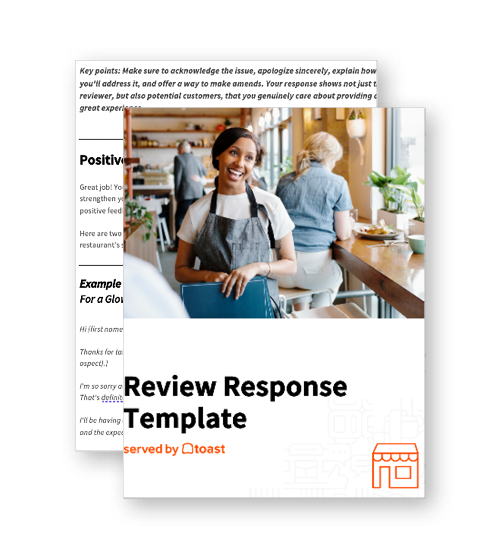
 Restaurant Review Response Template
Use this free template to easily respond to various types of restaurant reviews: positive, negative, mixed, and those without comments.
免费下载Google restaurant reviews are like digital word-of-mouth recommendations, influencing dining decisions. For restaurant owners, managing Google Reviews is important for success in a competitive market, as a single star can impact whether a dining room is full or empty.
Here’s how to leverage Google reviews for your restaurant to drive more customers.
Google dominates restaurant review searches
The numbers speak for themselves.
According to Toast's survey of over 1,000 diners, 46% of people check Google Reviews first when researching restaurants, making it twice as popular as Yelp at 23%. This strong preference means that your Google Reviews profile serves as your restaurant's primary digital storefront.
The star rating threshold that makes or breaks restaurants
Restaurant owners need to understand the importance of star ratings and consumer behavior.
Toast's research reveals that 43% of people won't visit a restaurant if its rating falls below 3-3.5 stars. Even more, 14% of diners won't consider restaurants rated below 4 stars.
The demographic breakdown provides insights for targeting your reputation management efforts. Women show higher sensitivity to low ratings, particularly those over 60, who are more likely to avoid restaurants below 3.5 stars. If older female diners represent a key demographic for your restaurant, maintaining higher ratings becomes all the more important for business success.
This data shows that in the restaurant industry, your star rating directly impacts your bottom line. Research shows that if your Yelp score increases by just half a star, you are up to 49% more likely to be fully booked during peak times.
Most diners discover restaurants through offline channels
Despite Google's dominance in review checking, Toast's survey found that offline channels still lead restaurant discovery. Word of mouth remains the top method at 24%, followed by foot traffic at 17%. Digital channels like social media (15%) and review sites (14%) ranked lower, with Google searches at 19%.
This also represents an opportunity: while diners may discover your restaurant through traditional means, many will validate their decision by checking your Google Reviews. This is your chance to convert interested prospects into actual customers through strong online ratings.
The review-writing reality for restaurant owners
Understanding customer review behavior helps shape realistic expectations for generating feedback. According to Toast's data, 53% of diners either never or rarely write restaurant reviews after their experience. Only 10% of diners always write reviews, with this group skewing male and aged 45-60.
However, 18% of respondents either never or rarely check restaurant ratings before visiting, suggesting that while not everyone writes reviews, the majority still read them. This makes each review you receive even more important for bringing in future guests.
Proven strategies for generating Google Reviews
Leverage your POS system for immediate feedback
Point-of-sale systems offer the most effective method for capturing guest sentiment. The Toast Guest Feedback tool prompts customers with thumbs-up or thumbs-down options during checkout, allowing you to address issues before they become negative online reviews.
This immediate feedback loop serves dual purposes: preventing negative reviews and identifying satisfied customers who might be willing to share positive experiences online. When customers provide positive feedback through your POS system, train staff to ask if they'd consider sharing their experience on Google Reviews.
Master the art of email and text outreach
Include review requests in digital receipts with personalized messaging: "We hope you enjoyed your experience at [Restaurant Name]. Your feedback helps us serve our community better—would you mind sharing a review on Google?"
Research suggests asking for reviews several weeks after the dining experience rather than immediately, as time can provide customers with a more positive perspective on their visit.
Convert in-person compliments to online reviews
When guests express satisfaction during their visit, seize the moment to request an online review. Train staff to respond with transparency: "Thank you! We're so glad you enjoyed your meal. If you wouldn't mind, a Google review would really help other diners discover us. We're a local business trying to reach more people in our community."
Explaining why the review matters feels less transactional and more collaborative than simply asking.
Implement strategic review request cards
Update the traditional comment card approach by providing small cards with QR codes linking directly to your Google Reviews page. Hand these out with receipts or include them with takeout orders. The message should be simple: "How did we do today? Scan to leave us feedback on Google."
This method can work because it doesn't pressure customers to act immediately, but provides an easy mechanism when they're ready to share their experience.
Restaurant Review Response Template
Use this free template to easily respond to various types of restaurant reviews: positive, negative, mixed, and those without comments.

Managing your Google Reviews presence
Claim and optimize your Google Business Profile
Ensure you've claimed your Google Business Profile and filled out every section completely. Include accurate hours, contact information, photos, and menu details.
Respond to all reviews professionally
Respond to positive reviews with gratitude and specific details about what you're glad they enjoyed. For negative reviews, acknowledge the concern, apologize for the experience, and offer to discuss the matter privately.
Your response to negative feedback often matters more than the original review. Potential customers want to see how you handle problems, and a thoughtful response can enhance your reputation.
Monitor reviews across multiple platforms
While Google dominates, customers also leave reviews on Yelp, OpenTable, TripAdvisor, and social media platforms. Use review monitoring tools to aggregate feedback from multiple sources and maintain consistent response standards across all platforms.
The quality versus quantity debate
Focus on encouraging your most satisfied customers to leave detailed, thoughtful reviews rather than pursuing volume. Research published in the Journal of Production and Operations Management found that the best individual reviews persuade potential customers more than average ratings.
Detailed positive reviews that mention specific dishes, service experiences, or atmosphere elements provide social proof that resonates with potential diners. These comprehensive reviews also help your restaurant appear in more specific Google searches.
Building long-term review success
Remember that almost 50% of restaurant guests are influenced by positive online reviews. Your Google Reviews strategy can help drive business growth through authentic customer support. And even more, it serves as a powerful marketing tool, customer service channel, and competitive differentiator on one platform that demands strategic attention and consistent excellence.
FAQ
Q: How often should I ask customers for Google Reviews? A: Focus on asking satisfied customers organically rather than every customer systematically. Train staff to recognize positive experiences and make authentic requests for reviews from genuinely happy guests.
Q: Should I respond to every Google Review? A: Yes, responding to all reviews shows active engagement and customer care. Thank positive reviewers specifically and address negative feedback professionally with solutions.
Q: How can I improve my Google Reviews star rating? A: Focus on operational improvements in food quality, service, and atmosphere rather than review manipulation. Consistently excellent experiences naturally generate positive reviews.
Q: What should I do about fake negative reviews? A: Report obviously fake reviews to Google through their business profile management tools. Focus on generating authentic positive reviews to outweigh any questionable negative feedback.
Q: How important are Google Reviews compared to other review platforms? A: Google Reviews are the most critical, with 46% of diners checking them first. However, maintain a presence on Yelp (23%) and other platforms where your customers leave feedback.
这篇文章有帮助吗?
免责声明:此信息仅作为一般性参考,发布并不构成认可。Toast 不保证本内容中包含的任何信息、文本、图形、链接或其他项目的准确性或完整性。Toast 不保证如果您遵循本文的任何建议,就能取得任何特定结果。您可能需要咨询专业人士,如律师、会计师或商业顾问,以获取针对您情况的具体建议。
 趋势
趋势