How to Accommodate Guests With Food Allergies
Serve up a more enjoyable, accommodating dining experience.

作者
 RESOURCE
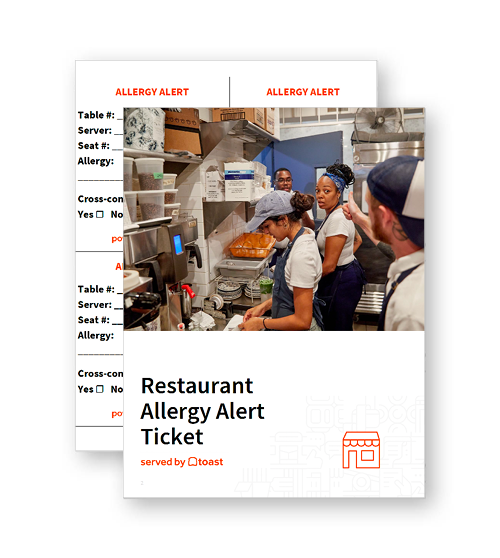
 Restaurant Allergy Alert Card Template
Restaurant staff can use this allergy card template as an extra precaution to keep guests safe.
免费下载
This content is for informational purposes only and is not intended as legal, accounting, tax, HR, or other professional advice. You are responsible for your own compliance with laws and regulations. Contact your attorney or other relevant advisor for advice specific to your circumstances.
Food allergies are one of the most pressing issues for restaurants today. FARE reports that allergies affect an estimated 32 million Americans today and that number is only increasing. Between 1997 and 2011, the CDC discovered that the number of children living with food allergies had increased by a whopping 50 percent.
An allergic reaction to food is triggered by the body’s immune system. The most common allergens for adults are fish, shellfish, peanuts, and tree nuts, while the most problematic foods for children are oftentimes eggs, milk, peanuts, tree nuts, soy, and wheat.
Healthline reports that symptoms can appear within a few minutes to a few hours after ingesting an allergen, with symptoms including swelling of the tongue, mouth or face, difficulty breathing, low blood pressure, vomiting, diarrhea, hives, or an itchy rash. In the most severe cases, a food allergy can cause a guest to go into anaphylaxis.
IMPORTANT: If a guest at your restaurant is exhibiting the signs of a food allergy, call 9-1-1 immediately. The FARE (Food Allergy Research & Education) organization has an emergency protocol plan online that can be kept at your restaurant.
Restaurant Incident Reporting Template
Use this free template to keep a clear, consistent record of accidents, employee issues, and guest complaints while protecting your business in the process.

Food Scientist and Certified Professional in Food Safety (CP-FS), Janilyn Hutchings, had some ideas to share around ways restaurants can keep guests dining with food allergies safe during the duration of their visit. Hutchings currently works for StateFoodSafety as an in-house food safety specialist and food safety education writer.
A StateFoodSafety employee with a pistachio allergy once said to Hutchings, “Ever since learning of my food allergy, I’ve had to be that person who always asks ‘Are there nuts in this?’ I’ve run the gamut of responses to that question. Food workers have been kind, rude, confused, unsure, dismissive, and accommodating.”
For many diners living with food allergies, the idea of eating out can be terrifying. A meal that would be perfectly safe for one guest could be life-threatening for another. It’s important for restaurant staff to treat guests living with food allergies with patience and respect.
Many restaurants have risen to the task and have taken steps to educate and train their employees in property allergy protocol, but as a whole, there is much more that can be done to protect restaurant guests dining with food allergies.
Here are some tips Hutchings has for restaurants looking to improve their food allergy response plan.
SOP 模板
此模板可帮助您为整个业务创建标准操作程序,从而保持一致性并轻松培训员工。
4 Ways to Make Guests Living with Food Allergies At Your Restaurant Feel At Home
Require all staff members to be allergen-trained and learn the most common food allergies
According to The FDA, the 8 major food allergens are:
Peanuts
Eggs
Dairy
Wheat
Shellfish
Fish
Soy
Tree nuts.
Though these triggers are responsible for the majority of food-related allergic reactions, some restaurant guests may also be living with chronic gastrointestinal or food-related intolerances such as Celiac’s disease, which is responsible for gluten-sensitivity. Food intolerance is different than a food allergy because they don’t involve the diner’s immune system, but servers should be equally aware of both and the signs a guest may exhibit when an allergen is present in their meal.
Train your servers to take every guest report of a food allergy seriously StateFoodSafety has an accredited food safety course that your guests can take to ensure they have the proper knowledge to protect your guests.
"Luckily, my experiences with employees being rude or dismissive have been few and far between; however, a majority of my experiences have been with employees that are unsure or even confused by what I’m asking them," the StateFoodSafety employee said.
Prevent cross-contact in order to protect your guests and your restaurant
Cross-contact or cross-contamination – when a guest’s food becomes inadvertently contaminated with an allergen by coming in contact with another food item that contains said allergen – can have serious consequences for your restaurant. Even if the food is cooked it does not prevent the guest from eating it from having an allergic reaction.
Train your servers to be vigilant about reporting any guest dining with food allergies to your kitchen staff, who can then in term prevent cross-contamination while the food is being prepared. Communication between your team members is key to preventing cross-contact. Oftentimes, servers and bar staff are able to memo the kitchen directly using the restaurant’s point of sale system, a feature that comes in handy when the need to communicate guest allergies arises.
"I once attempted to order at an ice cream parlor that had a policy in place that they did not change gloves or clean their ice cream scoops for anyone with a food allergy. This was jarring to hear—so I spoke to a manager that had the same dismissive attitude and confirmed that they would not do anything to make eating at their establishment safer for those with allergies,” said one StateFoodSafety employee to Hutchings about the treatment she’s received while dining with a pistachio allergy.. “Even if your establishment doesn’t provide an allergen-free menu, train your employees to handle customers’ food allergies with care and respect.”
Include allergen call-outs on your menu that highlight the big 8
Creating allergen identifiers on your menu – whether they be small icons, words, or a color coded system – promotes transparency and saves time for your staff who now don’t need to run back and forth from the table to the kitchen to see if the allergen in question is present in the dish..
Incorporating menu items that don’t include the 8 most common food-allergy triggers can also make a world of difference for your guests. People go out to eat for fun and stressing over the menu because of a food allergy creates for a less than ideal dining experience. Creating a menu that is allergy-friendly, either by calling out the presence of allergens or the absence of allergens in a specific dish, eliminates a lot of extra work for your staff and creates a better dining experience for your guests. Diner resource Allergy Eats recently released their list of the most allergy-friendly chain restaurants today, a helpful resource you can use to improve your guest experience for diners living with food allergies.
Train your staff to recognize the symptoms of an allergic reaction
Training your servers to recognize the symptoms of an allergic reaction can prevent tragedies by getting a guest the help they need sooner. The most recognizable symptoms of an allergic reaction are:
Mild swelling
Skin redness
Aches
Stuffy or runny nose
Sneezing
Watery or itchy eyes
Abdominal pain
Nausea and vomiting
Dizziness
Diarrhea
A more serious allergic reaction, known as anaphylaxis, is when the tongue, throat, and lips swell up, making it hard for the guest to breathe. If a server notices any signs of anaphylactic shock they should alert their manager immediately and call 9-1-1.
As with all other forms of restaurant training, training your staff in how to spot an allergic reaction should be recurring. When every new staff member starts, make sure a part of their new hire onboarding and week one checklist includes learning about food allergens; the rest of your staff should be required to brush up on their food allergen knowledge at least once a year.
Restaurant Allergy Alert Card Template
Restaurant staff can use this allergy card template as an extra precaution to keep guests safe.
Communication is key in preventing an allergen from reaching a guest’s plate. Some restaurant point of sale systems, like Toast, offer an “item detail” function where staff are able to pull up important notes and details about menu items, including the presence of food allergens. Having all of the information at your server’s fingertips is paramount to ensuring guest safety and being able to make educated recommendations if a dish would be unsafe for a guest.
While a guest dining with food allergies requires special attention, there are concrete steps that you can take to ensure their safety at your restaurant, including baking in allergy protocol into the education of every employee, maintaining proper organization in the kitchen, and emphasizing compassion when a guest who discloses a food allergy. If you combine all of these steps your restaurant will continue to run smoothly and provide a safe space for guests living with food allergies.
这篇文章有帮助吗?
免责声明:此信息仅作为一般性参考,发布并不构成认可。Toast 不保证本内容中包含的任何信息、文本、图形、链接或其他项目的准确性或完整性。Toast 不保证如果您遵循本文的任何建议,就能取得任何特定结果。您可能需要咨询专业人士,如律师、会计师或商业顾问,以获取针对您情况的具体建议。
 趋势
趋势