
How to Get a Restaurant Business Loan with Bad Credit
Let’s dig into what exactly bad credit is, ways you can work to improve your credit score, and business loan and funding options for restaurateurs with bad credit.
作者
 RESOURCE
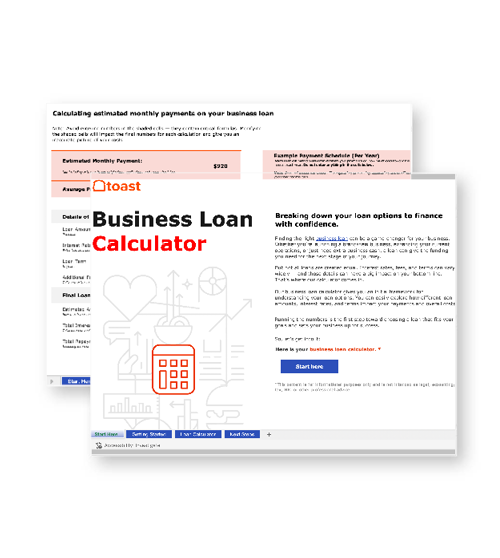
 Business Loan Calculator
Use this free calculator to understand how different loan amounts, interest rates, and terms will impact your payments and overall costs.
免费下载
The information discussed in this article is provided for informational purposes only and should not be relied upon as financial or legal advice, or credit counseling. For financial, credit, or legal advice, you should consult a professional financial advisor or your attorney.
As a restaurant owner, you need access to capital to fund your business and its growth, whether you’re looking to replace broken kitchen equipment, finance a big renovation, invest in a new location, or come back from a crisis. One way to access the capital you need to fund your vision or help see you through a tough time is through a business loan. But getting a business loan is easier said than done, especially if you have a bad personal credit score.
Why? Because bad credit implies that you haven’t managed your finances properly in the past.
Fear not, though: even if you have bad credit, there are financing options out there for you to access for your restaurant. Let’s dig into what exactly bad credit is, ways you can work to improve your credit score, and business loan and funding options for restaurateurs with bad credit.
New development for 2021: On March 11, 2021, President Biden signed the $28.6 billion Restaurant Revitalization Fund into law as part of the American Rescue Plan Act. This fund provides much-needed support for the food and beverage industry in the form of grants — unlike loans, the government’s Restaurant Relief Fund grants don’t need to be paid back and are not counted as taxable income. Learn more here ⟶
What is bad credit?
Your personal credit score can help lenders decide whether to offer you credit and, if they do, on what terms. In lenders’ eyes, the higher your credit score, the higher your likelihood to pay off debt on time. A lower credit score indicates a higher risk of default, which can increase your cost of capital (i.e. higher interest rates and fees).
While there are many companies that generate personal credit scores through credit scoring models, the most commonly used credit scoring models come from VantageScore and FICO.
The VantageScore and FICO models use a personal credit score range of 300 to 850. Here’s a general breakdown of personal credit score ranges, according to Experian:
For the FICO® Score model:
Very poor: 300-579
Fair: 580-669
Good: 670-739
Very good: 740-799
Exceptional: 800-850
For the VantageScore model:
Very poor: 300-499
Poor: 500-600
Fair: 601-660
Good: 661-780
Excellent: 781-850
Some of the factors that affect your personal credit score include payment history, credit utilization, length of credit history, mix of credit types, and recent applications. VantageScore and FICO differ slightly in their approaches, but, according to NerdWallet, both parties agree that payment history — whether you’ve consistently paid bills and other financial obligations on time — and credit utilization — the amount of your credit limit you use — are the most important factors in determining your personal credit score.
For additional context, it’s helpful to know about business credit scores, too. Here’s a quick overview of business credit scores from Credit Karma:
“A business credit score performs the same function for your business as a personal score does for your own finances. Lenders and creditors look to minimize risk when giving out loans, so they look for information on whether a business is likely to repay the loan. Business credit reporting agencies collect information on your business’s financial history and can use it to put together an assessment of your risk level for lenders — this serves as your business credit score.”
Unlike your personal credit score, business credit scores are often scored on a 1-100 scale. Generally, a business credit score of 75 or higher is considered “excellent.” But business credit scores are weighted differently depending on which of the credit bureaus you look at. More on that below.
Business Loan Calculator
Use this free calculator to understand how different loan amounts, interest rates, and terms will impact your payments and overall costs.

How to improve your credit score
As a business owner, you’ll find that a poor personal credit score may impact your ability to take out a business loan to support your restaurant. Before we get into the loan and funding options available to you, let’s first look at a few ways you can begin to improve and build up your credit score.
The first thing you can do is check your credit reports. Every 12 months, you are legally entitled to one free copy of your credit report from each of the major national credit bureaus: Experian, Equifax, and TransUnion. You’re also entitled to a copy of your credit report even if you’re denied a loan and have already received your one free report.
Your score may differ slightly from bureau to bureau, so it’s important you keep tabs on the individual numbers each credit bureau is reporting in order to have a well-rounded view of what your overall credit score is. Your free annual credit report may not include your credit score, but there are companies, like Credit Karma, that’ll allow you to get your score for free if you sign up for an account with them or in other circumstances.
As with personal credit scores, there are three major national credit bureaus that track business credit scores. They are: Equifax, Experian, and Dun & Bradstreet. However, unlike personal credit scores, you must pay to get a copy of your business credit score report from each for these credit bureaus.
A 2012 study by the Federal Trade Commission found that one in five consumers had an error on at least one of their three credit reports. The results of this study make it clear that you should check your credit reports regularly. By finding errors, successfully disputing them, and having them removed from your credit reports, you can start improving your credit score.
After checking your credit reports, work to improve the factors listed above that impact your credit score. FICO recommends taking some of the following steps to improve your credit score:
Pay your bills on time.
If you have missed payments, get current and stay current.
Keep balances low on credit cards and other revolving credit.
Pay off debt rather than moving it around.
Because factors such as these have the biggest effect on your credit score, actively working to improve them will help you begin positively building your credit.
Restaurant business loans: What are your options if you have bad credit?
Improving your personal credit score is important to your ability to take out a business loan, but it takes time. If you’re in need of urgent capital and can’t afford to wait, there are lenders out there who may approve your restaurant for a loan without taking your personal or business credit score into account.
Let’s take a look at what business loan options are out there for people Who may not qualify for credit-based loans so you can determine what might be best for your restaurant. We’ve also outlined the additional steps you may need to take when applying for non-credit based business loans.
Business loans without a credit score requirement
Most brick-and-mortar banks consider your credit score when evaluating your loan application, but there are some lenders that don’t.
Lenders who you have an existing relationship with may be more willing to approve your loan application without requiring a personal guarantee or minimum credit score, as they already have insight into your restaurant’s performance. If you’re looking for a loan based on your business’s current sales rather than your personal credit history, reach out to some vendors your restaurant already works with, like your point of sale provider, accounting software provider, or credit card processor, to see if they also offer access to loans or other types of financing.
But while those pros may sound appealing, some alternative loans can have short repayment timeframes and a higher cost of capital due to the increased risk the lender is taking on by extending capital without a personal guarantee to back the loan.
Short repayment timelines lower the risk to the lender, as they can expect to be repaid faster, but can put additional strain on your business as it requires you to cut into your restaurant’s cash flow more steeply than if you had a longer term loan. Make sure to budget for your loan against your restaurant’s expected sales over the repayment term and make sure that you will have enough cash left over for operating expenses, plus an emergency fund, before signing on the dotted line.
Another option is a secured business loan, where a bank may just take a security interest in the business property or other business or personal assets as collateral.
Business loans with a flexible term length
If you are worried about your ability to make hefty monthly payments over a short timeframe, you may want to look for a lender that offers flexible term lengths with a fixed cost of capital. Some lenders will allow business owners to make flexible payments as a fixed percentage of your restaurant’s sales, allowing you to keep up with your loan payments on busy days as well as slow days, without penalizing you for taking longer to repay.
Other restaurant funding options if you have bad credit
We’ve looked at some of the business loan options available to you if you have bad credit, but let’s take a look at some of your funding options beyond loans.
Lines of credit
According to Fundbox, “A line of credit is a predetermined amount of funds that you can borrow from when you need to and pay back later.”
A business line of credit allows fast funding and flexibility, letting you access cash on demand — you choose when to take out money, pay it back, and repeat. Just be sure you stick to its terms and conditions and pay off what you borrow on time and in full — and like with loans, it is not advisable to get a personal line of credit for business expenses.
However, it can be challenging to get a line of credit if you have bad credit. If you’re approved, you’ll have to pay higher than normal interest rates. Practice caution and read the fine print so you know what you’re getting into.
Merchant cash advances
With a merchant cash advance (MCA), a restaurant is selling a portion of their future revenue to the cash advance company in exchange for an up-front purchase price, plus a fixed cost. Essentially, it’s a cash advance that’s paid for through a percent of daily credit card sales.
A merchant cash advance has a higher chance of being approved than traditional small business loans or lines of credit. According to the Federal Reserve’s 2020 Small Business Credit Survey, 87% of businesses that applied for an MCA were approved.
However, a merchant cash advance isn’t without its cons and can lead to further cash flow issues. Why? Because it consumes a chunk of your sales until the MCA is completely paid.
If you have poor credit, the process of obtaining a business loan and other funding for your restaurant can be frustrating, but there are lenders out there who may be willing to work with you. As you go through the process of securing financing, simultaneously work on building your credit and improving your credit score. Carefully think through your loan and funding options, read between the lines, and select the option that works best to help you accomplish your business goals, with payments that won’t take too much out of cash flow.
A business loan shouldn’t leave you in a state of financial worry. With the right financing option, you’ll feel good about getting your restaurant the capital it needs to grow and succeed.
Whether your goal is to open a new location, invest in new equipment, expand your patio to serve guests outside during COVID-19, or just manage cash flow over the next few months, you're going to need a reliable source of funding to make your dreams a reality.
Toast Capital provides eligible Toast customers with access to loans from $1K to $300K that can be used for any restaurant need. Toast Capital Loans have one fixed cost with automated repayment that flexes with sales* – with no compounding interest and no personal guarantees. Once you’ve been approved and signed your Toast Capital Loan agreement, you can expect funds to be sent to your bank account in as soon as one business day**.
Toast Capital Loans are issued by WebBank. Loans are subject to credit approval and may not be available to borrowers in certain jurisdictions. WebBank reserves the right to change or discontinue this program without notice.
*Toast Capital Loans offer different target repayment terms ranging from 90 days to 360 days, depending on eligibility. The maximum repayment term is 60 days following the end of the target repayment term. Any outstanding balance due at the end of the maximum term will be collected automatically via ACH. If you select a 270- or 360-day target term, and you are provided with a Repayment Milestone Schedule with your Credit Agreement, then, every 30 days during the term, your total payments to date must equal the minimum amount disclosed to you. If they fall short, the difference may be collected via ACH.
**Funds are typically disbursed within 1-2 business days after signing your credit agreement.
Related Resources
餐厅经营计划模板
无论您处于餐厅经营的何种阶段,一份经营计划都将是您的指路明灯。利用这份免费模板梳理自己的愿景,确保万无一失。
这篇文章有帮助吗?
免责声明:此信息仅作为一般性参考,发布并不构成认可。Toast 不保证本内容中包含的任何信息、文本、图形、链接或其他项目的准确性或完整性。Toast 不保证如果您遵循本文的任何建议,就能取得任何特定结果。您可能需要咨询专业人士,如律师、会计师或商业顾问,以获取针对您情况的具体建议。
 趋势
趋势
