
Digital Marketing for Restaurants: 10 Must-Know Trends for 2026
Reaching guests online can open more doors to first-time orders and repeat visits. Discover 10 digital marketing trends for restaurants in 2026.
ผู้เขียน
 RESOURCE
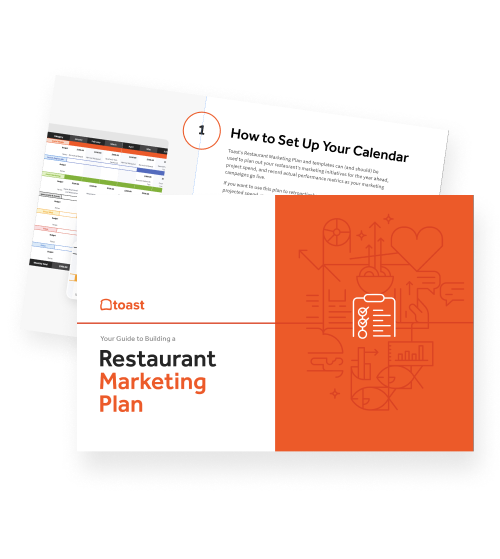
 Restaurant Marketing Plan
Create a marketing plan that'll drive repeat business with this customizable marketing playbook template and interactive calendar.
ดาวน์โหลดฟรีDigital marketing for restaurants uses search engines, social media, websites, email, and text messages to attract guests, generate orders, and encourage repeat visits. It helps people discover what you serve, decide whether to visit, and stay connected afterward.
Knowing what guests order and how often they visit can make that follow-up more useful. Toast Marketing connects guest and purchase information with email and SMS campaigns, helping you share relevant offers or reconnect with someone who hasn’t visited recently.
This guide explains how digital marketing works for restaurants, why it matters, and 10 trends to know in 2026.
Key takeaways
Choose social platforms based on your guests’ habits, not overall popularity.
Accurate listings, current menus, and easy online ordering help turn discovery into orders.
Relevant email, SMS, and achievable loyalty rewards give guests reasons to return.
AI can simplify campaign planning and content creation, with people reviewing the final decisions.
Measure orders and repeat visits alongside clicks, views, and followers.
Guide to Restaurant Social Media Marketing
Learn how to optimize your social media presence to showcase your brand, tell your story, attract new customers, and engage with your audience.

What is digital marketing for restaurants?
Digital marketing for restaurants uses online channels to attract guests, generate orders, and encourage repeat visits. It includes paid advertising alongside activities such as updating business listings, sharing food photos, responding to reviews, and communicating with subscribers.
These activities work together as part of a broader restaurant marketing strategy. Someone might discover a dish on Instagram, check the restaurant’s menu on Google, and order through its website. After that first order, a timely email or loyalty reward can give them a reason to return.
Why does digital marketing matter for restaurants?
Bringing in guests is a priority for operators. In Toast’s 2026 Voice of the Restaurant Industry Survey, 47% of 676 surveyed restaurant decision-makers identified increasing guest demand as their main revenue-growth focus.
Operators are also investing accordingly. The 2025 Restaurant Technology Outlook from Restaurant Business and Nation’s Restaurant News found that 46% of surveyed operators were most likely to direct technology investment toward digital marketing, making it the leading category for a second consecutive year.
For individual restaurants, those efforts can support several goals:
Get discovered: Reach people searching or browsing for somewhere to eat.
Help guests choose: Make menus, prices, photos, and reviews easy to find.
Generate orders: Give interested visitors a straightforward way to order or reserve.
Encourage returns: Stay in touch with guests who want to hear from you.
Understand results: Compare campaign activity with orders, redemptions, and repeat visits.
Restaurant Email Marketing Templates
Download our easy-to-use Microsoft Word templates to create compelling restaurant newsletters and marketing emails.
10 digital marketing trends for restaurants in 2026
Some of these opportunities are emerging, while others are established practices reinforced by newer research. Together, they cover how guests discover restaurants, decide to order, and keep coming back.
Trend | Practical focus |
Audience-specific social marketing | Choose platforms around guest behavior |
Food-focused and guest-created content | Show what makes a visit worthwhile |
Local SEO and maps | Help nearby diners find accurate information |
AI-assisted restaurant discovery | Make restaurant details clear and accessible |
Active review management | Build confidence and address concerns |
Websites that help guests order | Turn interest into a clear next step |
Guest-data personalization | Make outreach more relevant |
Email and SMS retention | Give existing guests reasons to return |
Accessible loyalty rewards | Make participation convenient and worthwhile |
AI-supported campaign management | Connect planning with restaurant data |
1. Choose social platforms around your guests
The right social platform depends on who you want to reach. In Toast’s October 2025 restaurant discovery survey, Facebook was cited by 27% of respondents, Instagram by 15%, and TikTok by 14%. Among Gen Z, however, 38% cited TikTok, making it that group’s leading discovery channel.
That makes audience fit more useful than assuming one platform works best for every restaurant.
Audience: Consider the people who already visit and those you hope to attract.
Platform role: Decide whether each account should support discovery, conversation, or orders.
Content: Adapt the presentation to the channel rather than copying every post unchanged.
Results: Track inquiries, ordering clicks, and redemptions alongside views and followers.
For paid campaigns, Toast IQ Grow includes Toast Advertising Pro, which supports campaigns across Google, Facebook, and Instagram. Operators can direct people to their own ordering channels and review advertising performance alongside sales data. Ad spend is separate from the package fee.
2. Show the food—and let guests help tell the story
Food content gives people a concrete reason to pay attention. In Toast’s July 2024 social-media survey, 84% of respondents preferred seeing photos of a restaurant’s food and drinks on its social accounts.
Guests can contribute to that story, too. “Organic social media is our best marketing,” said Joy Zarembka, COO of Busboys and Poets, describing customers who discover the restaurant and share their experiences on TikTok.
Food photography: Show actual dishes, portions, and drinks.
Short videos: Capture preparation, a tableside presentation, or the atmosphere.
Guest posts: Reshare relevant content with permission and credit.
Useful details: Include the item’s name, availability, and how to order it.
To keep posting manageable, Toast’s social marketing tools let teams draft and schedule Facebook and Instagram posts from Toast Web, including images and promotions. Upcoming and published posts appear alongside other campaigns, making the schedule easier to follow.
3. Make local search and maps part of the marketing plan
Some guests are already looking for their next meal. Your job is to make the restaurant easy to find and evaluate. Toast’s October 2025 discovery survey found that respondents used both map apps, cited by 18%, and search results, cited by 16%, to discover restaurants. Strong restaurant SEO starts with information people can use:
Business details: Keep addresses, phone numbers, and hours accurate, including holidays.
Menus: Make current items and prices easy to access.
Photos: Show the food, entrance, seating, and atmosphere.
Next steps: Provide clear ordering, reservation, and directions links.
Location pages: Give each location its own relevant details.
Toast IQ Grow’s managed marketing support includes help with SEO, your Toast website, and the online ordering experience. A Marketing Success Manager can also recommend Google Business Profile updates, although changes to non-Toast properties remain with the operator.
4. Prepare for AI-assisted restaurant discovery
AI recommendations offer another way for guests to explore dining options. In Toast’s December 2025 survey of 850 U.S. adults, 50% said they would welcome AI assistance with discovering restaurants. Preparing for this opportunity starts with clear, reliable information.
Descriptions: Explain the cuisine, service style, location, and dining experience.
Readable menus: Make menu details available as accessible text where possible.
Consistency: Keep website, listing, and ordering information aligned.
Helpful answers: Address questions about reservations, pickup, dietary options, and accessibility.
Toast Websites, included in IQ Grow, provides built-in SEO features and syncs menus, pricing, and availability with Toast POS. That helps keep the website current without a separate round of edits whenever the menu changes. No website tool guarantees an AI recommendation, but accurate information gives guests a better starting point.
5. Treat reviews as an ongoing conversation
Reviews help prospective guests decide whether to visit, but they also offer a chance to reconnect with someone whose experience fell short.
In a Toast guest-feedback survey, 94% of respondents said online reviews influenced where they ate. Meanwhile, 66% would consider returning after negative feedback if the restaurant responded and showed it cared.
Request feedback: Make it easy for guests to share an honest experience.
Respond specifically: Acknowledge the actual compliment or concern.
Offer a next step: Explain how someone can reach the team when a problem needs more attention.
Look for patterns: Address recurring complaints about food, timing, or service.
Keep requests neutral: Invite feedback consistently rather than asking only delighted guests.
Alongside monitoring public reviews, restaurants can use Toast Guest CRM to review collected guest feedback and AI-generated summaries. These can help teams spot recurring issues and decide where a personal response or operational change is needed.
6. Give website visitors a clear path to ordering
A campaign can create interest, but the page it leads to must help guests make a decision. In Toast’s October 2025 discovery survey, price/value and menu variety were cited by 55% and 43% of respondents, respectively, among the factors that persuaded them to visit.
Current information: Show accurate menus, prices, and availability.
Mobile usability: Make essential details readable without excessive scrolling or zooming.
Relevant destinations: Link a promotion to the featured offer or item.
Clear actions: Make ordering, reservations, and other relevant options easy to find.
Consistent promises: Match advertised prices and conditions to the checkout experience.
Toast IQ Grow includes Toast Online Ordering Pro, which supports ordering on the restaurant’s own domain, promotional banners, and featured items. A campaign can lead guests to a branded ordering experience while orders flow into the POS and kitchen.
7. Use guest information to make marketing more personal
Personalization begins with remembering the relationship, not simply adding someone’s first name to an email. Toast’s April 2026 survey of 1,500 U.S. adults found that 48% felt most valued when staff remembered them, while 30% said they always received that recognition.
That finding concerns hospitality, but it offers a useful principle for marketing: use what guests have shared to make the interaction more relevant.
Guest history: Consider previous orders and visit frequency.
Audience segments: Distinguish first-time guests, regulars, and lapsed customers.
Relevant offers: Match messages to demonstrated interests.
Permissions: Respect communication preferences and marketing opt-ins.
Service connection: Use guest information to support the visit, not only the campaign.
Toast Guest CRM combines orders, visits, and reservations into guest profiles. Its insights can help identify valuable or at-risk guests, giving operators more context for a welcome message, a thank-you, or an invitation to return.
Restaurant Review Response Template
Use this free template to easily respond to various types of restaurant reviews: positive, negative, mixed, and those without comments.
8. Use email and SMS to encourage the next visit
Email and text messages give restaurants a direct way to reach guests who already know them. Among restaurants using these Toast tools in Q1 2026, 86% of email-originated orders and 83% of SMS-originated orders came from repeat guests. These figures describe who ordered—not conversion rates or the sales increase caused by a campaign.
The same research highlights Cafe Bernie’s practical approach: SMS for nearby regulars, email for a broader audience, and messages timed around dining decisions.
Welcome messages: Give new subscribers a useful introduction.
Timely offers: Reach guests before they make lunch or dinner plans.
Re-engagement: Give someone who hasn’t visited recently a reason to return.
Channel selection: Use email for more detail and SMS for concise, timely updates.
Measurement: Review orders and repeat activity alongside engagement.
Toast Marketing supports guest segments and automated outreach, including welcome messages, “Miss You” emails, and VIP campaigns. Within IQ Grow, the Marketing Success Manager also helps plan and run email and SMS campaigns, with operator approval.
9. Make loyalty rewards easy to understand and earn
A loyalty program needs to feel worthwhile from the guest’s side of the counter. Toast’s loyalty analysis reported return rates near 30% for enrolled guests versus a 7% baseline. The research compared loyalty and non-loyalty performance over January 13–April 13, 2026; it doesn’t establish a guaranteed improvement from enrollment alone.
The same article reports that more than half of surveyed diners had left a program because rewards were too difficult to earn or weren’t worth the effort.
Simple enrollment: Make joining convenient in-store and online.
Clear progress: Explain how earning and redemption work.
Relevant benefits: Offer rewards guests actually want.
Achievable milestones: Avoid making the first useful reward feel out of reach.
Business results: Review return visits and reward costs together.
Toast Loyalty, part of IQ Grow, lets restaurants reward dollars spent or visits and customize redemption options. Day-and-time bonuses can support promotions such as double-point Tuesdays, while connections with email marketing and the restaurant’s website help guests discover the offer.
10. Connect AI campaign support with restaurant data
AI becomes more useful when it can work with the restaurant’s actual performance and marketing goals. In Toast’s 2026 industry survey, 85% of operators expected to use AI more in the future, although that finding covers AI broadly rather than marketing alone.
For a marketing-specific example, Toast reported 69% higher email click-through rates for messages created with its Marketing Agent beta than those created without it, based on March 1–April 1, 2026 data. That’s an engagement comparison, not a sales increase; individual results vary.
Campaign opportunities: Use past performance to identify occasions and offers worth testing.
Coordinated planning: Build related email, SMS, and social campaigns around the same goal.
Content development: Draft materials that reflect the restaurant’s information and brand.
Human review: Check accuracy, timing, audience, and promotion costs before launch.
Performance: Compare campaign-attributed orders with the spending involved.
Toast IQ Grow pairs AI campaign support with a dedicated Marketing Success Manager who helps refine messaging, publish approved campaigns, and review monthly results. The next month’s calendar gives operators a practical plan to review.
Simplify your restaurant’s digital marketing
A great food photo can spark someone’s interest, an easy-to-use menu can help them order, and a timely message can bring them back. When those pieces work together, each campaign gives you another chance to learn what your guests respond to.
Toast IQ Grow connects those marketing tools with an AI marketing agent and a dedicated Marketing Success Manager. You get help turning ideas into campaigns, keeping the schedule on track, and reviewing results—so growing your restaurant doesn’t have to mean doing all the marketing yourself.
Restaurant Competitive Analysis Template
Use this free template to size up your competitors, analyze your market, and identify your restaurant’s strengths, all in one place.
FAQ
How do you do digital marketing for a restaurant?
Start with a clear goal, keep your website and search listings accurate, choose channels your guests use, and track whether campaigns generate orders and repeat visits.
What are the four types of digital marketing for restaurants?
Four common categories are search marketing, social media marketing, content marketing, and email and SMS marketing, which work together to attract guests and encourage returns.
What is the 30/30/30 rule for restaurants?
The 30/30/30 rule is a rough budgeting guideline that allocates 30% of revenue each to food, labor, and other operating costs, leaving a 10% profit target—not a digital marketing formula.
Which social media platform is most effective for restaurants?
There is no single best platform: Toast’s October 2025 survey found Facebook led restaurant discovery among social platforms overall, while TikTok led among Gen Z.
Do online reviews really affect restaurant revenue?
Online reviews can affect revenue by influencing where people eat: 94% of respondents in Toast’s guest-feedback survey said reviews influenced their dining decisions.
Is paid social advertising worth it for restaurants?
Paid social advertising can be worthwhile when it generates profitable orders, so compare campaign costs with resulting business rather than judging success by clicks or followers alone.


บทความนี้มีประโยชน์สำหรับคุณหรือไม่
ข้อความปฏิเสธความรับผิดชอบ ข้อมูลนี้จัดทำขึ้นเพื่อวัตถุประสงค์ในการให้ข้อมูลทั่วไปเท่านั้น และการเผยแพร่ข้อมูลนี้ไม่ถือเป็นการรับรองใดๆ Toast ไม่รับประกันความถูกต้องหรือความสมบูรณ์ของข้อมูล ข้อความ กราฟิก ลิงก์ หรือรายการอื่นใดที่รวมอยู่ในเนื้อหานี้ Toast ไม่รับประกันว่าคุณจะได้รับผลลัพธ์ที่เฉพาะเจาะจงใดๆ หากคุณปฏิบัติตามคำแนะนำในเอกสารนี้ คุณอาจต้องปรึกษาผู้เชี่ยวชาญ เช่น ทนายความ นักบัญชี หรือที่ปรึกษาทางธุรกิจ เพื่อขอคำแนะนำที่เหมาะสมกับสถานการณ์ของคุณโดยเฉพาะ

Subscribe to On the line
Sign up to get industry intel, advice, tools, and honest takes from real people tackling their restaurants' greatest challenges.
เมื่อส่งข้อมูล แสดงว่าคุณตกลงที่จะรับอีเมลการตลาดจาก Toast เราจะจัดการข้อมูลของคุณตาม คำชี้แจงความเป็นส่วนตัว ดูข้อมูลเพิ่มเติมสำหรับผู้อยู่อาศัยในรัฐแคลิฟอร์เนียได้ที่ คลิกที่นี่