
How to Be A Good Restaurant Manager
Honestly, what don’t restaurant managers do?

ผู้เขียน
 RESOURCE
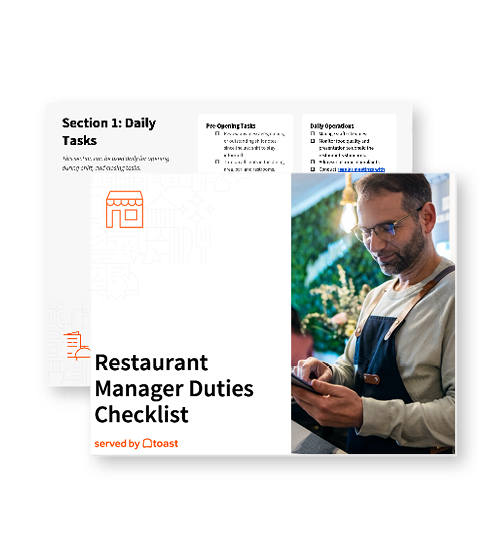
Restaurant Manager Duties Checklist
Use this free checklist to help streamline daily tasks, make sure weekly duties get completed, and ensure your manager stays organized.
ดาวน์โหลดฟรีOne of the cold, hard truths of running a business is that people don’t leave companies, they leave managers.
Think back on the timeline of your professional career: If I were to ask you to name an amazing manager who had a substantial impact on your career, who comes to mind? Now, if I were to ask you to name the worst manager you’ve ever worked under, who would you pick?
Great managers motivate, appreciate, and inspire, while poor managers teach us what not to do and who not to be.
Says former restaurant jack-of-all-trades, Lizzy Fitzgerald, of her experiences working alongside great restaurant managers, “I once watched a GM write a $300 check and hand to the server whose money had been stolen. I’ve seen a manager physically step in between a server and an aggressive guest to protect the server from almost certain harm. After an incredibly stressful week juggling my senior year of college, a full-time internship, and a full-time job, a manager once let me cry in his office until I had let it all out, and then gave me the rest of the night off.”
On the other hand, she's also had her fair share of experiences working for ill-equipped restaurant managers. “I’ve had to work with the flu multiple times because I wasn’t allowed to call out,” says Lizzy. “I once worked with someone who had food poisoning and the manager wouldn’t let them go home because they were 'probably faking.'“
Technically, there’s no right or wrong way to manage a restaurant. Every restaurant manager approaches it differently, adding their own personal flair to the role. Few restaurant managers are great from day one; getting better at your job, any job, takes time, trial and error, and a commitment to professional growth. But before we get into the specifics around how to be a good restaurant manager, first things first: What do restaurant managers do exactly?

Subscribe to On the line
Sign up to get industry intel, advice, tools, and honest takes from real people tackling their restaurants' greatest challenges.
เมื่อส่งข้อมูล แสดงว่าคุณตกลงที่จะรับอีเมลการตลาดจาก Toast เราจะจัดการข้อมูลของคุณตาม คำชี้แจงความเป็นส่วนตัว ดูข้อมูลเพิ่มเติมสำหรับผู้อยู่อาศัยในรัฐแคลิฟอร์เนียได้ที่ คลิกที่นี่
What Are The Duties of a Restaurant Manager?
In our industry, restaurant managers really rule the roost. Here are some common restaurant manager duties:
Keeping meal service humming along
Checking in that their experience is in line with (or exceeding) expectations
Ensuring all staff are performing the basic functions of their role
Maintaining open and productive communication between the front and back of house
Tracking sales and inventory reports
Making purchasing decisions
Creating employee schedules
Conducting employee payroll
Responding to online reviews (both positive and negative)
Voiding checks
Updating the menu
Establishing and evaluating the menu pricing strategy
Handling disgruntled guests
Cutting guests off
And much, much, much more.
Besides managing the restaurant's operations, restaurant managers are also people managers. Meaning, it’s their job to oversee the wellbeing of all employees and ensure that they’re feeling safe, supported, and able to perform the basic functions of their role in the restaurant.
In many restaurants, training of any kind is low on the priority list. That’s because a free moment to devote to anything besides waiting on guests, crafting cocktails, or whipping up entrees is precious and hard to come by. As a result, many restaurant managers got to where they are by staying the course, learning from their surroundings, taking the initiative to become a leader in their restaurant, and showing their superiors they’re capable. Not exactly the typical path to management you’d see in other industries.
The emphasis on learned, experiential knowledge over hands-on management training can be a good thing and a not-so-good thing. Good because many managers know what works and what doesn’t because they’ve lived in both work environments, but also not-so-good because they may lack the technical training that substantially improves one’s ability to lead teams and manage people. Though working in a restaurant can be wildly unpredictable, “winging it” because you lack a background or training is a pretty uncomfortable way to work each day. It’s also likely contributing to the overwhelming amount of restaurant managers quitting.
Whether you’re a new restaurant manager or a veteran looking to improve your skills, there are a number of tools, tricks, and tactics you can use to become a good restaurant manager. We’ve compiled a list of handy do’s and don’ts based on feedback and stories shared by real restaurant people, to help those looking to improve their restaurant manager skills.
Learning How to be A Good Restaurant Manager: 7 Do’s and Don’ts
DO Perform Your Duties As a Restaurant Manager (DON’T Hide in the Back Office)
Restaurant managers have a wide array of responsibilities, and only so many hours in the day to accomplish them. It’s perfectly natural to want to find a quiet place – the back office – and hide there so you can be productive. By doing so, however, you’re leaving your team out to dry by not being present when and where they need you most: out on the floor.
“I used to have my boyfriend bounce people for me, because the manager was downstairs (making them too far away to grab) or nowhere to be found,” says Kate R., a former bartender.
Things happen pretty fast in restaurants. Dishes break, drinks spill, guests get frustrated, people slip. Without a manager available to quickly address, solve, or diffuse a hairy situation, your staff and restaurant are left vulnerable.
Depending on the severity of the situation, you could be looking at a damaging online review, a guest walking out on their check, a staff member put in an unsafe situation, or even a lawsuit (when old ladies slip and fall, they fall hard; I'm speaking from experience.)
Table check in’s are a great tactic restaurant managers use to spot and diffuse a sticky situation before it transpires. They can get a second drink, check on a late order, send back an undercooked dish, or rush payment so that the guest leaves satisfied with their experience. Needless to say, table check in’s are hard to do if you’re hiding in the back office, hunched over payroll.
DO Show Your Restaurant Staff You Appreciate Them
If you treat your staff like they’re expendable, they’ll leave. Simple as that.
“On one of my last days at work at one restaurant (I had handed in my two week notice already) my boss put a sign up on a door that said “the next employee that slams this door in my presence will be terminated immediately” because he was too cheap to fix the hydraulic door closer thing on the top of the door. I didn’t say anything, but what a way to tell all your employees they don’t matter!” says Miles H.
Which is to say, if you treat your staff like they matter, because they do, they’re much more likely to stick around.
“I was an assistant manager for a pizza place for 10 years,” says Miranda P. “I think the most important thing I learned over that time was to focus on your staff. Because like the quote says, they don't quit the job, they quit the management. If you put good energy into your staff, you'll reap the benefits. Genuinely caring but holding them responsible for duties goes a long way.”
Employee turnover is expensive; replacing one hourly employee costs around $6,000.00. Staff appreciation, on the other hand, is an incredibly inexpensive way to improve your employee retention, workplace culture, and guest experience in one fell swoop. It also feels good showing another person appreciation. Seriously: Try giving one of your staff members a compliment without cracking a smile. Exactly my point.
DO Foster and Support Your Staff Members’ Professional Growth
As we touched on earlier, many restaurant managers got to where they were with hard work and elbow grease, not by following a laid out path and climbing the steps in a career ladder.
Career advancement is a largely unaddressed area in the restaurant industry. Few restaurants devote time and energy towards helping employees identify clear paths, or even suggesting actions they can take to move to the next level in their hospitality career.
The restaurant industry has an incredibly high annual employee turnover rate: currently 75% . Which means many restaurant staff members aren’t seeing the value in sticking around long term.. If we gave them a reason to see a future in the industry (by way of career advancement opportunities) and a goal to work towards (promotion), we just might see those terrible statistics shift.
“I worked as a doorman at a popular beer bar. I’d scheduled a meeting with the owner to move to a permanent serving role, after having already subbed in that position a couple of times. The owner rescheduled the meeting three times,” says Kamil M. of an experience with a former manager. “The next time I saw him was when I was bartending at another establishment.”
Want your employees to be in it for the long haul? Don’t be like Kamil’s manager, and cancel career-related conversations three times because something came up. Here are a few ways restaurant managers can be a resource to staff looking to grow their career in hospitality:
Maintain an open door policy
Provide hospitality skills training
Consistently have career growth chats with your staff members
Clearly outline to staff what it takes to get to the next level from the role they’re currently at
Set career growth goals with your staff
Offering the chance for staff members to move up in your restaurant is a practice known as promoting from within. Promoting staff members to available leadership opportunities is a very effective way to increase staff engagement and productivity, decrease turnover, improve your workplace culture, and breed staff loyalty. If your staff members know a future in management at your restaurant is an option, they’re much more likely to stay and see it through, instead of leaving to join another restaurant.
“I worked at a frozen yogurt chain that was hiring for manager positions and several current employees were looking to be promoted. GM went with an external hire. That guy was skimming money from the register and was fired. External manager number 2 was on the job 3 weeks before he was fired for predatory behavior. External manager 3 had an anger management issue and tossed a blender across the kitchen” says Eric M. of his experience with a restaurant that chose to hire externally instead of promoting from within. “It was at that point they promoted internally, but a lot of the original candidates had left after being passed over.”
DON'T Make Your Staff Feel Uncomfortable or Unsafe at Work (It’s Illegal)
Where other industries have progressed in establishing guidelines for acceptable and unacceptable workplace behavior, the restaurant industry has fallen noticeably behind. According to a report conducted by Buzzfeed news, more sexual harassment claims are filed by restaurant employees than in any other industry.
“More than 170,000 claims were filed with the US Equal Employment Opportunity Commission between 1995 and 2016. Of those, 83 percent came from women. Just over 10,000 were filed by employees of full-service restaurants” reports Daniela Garlaza in a piece for Eater about sexual harassment in the restaurant industry. “An additional 1,000 came from those who work in other types of eating establishments, including bars or limited-service restaurants...The EEOC notes that these complaints only represent the ones that were not resolved internally — and of course don’t count the ones that were never reported at all.”
We get it — part of the charm of working in a restaurant is the relaxed, non-traditional work environment. But when those loose boundaries enable a guest or staff member to cross a line, it’s the restaurant manager’s job to address the situation, and do all that they can to ensure it never happens again.
“I worked at a rooftop Mexican bar in NYC, and we had one manager that was best described as ‘inappropriate’, “ says Matt H. “We had constant complaints of him being too handsy with female coworkers and patrons, making inappropriate comments, and making promises to his ‘friends’ that they could skip the busy line to the rooftop on the weekends. The frustrating part was he was actually very good at his job, but his behavior eventually had him removed.”
Creating an employee handbook, mandating yearly sexual harassment training, and schooling staff on safe alcohol serving practices and how to spot an intoxicated guest are all ways you can help foster a safe, supportive workplace culture.
Beyond that, establish yourself as a resource for staff members who may have found themselves in an uncomfortable situation. “We have an open door policy. If staff ever feel threatened, they can obviously come in and let us know and we'll have a meeting” says Logan Hostettler, owner of 1894 Lodge in New Washington, Indiana. “And whenever something does happen, we talk about it in our pre-shift meeting . ‘How did this affect you guys? Is this something that's emotional to you? Is this something that you agree with, disagree with?’”
Restaurant Manager Resume Template
Get hired for that dream manager job with the restaurant manager resume template, a customizable Word doc that outlines skills, education, and more.

DO Create Your Employee Schedules Based on Sales Data and Staff Availability
Scheduling a certain number of servers or bartenders because you have a hunch you may be busy Saturday night is no way to run a successful restaurant.
Use the sales reports available in your restaurant’s POS system to get a clear understanding of the volume you do every shift – broken down by total sales, number of checks, and average table turn time – and then build your employee scheduling strategy around those numbers. And incidentally, make sure to only schedule employees who’ve told you they’re available to work that shift, otherwise you might end up with a no call no show.
Finding the perfect recipe for a well-staffed shift will take a little trial and error. If you schedule too few staff behind the bar and on the floor, it’s almost guaranteed guests will have to wait longer for their drinks, food, and check. And your staff will have less time to devote toward creating a memorable experience for their guests. If you schedule too many staff members and the shift ends up being slow, you can always send staff members home, or have them tackle outstanding tasks like giving the bar a deep clean or changing up the decor; the catch here is that your staff may feel disgruntled because they lost money coming in for this shift.
“I was a bartender at a new hotel run by two brothers. They had never run a restaurant or bar before,” says Dennis M. of an experience in Boston, MA.. “They hired a manager who also had no experience, so didn’t have an understanding of hiring needs. They hired a total of 4 bartenders for the two hotel bars 7 days a week, because they thought that they weren’t going to be busy. The first two weeks we were open, I worked a total of 180 hours from open to close. The first Friday we were open the other bartender for the downstairs called out and I was left to deal with a huge crowd in a new location and almost quit. Always over hire in the expectation that you’re going to be busy and then let nature take its course.”
DON'T Ignore Labor Laws And Predictive Scheduling Laws
The Fair Labor and Standards Act (FLSA) protects the rights of hourly restaurant workers, including provisions about the legally mandated minimum wage, when overtime goes into effect, and how tips are distributed.
[Click here to read The Bureau of Labor’s FLSA Guidelines for Restaurants]
In addition to FLSA requirements, some states have adopted fair scheduling laws – sometimes called predictive scheduling laws – to give staff more consistency when it comes to the shifts they’re scheduled.
Though working in a restaurant does traditionally involve long hours, there is a limit to how long those hours can be. “I was a GM at the last restaurant I worked at, and the required hours for me were 65-70 a week. I routinely went over that, “ says Patrick F.
In states, counties, and cities with predictive scheduling laws in effect, employers of hourly workers must meet guidelines on:
Employee breaks (both between and during shifts)
Predictable pay
Advance notice
Recourse rights and reporting
Penalties owed for failing to adhere to any of the regulations outlined in the policy
Part of becoming a good restaurant manager is staying educated and compliant with all local labor laws pertaining to hourly restaurant workers. Working your employees to the bone breeds burnout and turnover; it’s also awful for their physical and emotional well being. Treat your employees well, respect their rights, and prioritize their personal and professional growth. Do that, and we guarantee you’ll be rewarded with engaged employees who stick around for the long run, or at least recommend your restaurant to their networks as a great place to work. Employee referral programs, where your existing staff is rewarded for referring job applicants, are an incredibly reliable way to source quality candidates for open roles!
DO Set Clear Job Expectations With Your Employees
Whenever you hire a new staff member, their first shift should include a conversation where you provide a detailed rundown of their responsibilities and duties.This way, your new staff member is fully aware of all that is expected of them, and you, the restaurant manager, are aware of any areas where they may need additional support or training.
Most restaurants take an “all hands on deck” approach to staff roles. That means all team members pitch in to make sure guests are satisfied with their experience, that tables are turning, and that the restaurant makes it through meal service successfully. For example, servers are typically given an allotted section on the floor, but are expected to be section-agnostic when it comes to bussing tables, running food, or checking on refills or second drinks.
That said, while sharing the load is an effective way to keep operations humming along during service, it can be confusing when a staff member is expected to be everywhere at once, or doesn’t have clear direction from management about which tasks and responsibilities take priority.
Amelia B., a former hostess, had this to say about an experience where role expectations weren’t clearly outlined. “We never had the staff we needed, so managers would have us bus tables and pour water and such so people would not have long wait times. But then we would get in trouble for not being at the host stand. You can’t be in two places at once.”
If your staff feels overwhelmed and confused during shift, it will reflect in the level and quality of service they show your guests. So as part of training procedures, share a prioritized list of each staff member’s duties and responsibilities, so that if they’re approached for help, they can decide whether or not it will affect an important area of your restaurant’s operations. For example, the number one job of a host or hostess is greeting and seating guests. If they’re called away to do something else in the restaurant and a line forms at the door, it could create problems for the rest of your staff. Help them feel empowered to say no, if leaving the host stand means guests may be left waiting.
Restaurant Manager Training Checklist
Use this free checklist to help streamline your training process and set your new chefs up for success.
8 Resources To Help Improve Your Restaurant Manager Skills
So there you have it, the biggest do’s and don'ts for new and existing restaurant managers, looking to become the best they can be.
Whether or not you feel there are resources provided to you at your job, there are still ways to take proactive steps towards becoming the best restaurant manager you can be. Subscribe to relevant blogs and restaurant news sites, sign up for in-person or online courses, download ebooks and guides, attend industry nights – there are a number of tools, templates, and tips available for those willing to learn and improve their restaurant management skillset.
How to Manage a Restaurant in Today’s Competitive Environment by Toast
How to Do Payroll for Restaurants by Toast
By the Numbers: A Week in the Life of a Full Service Restaurant by Toast
The Guest Experience Bootcamp by Toast
How to Be a Confident Manager by Typsy
How Managers Should Prioritize Tasks by Typsy
บทความนี้มีประโยชน์สำหรับคุณหรือไม่
ข้อความปฏิเสธความรับผิดชอบ ข้อมูลนี้จัดทำขึ้นเพื่อวัตถุประสงค์ในการให้ข้อมูลทั่วไปเท่านั้น และการเผยแพร่ข้อมูลนี้ไม่ถือเป็นการรับรองใดๆ Toast ไม่รับประกันความถูกต้องหรือความสมบูรณ์ของข้อมูล ข้อความ กราฟิก ลิงก์ หรือรายการอื่นใดที่รวมอยู่ในเนื้อหานี้ Toast ไม่รับประกันว่าคุณจะได้รับผลลัพธ์ที่เฉพาะเจาะจงใดๆ หากคุณปฏิบัติตามคำแนะนำในเอกสารนี้ คุณอาจต้องปรึกษาผู้เชี่ยวชาญ เช่น ทนายความ นักบัญชี หรือที่ปรึกษาทางธุรกิจ เพื่อขอคำแนะนำที่เหมาะสมกับสถานการณ์ของคุณโดยเฉพาะ
 กำลังมาแรง

Subscribe to On the line
Sign up to get industry intel, advice, tools, and honest takes from real people tackling their restaurants' greatest challenges.
เมื่อส่งข้อมูล แสดงว่าคุณตกลงที่จะรับอีเมลการตลาดจาก Toast เราจะจัดการข้อมูลของคุณตาม คำชี้แจงความเป็นส่วนตัว ดูข้อมูลเพิ่มเติมสำหรับผู้อยู่อาศัยในรัฐแคลิฟอร์เนียได้ที่ คลิกที่นี่