
Quick answer: We surveyed 850 U.S. adults who eat out weekly about shrinking portions. Half say portions have gotten smaller in the past year. Forced to choose how a restaurant should handle rising costs, they'd rather absorb a price increase than a smaller plate — and nine in ten would order a half portion if one were priced fairly.
Menu prices are rising, though not evenly. Toast’s Menu Price Monitor tracked regular coffee up 7.1% year over year in September 2026, beer up 2.8%, burgers up 2.2% to a median $14.80, and wings up just 0.7%.
More than 80% of operators told the National Restaurant Association their food costs had risen, and a third said their business wasn’t profitable in the first half of the year. Bloomberg reported in September on a Chicago restaurant that cut its burger patty from 8 ounces to 7¼, added fried onion strings and shredded lettuce, and held the price at $20 before eventually adding a dollar. The owner was protecting a price point his guests could live with. “If it goes too high, people won’t come,” he told Bloomberg.
Guests notice these changes. We asked 850 diners what they’d rather a restaurant do.
Are restaurant portions getting smaller?
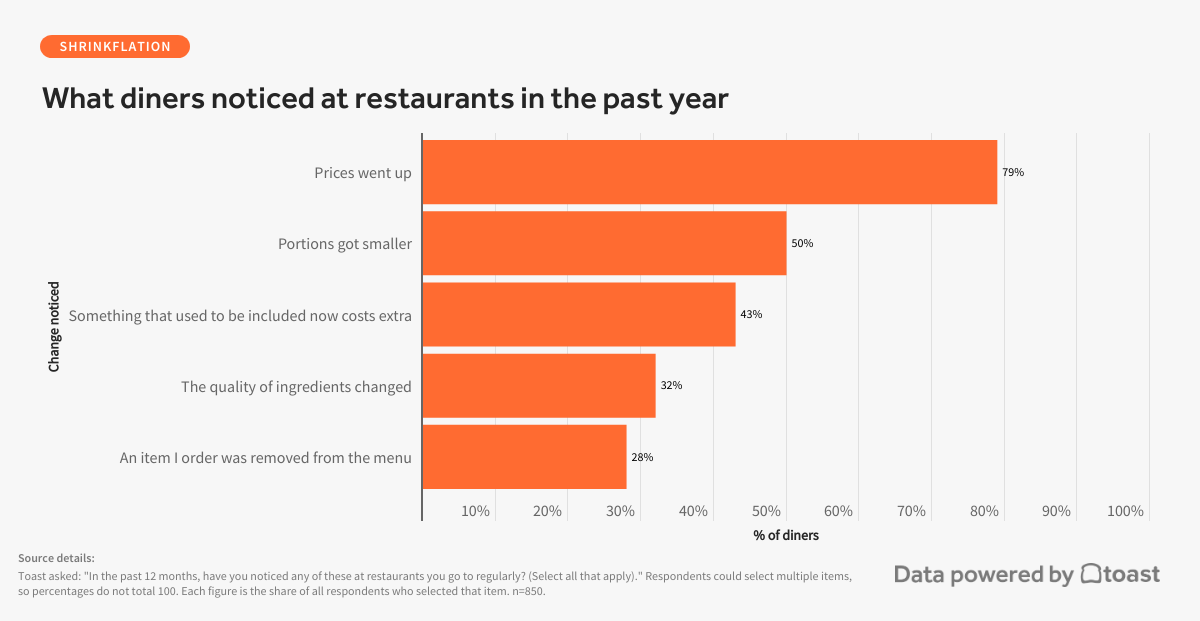
50% of U.S. diners who eat out weekly say restaurant portions have gotten smaller over the past year, according to Toast’s survey. 79% say prices went up over the same period, and only 7% noticed none of these changes.
What customers have noticed in the past 12 months:
Prices went up: 79%
Portions got smaller: 50%
Something that used to be included now costs extra: 43%
The quality of ingredients changed: 32%
An item I order was removed from the menu: 28%
How do customers notice smaller portions?
Most diners who report smaller portions base that on memory rather than measurement. 59% say the food simply looked smaller than they remembered, while 22% have something concrete behind the claim: 15% counted fewer pieces and 7% compared the dish to a photo, a past order, or the menu description.
Only 7% assumed the portion shrank because the price went up. Most customers reporting smaller portions are responding to the food itself, not to the bill.
What do restaurants charge extra for now?
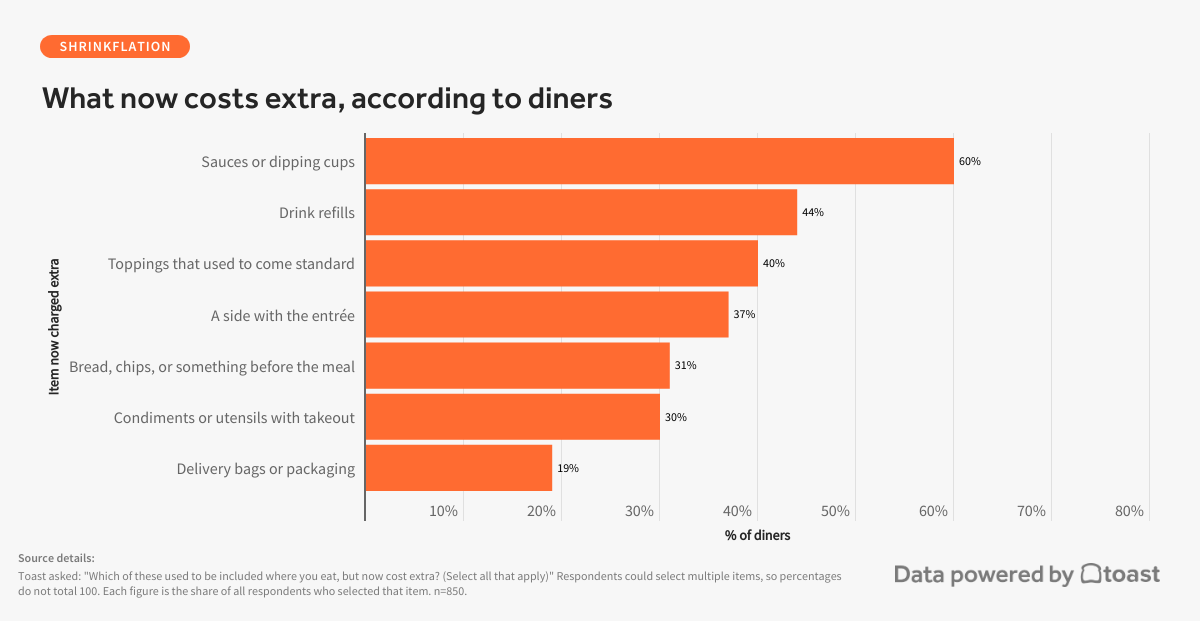
Sauce tops the list. 60% of diners say sauces or dipping cups now cost extra at restaurants they visit regularly, the most-cited add-on charge in Toast’s survey. Drink refills follow at 44% and standard toppings at 40%. Only 7% said none of the items we asked about were showing up on the bill.
Would customers rather pay more or get smaller portions?
Pay more. Asked to rank five things a restaurant could do when its costs rise, diners put raising the price and leaving the dish alone first overall. Charging separately for something that used to be included came second, serving a smaller portion third, using cheaper ingredients fourth, and taking the dish off the menu last.
Pulling the dish is the most divisive option tested. 25% rank it first while 38% rank it last, more at the extremes than any other option. This suggests a sizable group of guests would rather lose a dish than eat a version with cheaper ingredients or less protein.
How much can a portion shrink before customers notice?
61% of diners wouldn’t accept a cut of more than about 10%, including 27% who say any reduction at all would leave them feeling shortchanged.
Price tolerance has limits too. Asked about a dish they’d normally pay around $15 for, 41% said they wouldn’t go beyond $1 more, and 71% wouldn’t go beyond $2. A $1 increase on its own would send 24% elsewhere.
For context, Toast’s Menu Price Monitor puts the median burger at $14.80 in September 2026, 20 cents under the $15 dish we asked about. That burger rose 32 cents over the year, an increase 87% of diners say they’d absorb without switching to something else.
Do customers want smaller portions at lower prices?
90% of diners would order a half-size version of a dish at the right price, and only 10% say they wouldn’t order one at any price.
25% off the existing price is the most common expectation for what a half-size portion should cost, though 38% want about 33% off or more, and 9% would pay full price for half the food if it suited them.
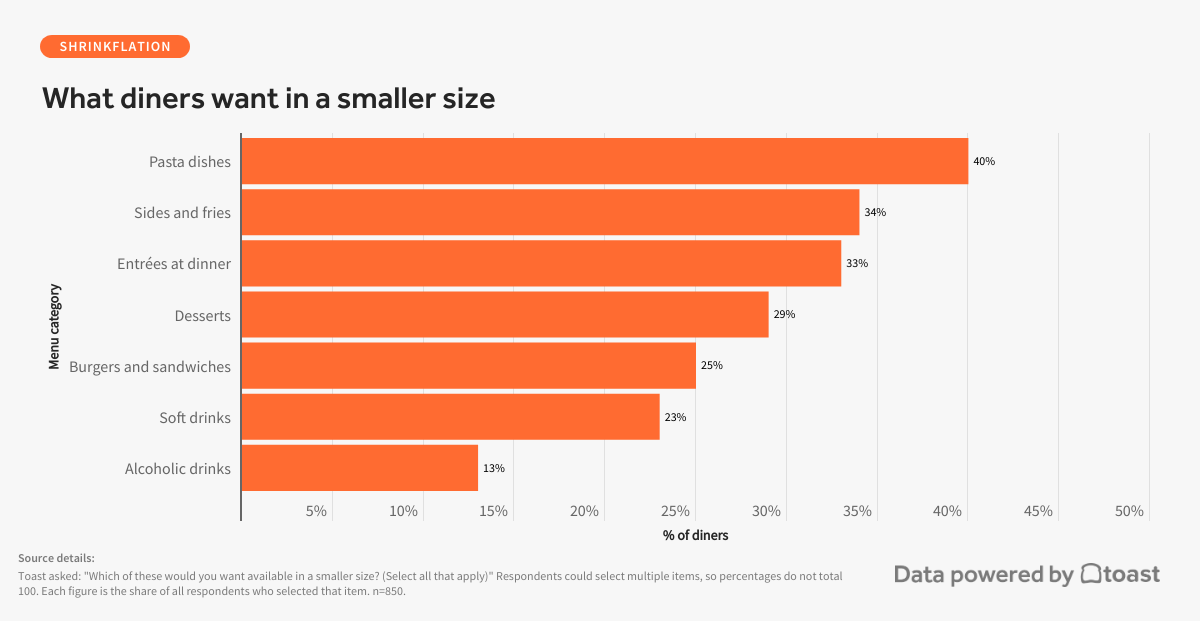
80% want at least one category available in a smaller size, led by pasta dishes at 40%, sides and fries at 34%, and dinner entrées at 33%.
How are customers changing the way they order?
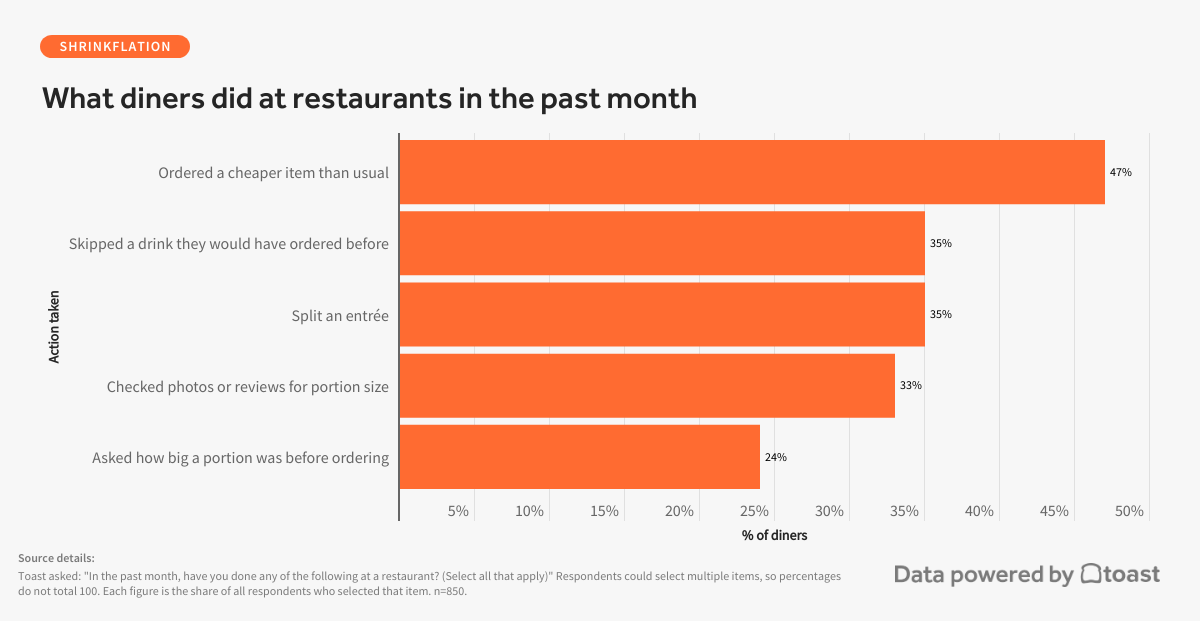
84% of surveyed diners did at least one of the following at a restaurant in the past month, led by 47% who ordered a cheaper item than they normally would.
Ordered a cheaper item than you normally would: 47%
Skipped ordering a drink you would have gotten before: 35%
Split an entrée with someone: 35%
Looked at photos or reviews to check the portion size: 33%
Asked how big a portion was before ordering: 24%
The consequences are pretty clear. 80% say a change to portion, price, or what’s included has affected how they treat a specific restaurant: 19% stopped going and haven’t returned, 26% stopped for a while, and 35% go less often.
How should restaurants respond to shrinkflation?
Guests prefer a price increase to a smaller portion
Diners rank raising the price above every alternative. Keeping the same price while changing the dish ranked below it, as did taking the dish off the menu altogether.
Consider: when weighing how to respond to rising costs, keep in mind that customers ranked a price adjustment ahead of a smaller portion. 76% say they’d absorb a $1 increase on a $15 dish, and the median burger on Toast menus moved 32 cents over the past year.
Small reductions still get noticed
61% wouldn’t accept a cut of more than about 10%, including 27% who say any reduction at all would leave them feeling shortchanged.
Consider: before trimming a portion, check whether the saving is worth more than a price increase customers have already shown they’d accept.
Half portions have real demand
90% would order a half portion at the right price and 80% want at least one category available smaller, led by pasta at 40%. 25% off is the most common price expectation.
Consider: adding half portions for two or three high-volume items rather than leaving them to be requested, and pricing them around 25% below full size.
Say why
67% find a change easier to accept when the menu explains it, and just 8% say an explanation makes things worse.
Consider: adding a single line on the menu where a dish has changed. It’s a low-stakes step that 67% of customers say would make the change easier to accept.
Menu Engineering Worksheet
Use this menu engineering worksheet, complete with intricate menu engineering formulas, to determine areas of strength and weakness in your restaurant's menu.

Toast conducted a blind survey of 850 U.S. adults ages 18+ who purchase at least one meal from a restaurant or café in a typical week, including dine-in, takeout, drive-thru, and delivery. The survey was fielded on September 23, 2026. Respondents were not made aware that Toast was fielding the study. Using a standard margin of error calculation, at a confidence interval of 95%, the margin of error on average is +/- 3-5%. Numbers are rounded and may not equal 100.
About the Toast Menu Price Monitor
The Menu Price Monitor, powered by Toast, uncovers key menu pricing trends across the restaurant industry through aggregated sales data from restaurants on the Toast platform, which has approximately 180,000 locations as of June 30, 2026. This information is provided for general informational purposes only, and publication does not constitute an endorsement. Toast does not warrant the accuracy or completeness of any information, text, graphics, links, or other items contained within this content. Individual results may vary. Toast does not guarantee you will achieve any specific results if you follow any advice herein. It may be advisable for you to consult with a professional such as a lawyer, accountant, or business advisor for advice specific to your situation. The Toast Menu Item Price Tracker does not indicate Toast's operational performance or its reported financial metrics. The menu price monitor does not account for portion sizes and is the median figure across all dishes.