How to Create a Restaurant Budget (+ Free Template)
Plan it, track it, fix it before it hurts. Grab our free restaurant budget template and learn where operators most often overspend, and how to rein it in.

Tác giả
 RESOURCE
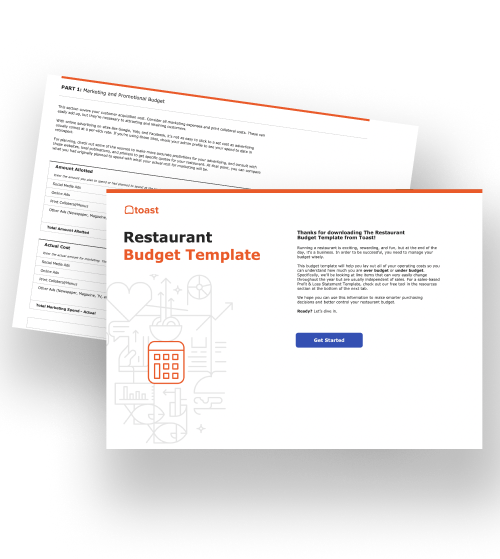
Restaurant Budget Template
Use this template to make sure your projections are accurate and help eliminate overspending across your business.
Nhận bản tải xuống miễn phíA restaurant budget estimates sales, expenses, and cash needs for a specific period. It helps you decide what the business can afford, prepare for upcoming bills, and compare planned spending with actual results.
Getting those numbers organized is a practical first step. Toast’s restaurant budget template provides spending categories and a way to compare projections with actual costs. If you’re opening a new restaurant, that planning also helps you determine which equipment, staffing, and technology investments fit your available funds.
Here’s what to include, how to build realistic estimates, and how to keep your budget useful as the business changes.
Key takeaways
A restaurant budget estimates sales, operating expenses, and cash needs to guide spending decisions.
Realistic budgets reflect expected demand, current supplier prices, staffing requirements, and seasonal changes.
Cash-flow planning helps restaurants prepare for payment deadlines and slower sales, even when the budget projects a profit.
Comparing actual results with budgeted amounts helps operators identify problems and adjust purchasing, staffing, or other spending.
A restaurant budget template provides a structure for organizing projected costs and tracking spending.
Restaurant Profit and Loss Statement Template
Evaluate your restaurant's financial strengths and weaknesses with the free P&L and income statement template.

What should a restaurant budget include?
A restaurant budget should cover expected sales, operating expenses, and the additional cash needed for purchases, payments, and reserves. Start with a cost breakdown so the plan accounts for more than food, wages, and rent.
Some costs stay relatively steady, such as monthly rent. Others rise with activity, such as ingredients and takeout packaging. Labor often includes both: you need basic coverage to open, then additional employees when demand increases.
Toast’s free budget template includes categories for marketing, technology, equipment, and professional services, giving you a starting structure for organizing spending.
Budget category | What to include | What to consider |
Sales | Food, beverages, catering, events, and other revenue | Separate channels or categories when demand and costs differ |
Food and beverage costs | Ingredients and beverages expected to be used | Base estimates on sales volume, menu mix, portions, and supplier prices |
Labor | Wages, salaries, employer payroll taxes, benefits, and training | Include essential coverage and staffing that changes with demand |
Occupancy and operations | Rent, utilities, insurance, cleaning, repairs, and maintenance | Identify predictable bills and expenses that fluctuate |
Marketing and technology | Advertising, software subscriptions, ordering tools, and payment-processing fees | Include recurring charges and fees that increase with sales |
Professional and administrative costs | Accounting, legal services, licenses, permits, and office expenses | Plan for renewals and bills that arrive less frequently |
Separate startup and cash requirements | Deposits, equipment purchases, loan principal, and operating reserves | Track these separately from operating expenses |
How to create a restaurant budget
Build the budget around how your restaurant actually operates. Consistent categories make that easier, so align the plan with your chart of accounts—the categories used to organize financial transactions.
1. Choose a timeframe and gather your records
A monthly budget makes results manageable to review, while an annual view helps you anticipate seasonal changes and larger expenses. Start with the records you already have, then identify where you need estimates.
Reliable accounting makes this work easier. If expenses are missing or categorized inconsistently, clean up those records before using them to set future targets.
Match reporting periods: Compare sales and expenses from the same dates.
Collect operating records: Gather sales reports, financial statements, supplier invoices, payroll records, leases, and subscription agreements.
Identify unusual activity: Flag closures, major repairs, special events, or one-time promotions that could distort expectations.
Use quotes for a new restaurant: Build estimates from supplier pricing, lease terms, equipment proposals, and planned staffing.
Record your assumptions: Note where each estimate came from so you can revisit it later.
Restaurant Profit Margin Calculator
Use this free Restaurant Profit Margin Calculator to see how efficiently you turn sales dollars into profits.
2. Forecast sales realistically
Your sales forecast estimates how many guests or orders you expect and how much they’ll spend. Build it around demand and capacity rather than the revenue you hope to achieve. For example, a hypothetical restaurant might project:
100 orders per day × $25 average order × 26 operating days = $65,000 in monthly sales
For a new restaurant, start with a realistic estimate of orders and average spending, then revise the forecast as actual sales become available.
Use comparable history: Review similar weekdays, weekends, and seasons.
Separate volume from pricing: Higher menu prices can increase revenue without bringing in more guests.
Account for the calendar: Consider holidays, local events, operating days, and planned closures.
Check capacity: Make sure the kitchen, dining room, and team can handle the projected volume.
Use consistent sales figures: Exclude sales tax and guest-paid tips, and account for discounts and refunds.
3. Estimate food and labor costs
Food and labor estimates should reflect what you expect to sell and the work required to serve it. A target percentage can help you check the plan, but the underlying quantities, prices, and hours need to make sense.
Keeping the supporting records current helps. xtraCHEF by Toast digitizes supplier invoices and tracks ingredient and recipe costs, giving operators more detailed information for their estimates. In a Toast survey, xtraCHEF customers reported saving an average of one to five hours per week using xtraCHEF.¹
Cost the expected menu mix: Use current ingredient prices, recipe quantities, and portions to estimate the cost of what guests will order.
Account for waste: Include realistic allowances for spoilage, preparation loss, and mistakes.
Separate usage from purchasing: Products bought this month may remain in inventory for next month; track supplier payment timing in the cash plan.
Build staffing by role and shift: Include preparation, service, cleaning, opening, and closing work.
Include employer costs: Add applicable payroll taxes, benefits, overtime, and paid training.
Check the remaining budget: Make sure projected food and labor spending leaves enough for other expenses.
For labor, Toast Payroll & Team Management connects employee hours and tips from Toast POS with payroll workflows, helping operators keep compensation records organized.
¹ Based on a survey of 79 xtraCHEF Pro and Essentials customers from 11/2/24 to 11/29/24. Individual results may vary.
Balance Sheet Template
This template will help you forecast short and long-term cash flow and assess the overall financial health of your restaurant.
4. Add expenses that are easy to overlook
Smaller charges can add up, especially when they arrive through different vendors or depend on order volume. Review contracts, invoices, and bank statements before assuming food, labor, and rent cover most of the plan.
Transaction and ordering fees: Include payment processing, delivery commissions, and other channel-specific charges.
Technology: Account for subscriptions, hardware, add-ons, and implementation when reviewing POS system costs.
Operating supplies: Include packaging, cleaning materials, uniforms, and smallwares.
Maintenance: Plan for routine servicing and repairs.
Professional services and renewals: Include accounting, permits, licenses, and insurance.
Marketing: Budget for ongoing campaigns and planned promotions.
5. Check cash needs and test a slower-sales scenario
Cash-flow planning checks when money is expected to arrive and when payments must leave the account. Start with available cash, add expected receipts, and subtract upcoming payments. Then test what happens if sales fall below the forecast.
Using the earlier example, sales that come in 10% below the $65,000 forecast would total $58,500—a $6,500 revenue shortfall. Some expenses may decrease, but rent and other fixed obligations will remain.
Map payment dates: Include payroll, supplier invoices, rent, taxes, and other scheduled payments.
Include other cash outflows: Account for equipment purchases, deposits, loan principal, and planned owner distributions.
Test realistic disruptions: Consider slower sales, equipment failures, or temporary closures.
Plan a reserve: Base it on the bills that must be paid, seasonal patterns, and the risks your restaurant faces.
Identify responses early: Decide which purchases or projects could be delayed if cash becomes tight.
How to track and adjust your restaurant budget
Compare actual results with the budget regularly so you can understand differences and respond. As restaurant coach David Scott Peters writes in FSR, “Your budget is your proactive plan for success. Your P&L is your report card.”
The difference between an actual result and its budgeted amount is called a budget variance. For example, spending $22,000 against a $20,000 food-cost budget means you’re $2,000, or 10%, over budget.
Review during the month: Check sales and labor regularly, then complete a fuller comparison when monthly financial records are ready.
Investigate the cause: Higher food spending could reflect more orders, supplier price increases, waste, or a different sales mix.
Compare related figures: Review food costs alongside food sales before deciding whether the increase signals a problem.
Assign a response: Identify what needs to change, who will handle it, and when to check the result.
Keep the original budget: Preserve the plan for comparison while updating forecasts to reflect new information.
Toast Reporting + Analytics provides real-time sales, menu, and labor data to support that investigation. Ryan Keogh, general manager of White Horse Tavern, describes the benefit of timely reporting this way: “You’re making operational decisions in the moment, instead of waiting around for the next day.”
Build a budget you can keep using
Your first budget doesn’t need to predict every expense perfectly. It needs to give you a clear plan for what you expect to earn, what you need to spend, and when to take a closer look.
Start with Toast’s restaurant budget template, enter your estimates, and return to it as actual costs come in. If you’re preparing to launch, Toast’s tools for new restaurants let you start with the POS and add capabilities as you need them, helping you plan technology spending around your opening and future growth.
Restaurant Cost Control Guide
Use this guide to learn more about your restaurant costs, how to track them, and steps you can take to help maximize your profitability.
FAQ
What is restaurant budget balancing?
Restaurant budget balancing means comparing planned sales and expenses with actual results. The differences help you decide where to adjust spending or update forecasts.
How much should restaurants budget for equipment repairs?
Repair budgets depend on equipment condition, maintenance needs, and past repair costs. Include scheduled servicing and a reserve for unexpected breakdowns.
What are typical restaurant labor costs as a percentage of sales?
Labor costs vary by service model and staffing needs. For example, $30,000 in total labor costs on $100,000 in net sales equals 30%.
How do you calculate budget variance for a restaurant?
Subtract budgeted spending from actual spending. For example, spending $22,000 against a $20,000 budget means you are $2,000, or 10%, over budget.
How much should a restaurant set aside for theft and legal emergencies?
There’s no standard amount. Base your reserve on insurance deductibles, potential uninsured losses, legal expenses, and the cash needed to keep operating.
Bài viết này có hữu ích không?
TUYÊN BỐ MIỄN TRỪ TRÁCH NHIỆM: Thông tin này chỉ được cung cấp cho mục đích tham khảo chung và việc xuất bản không cấu thành sự xác nhận. Toast không đảm bảo tính chính xác hoặc đầy đủ của bất kỳ thông tin, văn bản, đồ họa, liên kết hoặc các mục nào khác có trong nội dung này. Toast không cam đoan bạn sẽ đạt được kết quả cụ thể nào nếu bạn làm theo lời khuyên bất kỳ trong tài liệu này. Bạn nên tham khảo ý kiến của chuyên gia như luật sư, kế toán viên hoặc cố vấn kinh doanh để được tư vấn cụ thể cho tình huống của mình.
 Thịnh hành



Subscribe to On the line
Sign up to get industry intel, advice, tools, and honest takes from real people tackling their restaurants' greatest challenges.
Bằng việc gửi, bạn đồng ý nhận email tiếp thị từ Toast. Chúng tôi sẽ xử lý thông tin của bạn theo tuyên bố về quyền riêng tư. Thông tin bổ sung dành cho cư dân California có tại tại đây.